Traditions
Why are there so many Hindu gods?
The question a second-generation child asks and most parents answer badly. The honest answer is that different Hindu traditions answer it differently.
The short answer
Most Hindu traditions hold that there is one ultimate reality and many forms through which it can be approached. Which forms, and how literally they are taken, is exactly what the major traditions disagree about — so there is no single Hindu answer to this question, and anyone giving you one is giving you their own.
Key facts
- The key term
- Iṣṭa-devatā — the chosen deity a person or family worships, without denying others
- Major traditions
- Vaiṣṇava (Viṣṇu and his forms), Śaiva (Śiva), Śākta (the Goddess), Smārta (five or six deities worshipped as forms of one reality)
- The often-quoted number
- 'Thirty-three' in the Vedas — koṭi means both 'crore' and 'kind', and the older sense is almost certainly 'thirty-three kinds'
- The philosophical claim
- 'Ekaṃ sad viprā bahudhā vadanti' — the real is one, the wise speak of it in many ways (Ṛgveda 1.164.46)
This is the question a child raised abroad asks first, usually after a classmate asks it of them. It is also the question most likely to be answered with something that sounds resolved and is not.
The short version: nearly every Hindu tradition holds that there is one ultimate reality. They disagree — seriously, and in writing, for centuries — about what the many deities are in relation to it.
What "one reality, many names" does and does not mean
The verse most often quoted here is from the Ṛgveda: ekaṃ sad viprā bahudhā vadanti, the real is one, the wise speak of it in many ways.
It is a genuinely old statement and it is genuinely part of the tradition. It is not, however, a creed that all Hindus subscribe to, and it does not settle the question. What it establishes is that this way of thinking is available and ancient. How far a given tradition takes it varies enormously.
The traditions actually disagree
Four broad streams, simplified, each with its own answer:
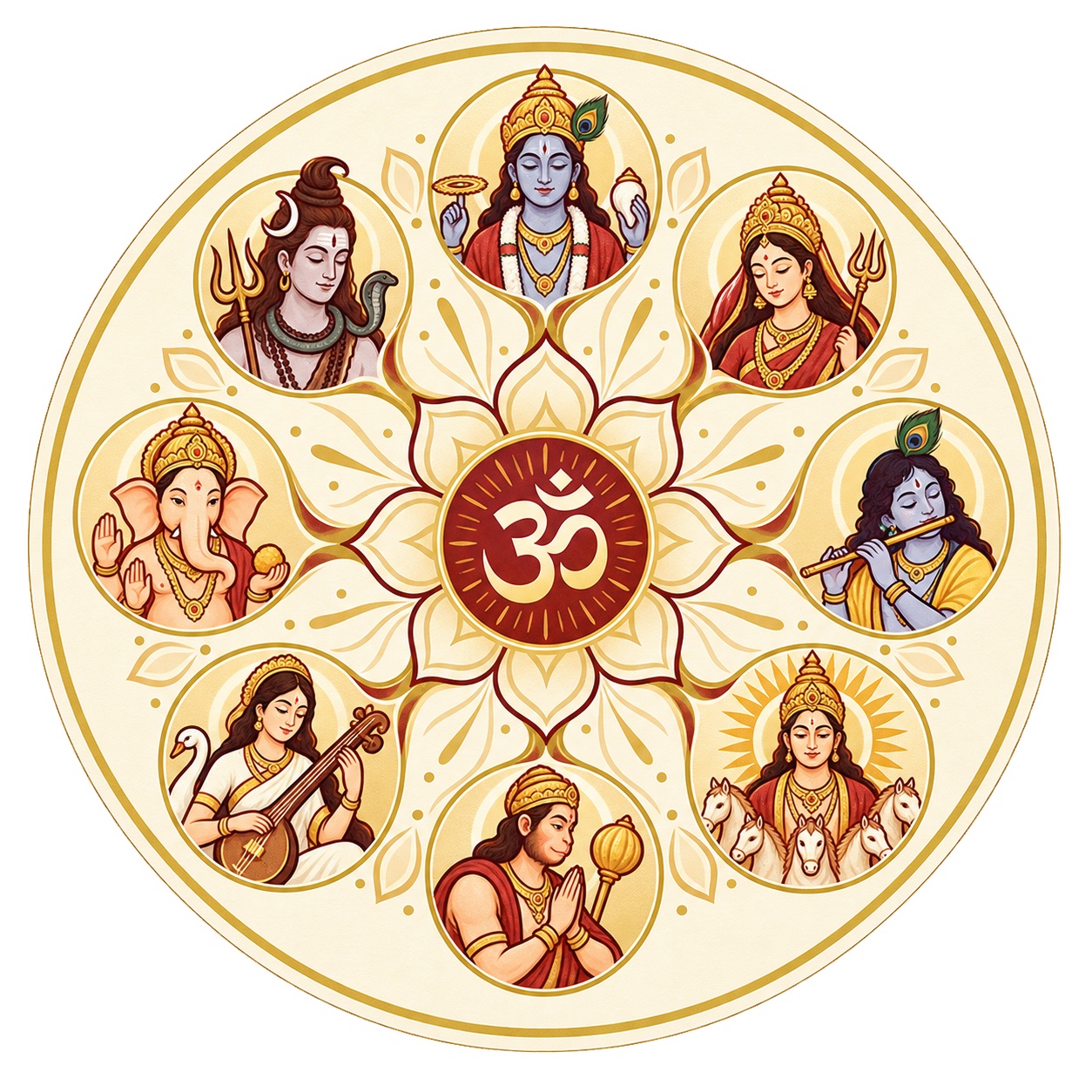
- Smārta. Worships five or six major deities — commonly Viṣṇu, Śiva, Devī, Gaṇeśa, Sūrya — explicitly as forms of one reality, with none supreme over the others. This is the tradition most compatible with "they are all the same God", and it is where that formulation is usually taught from.
- Vaiṣṇava. Viṣṇu, or Kṛṣṇa, is supreme. Other deities are real, but subordinate. A Śrīvaiṣṇava theologian would reject the claim that Śiva and Viṣṇu are the same thing under different names, and would have textual arguments ready.
- Śaiva. The same, with Śiva supreme. The Śaiva Siddhānta schools of the Tamil country worked this out in considerable philosophical detail.
- Śākta. The Goddess is the supreme reality, and the male deities derive their power from her. This is not a minor position; it is dominant across Bengal, Assam and parts of the south.
None of these is a heresy from the point of view of the others. They coexist, argue, and share temples.
What a household actually does
Under all of the above sits iṣṭa-devatā: the chosen deity. A family worships particular forms — often a family deity inherited by lineage, a village deity attached to a place, and a personal one — without thereby denying the rest.
This is why a Hindu household shrine can hold images of six deities without anyone experiencing a contradiction, and why the question "which one do you believe in?" reads as slightly beside the point from inside the practice.
The thirty-three million
The number is almost certainly a mistranslation, and it is repeated constantly, including in India.
Vedic texts speak of thirty-three deities, grouped in classes. The word koṭi means "crore", ten million — and also "kind", "category", "edge". The older reading, thirty-three kinds of deity, fits the grammar and the context of the passages; the ten-million reading fits nothing in them.
The inflated figure survives because it is memorable and because it flatters a particular idea of Indian abundance. It is not a count of anything.
How this changes across India
| Where | What differs |
|---|---|
| Tamil Nadu | Strong Śaiva Siddhānta and Śrīvaiṣṇava traditions with worked-out theologies; Murugan is a major deity here and barely present in the north. |
| Bengal and Assam | Śākta dominance. Durga and Kali are not one option among many but the centre of religious life, and the annual calendar is built around the Goddess. |
| Maharashtra | Vitthal at Pandharpur anchors the Varkari tradition, with a devotional literature of its own; Ganpati's public form is a nineteenth-century development with a political history. |
| Kerala | Ayyappa, Bhagavati temples and theyyam traditions, where deities are embodied by performers — a form of presence quite unlike image worship. |
| Village India, everywhere | Local and lineage deities — grāma devatā, kula devatā — often older than and only loosely connected to the pan-Indian pantheon, and frequently the ones a family actually turns to. |
Questions people ask
So is Hinduism monotheistic or polytheistic?
Neither word fits, which is why the question keeps producing bad answers. Both terms come from a European debate about a different set of religions. Different Hindu traditions are closer to monotheism, to non-dualism, or to a genuine plurality of deities, and they have argued about it among themselves for well over a thousand years.
Are all the gods just forms of one God?
That is the Smārta and broadly Advaita position, and it is the one most often taught abroad. A Śrīvaiṣṇava theologian would not accept it as stated: for them Viṣṇu is supreme and other deities are real but subordinate, not identical. Both are orthodox positions within Hinduism.
What are the 33 million gods?
Almost certainly a mistranslation that has hardened into folklore. Vedic texts speak of thirty-three deities. The word koṭi carries both "crore" and "kind" or "category", and the older reading is thirty-three kinds. The larger number circulates widely, including in India.
What do I tell a child who asks?
That the family worships particular deities, and that in most Hindu thinking these are ways of approaching one reality rather than competing gods — and then which ones your family keeps, and why. The specific answer is more useful to a child than the general one, and it is also more honest, since the general one is contested.
Sources (4)
- Ṛgveda 1.164.46 — For the one-reality-many-names verse, and its context, which is not a creed
- Wendy Doniger, The Hindus: An Alternative History — For the historical development of the pantheon, with the controversy around this work noted
- Gavin Flood, An Introduction to Hinduism — For the major traditions and how they differ on this question
- Julius Lipner, Hindus: Their Religious Beliefs and Practices — For iṣṭa-devatā and household practice
This page has not yet been fact-checked by a second person.
Something wrong here? Tell us — corrections are made in the open.
India,
once a week.
Stories, festivals, wisdom and experiences — delivered to your inbox.