Traditions
Living Culture: Indian traditions and customs
An everyday guide to the customs, gestures and habits that shape life across India — and to why almost none of them are universal.
7 pages
Why do some Indians touch the feet of elders? Why are shoes removed before entering certain homes and sacred places? What is the difference between a bindi and a tilak? Why do people join their hands in greeting?
Questions like these are often asked as though there must be one answer for all of India.
There usually is not.
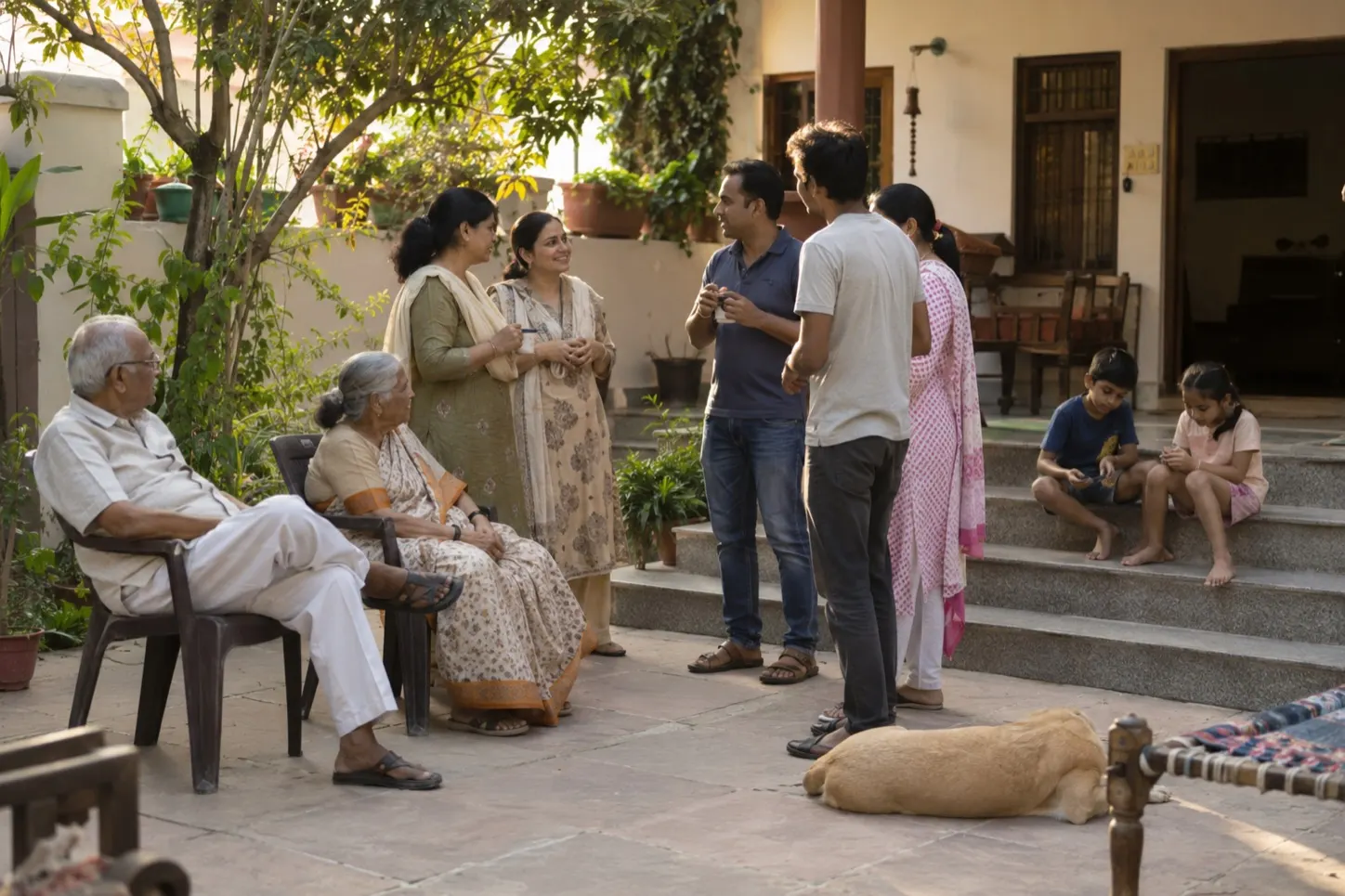
India’s customs vary across regions, languages, religions, communities and families. A practice familiar in one household may be uncommon in another. Something that is religious in one setting may function mainly as etiquette, identity or family tradition somewhere else.
Ashok K. Dutt and colleagues, writing about regional cultural identities in India, show how language and religion help mark distinct cultural regions across the country.
So on IndianCulture, “Indian tradition” does not mean “every Indian does this.”
A better starting point is to ask who practises a custom, where and when it is practised, what practitioners say it means, and what the sources actually tell us.
One practice can have several meanings
Indian traditions do not always fit neatly into categories such as religious, social or cultural.
Lighting a lamp may be part of worship, a festival, or a household routine. Flowers may be offered to a deity, used to welcome someone, or simply decorate a celebration. Touching an elder’s feet may have religious associations while also serving as a family expression of respect.
The same outward action can therefore carry different meanings.
Traditional explanations, historical evidence and scientific explanations also answer different kinds of questions. An old practice does not need a modern scientific explanation to make it meaningful. If a claim involves neuroscience, medicine, physics or another scientific field, it should be supported by scientific evidence.
For a broader set of everyday “Why do Indians…?” questions, see the Why do Indians…? series.
Indian does not mean identical
A Tamil Hindu family, Punjabi Sikh family, Gujarati Jain family, Bengali Muslim household and Goan Catholic family can all be Indian while following different traditions.
Even families from the same region and religious community may practise customs differently. Some customs cross community boundaries; others remain closely associated with a particular religion, region or family.
Context matters more than a universal rule. A shared outward form does not always imply a shared religious meaning.
Touching feet and showing respect
In many Hindu families, a younger person may touch the feet of a parent, grandparent, teacher or other respected elder and receive a blessing in return. The specific act is commonly described as charan sparsh. Pranam is broader: Sanskrit dictionaries use praṇāma for bowing, obeisance or respectful salutation, rather than only for touching feet.
How often families practise charan sparsh varies. Some do it regularly; others mainly at weddings, festivals or important family moments.
Read: Why do Indians touch feet?
Namaste and namaskar
Namaste is a Sanskrit salutation. The expression is built from namas — bow, obeisance or reverential salutation — and te, “to you”. Monier-Williams gives the relevant sense of namas, while the Rigveda preserves an early namas te construction in direct address.
In everyday life, joined palms can accompany namaste or namaskar as a greeting or gesture of respect. Usage varies by region, language, setting and community, so the gesture should not be treated as the only “Indian greeting”.
Removing shoes
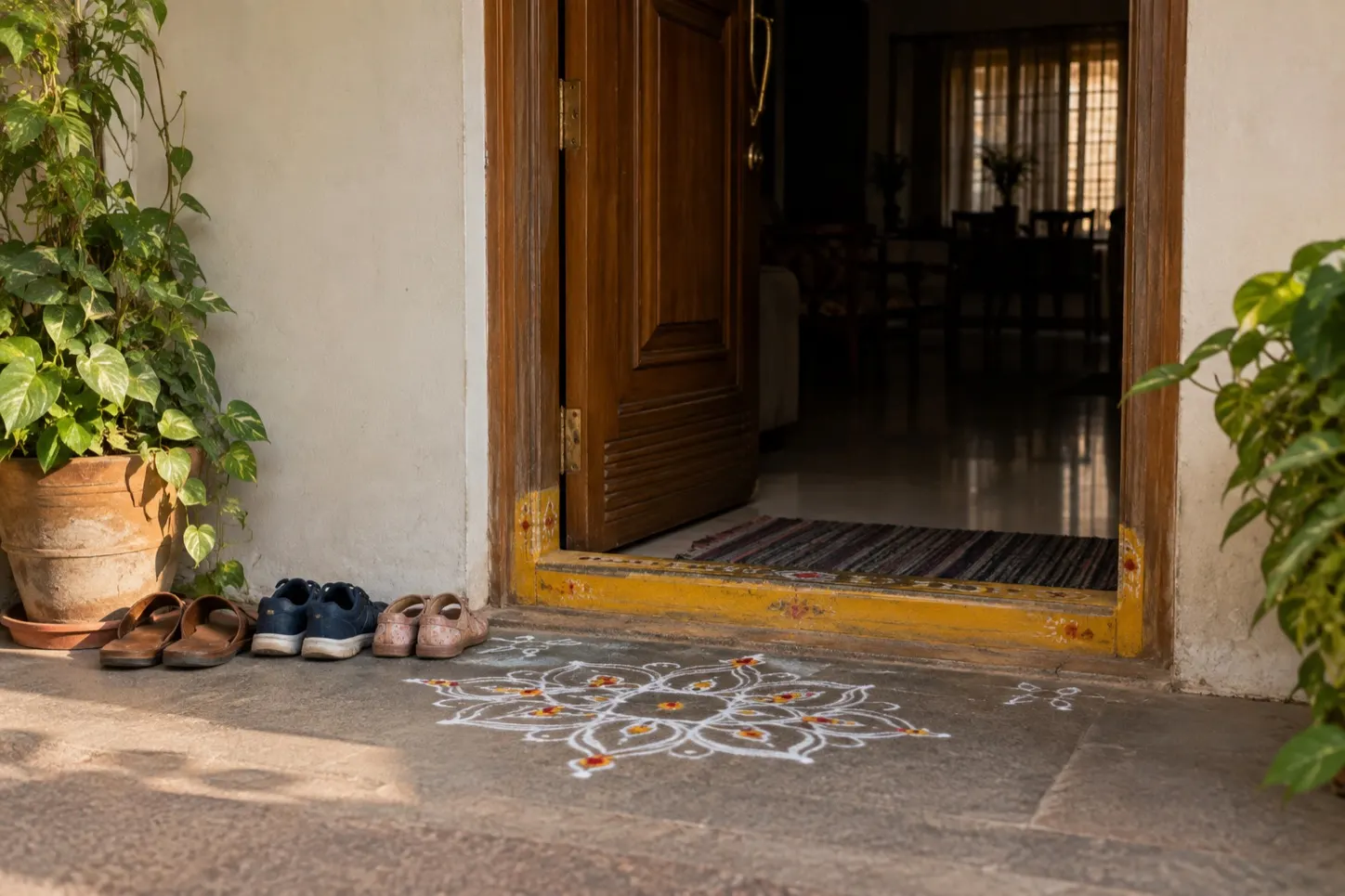
Many visitors encounter footwear rules in Indian homes and sacred spaces, but the exact expectation depends on the place. Rather than turning a varied practice into a universal religious rule here, our dedicated guide explains when shoes are removed, what different settings require and how to follow local etiquette.
Read: Why remove shoes in temples and other sacred spaces?
For a private home, the simplest approach is usually to notice what the hosts do or ask politely.
Bindi, tilak and sindoor
A bindi and a tilak are not simply two names for the same mark, and the clearest difference between them is who wears which. Pew Research Center's 2021 survey of religion in India found that 84 per cent of Hindu women said they wear a bindi, and 53 per cent of Hindu men said they wear a tilak. Pew defines the bindi as a decorative forehead mark worn by Hindu women, and the tilak as a forehead mark typically worn by Hindu men as a sign of piety; a tilak can also identify a particular Hindu tradition.
Neither is confined to one community, and the bindi least of all. In the same survey 29 per cent of Sikh women, 22 per cent of Christian women and 18 per cent of Muslim women also said they wear one — as Pew notes, even though the practice is not typically counted as part of those traditions. Nor is either universal among Hindus: in the Northeast, 59 per cent of Hindu women reported wearing a bindi and 21 per cent of Hindu men a tilak, against 84 and 53 nationally.
The material used is another matter. Kumkum, chandan (sandalwood paste) and vibhuti (sacred ash) may be used in different contexts. Vibhuti has a particularly strong association with Shiva and Shaiva practice; K. V. Singh treats bhasma in his section on Hindu ritual marks, while R. Nagaswamy documents sacred ash extensively in the Tamil Shaiva Tevaram tradition.
Sindoor is different again. In many Hindu communities it is associated with marriage and is characteristically placed in the parting of the hair. Both K. V. Singh and Devaleena Das describe this marital association and placement.
Diyas, turmeric and ceremonies
Some traditions already have deeper guides on IndianCulture.
The diya guide looks at why lamps appear in worship, festivals and household practice. The turmeric guide explores why haldi appears in ceremonies as well as everyday life.
For Hindu wedding practice, see Why do Hindu weddings circle the fire?. The fire ritual belongs in its specific religious and ceremonial context rather than being presented as something every Indian wedding follows.
Names carry their own histories and conventions too. See Why Indian names work differently for naming patterns, family names, regional variation and the limits of trying to infer identity from a name alone.
Similar words can belong to different traditions
Shared vocabulary can be misleading if it is assumed to carry exactly the same meaning everywhere.
Prasad, for example, is especially familiar in Hindu worship, but Sikh tradition has the specific institution of karah prasad. The Sikh Rehat Maryada gives a formal procedure for its preparation and distribution, and Michael Hawley discusses karah prasad as part of the institutional life of the gurdwara.
Jain traditions likewise include forms described as puja and aarti. John E. Cort documents both prescribed and lived forms of image worship among Svetambara Murtipujak Jains in Patan, and his later essay on Jain worship covers temple and domestic devotional practice.
The point is not that these practices are interchangeable. It is the opposite: familiar words must be understood inside the tradition using them.
For Hindu theology, doctrine and scriptural interpretation, see Religion and philosophy in India. For deities referred to across the Hindu material, see the Hindu gods guide. For festival-specific practice, see Festivals.
Food traditions have their own context
Eating with the fingers is normal in many Indian food traditions, but what is polite depends on the food, household and setting. A meal built around roti is handled differently from rice and dal, dosa, rasam or sambar.
The fuller discussion belongs with the cuisine itself rather than in a general traditions overview.
See Food & Cuisine.
Traditions are lived
Traditions are inherited, but people also negotiate them in everyday life.
Families preserve some customs and stop others. A practice can remain important while its meaning changes. Someone may wear a bindi devotionally, culturally or simply because she likes it. A family may observe one custom daily and another only at a wedding or festival.
That does not make the practice less real. It reminds us that culture is carried by living people rather than preserved unchanged in a display case.
Four questions to ask about any Indian custom
Who practises it?
Is the custom mainly associated with a religion, region, community or family, or is it shared more widely? “Indian” is often too broad an answer.
Where and when is it practised?
The same action can mean something different at home, at a place of worship, during a wedding or at a festival.
What do practitioners say it means?
Lived tradition matters. Two families can practise the same custom for different reasons, and neither family automatically speaks for all of India.
What does the source actually tell us?
A scripture can tell us what a religious tradition teaches. A ritual manual can describe a prescribed practice. Historical or ethnographic evidence can show how a community practised something in a particular place or period. Contemporary observation can show what people do today.
Those questions are connected, but not interchangeable.
New to this? Start with these three
- Why do Indians…A series answering the questions people are too embarrassed to ask about Indian customs — touching feet, removing shoes, the diya, turmeric and the many gods.
- Touching feetWhat charan sparsh means, who does it to whom, what the texts actually prescribe, and why the popular energy explanation is not the reason.
- Removing shoesWhy footwear comes off at temples and at the door of most Indian homes — what the rule is really about, and why the hygiene explanation is only half true.
Inside this section
Everything in Traditions
 Touching feetWhat charan sparsh means, who does it to whom, what the texts actually prescribe, and why the popular energy explanation is not the reason.
 Removing shoesWhy footwear comes off at temples and at the door of most Indian homes — what the rule is really about, and why the hygiene explanation is only half true.
 TurmericWhat haldi does in Indian ritual — the pre-wedding ceremony, the colour's associations, its use at births — and what the evidence for curcumin shows.
 The diyaWhat the oil lamp is for in Hindu worship — what it signals, what goes in it, which oil is used where, and why it is lit before anything else is done.
 The wedding fireWhat the fire is doing at a Hindu wedding, what the seven steps actually are, who leads which round, and how the sequence differs by community.
 Indian namesWhy some Indians have no surname, why initials come first in the south, why Andhra puts the family name first, and what to do when a form rejects it.
Questions people ask
Do these customs mean the same thing everywhere in India?
No. Meanings and expectations change by religion, region, language, community and family. A widespread custom can still have several local forms, so a useful explanation is specific about who practises it and in what setting.
Are these religious rules, or etiquette?
They can be either, both or neither. Removing shoes may be household etiquette in one setting and part of the expected conduct of a sacred space in another. Touching feet may express family respect while also carrying religious associations.
Should I touch someone's feet if I am not Indian?
You do not need to imitate a gesture you do not understand. If a family uses charan sparsh, a respectful greeting is usually enough unless your hosts say otherwise. Asking is better than performing the custom mechanically.
Do I have to remove my shoes when visiting an Indian home?
Not every Indian household follows the same rule. Look for shoes near the entrance, notice what your host does, or simply ask whether they would like you to take them off.
What is the difference between a bindi and a tilak?
Mostly, who wears it. Pew's 2021 survey found 84 per cent of Hindu women wear a bindi and 53 per cent of Hindu men a tilak — the bindi a decorative forehead mark, the tilak a mark of piety that can also identify a particular Hindu tradition. Neither is confined to Hindus, and the bindi least of all. Sindoor is different again — in many Hindu communities it is associated with marriage and is typically worn in the hair parting.
Is it rude to eat with my hands, or rude not to?
Neither is automatically rude. The appropriate method depends on the meal and the setting. Follow the conventions of the table you are at; in a traditional setting, local etiquette may matter more than whether cutlery is present.
Sources (15)
- Ashok K. Dutt, S. Davgun, Chandrakanta C. Khan and Chandralekha Sangwan, 'Distinct Regional Cultural Identities of India Based on Religion and Language', in Facets of Social Geography: International and Indian Perspectives (Foundation Books, 2012), ch. 16, 294–333 — For language and religion marking distinct cultural regions across India
- Monier Monier-Williams, A Sanskrit-English Dictionary, new ed. (Clarendon Press, 1899), entries praṇāma, caraṇa and sparśa — For the lexical distinction between a broad respectful salutation and a touch of the feet
- Vaman Shivram Apte, The Practical Sanskrit-English Dictionary (Shiralkar, 1890), entry praṇāma — Second lexical source for the broader sense of pranam: bowing, obeisance, reverential salutation
- Monier Monier-Williams, A Sanskrit-English Dictionary, new ed. (Clarendon Press, 1899), 528, entry namas — For namas as bow, obeisance, reverential salutation — the first element of namaste
- Stephanie W. Jamison and Joel P. Brereton, trans., The Rigveda: The Earliest Religious Poetry of India, vol. 2 (Oxford University Press, 2014), Rigveda 8.75.10 — For an early attested namas te in direct address. The verse reads namas te agna ojase, addressed to Agni
- K. V. Singh, Hindu Rites and Rituals: Origins and Meanings (Penguin Books India, 2015), 30 — For the tilak as a Hindu ritual mark
- Pew Research Center, Religion in India: Tolerance and Segregation (2021), 'Religious Clothing and Personal Appearance' — For the definitions of bindi and tilak, and for who wears each — 84% of Hindu women and 53% of Hindu men, with the bindi also reported by 29% of Sikh, 22% of Christian and 18% of Muslim women
- K. V. Singh, Hindu Rites and Rituals: Origins and Meanings (Penguin Books India, 2015), 31 — For bhasma and holy ash
- R. Nagaswamy, Tamil Nadu: The Land of the Vedas (Tamil Arts Academy, 2018 reprint), ch. 6 §6.4.6 — For sacred ash in the Tamil Shaiva Tevaram hymns and its association with Shiva
- K. V. Singh, Hindu Rites and Rituals: Origins and Meanings (Penguin Books India, 2015), 35 — For sindoor in the hair parting in connection with Hindu marriage
- Devaleena Das, 'Body, Boundaries and Sindoor Feminism in India', South Asia: Journal of South Asian Studies 43, no. 6 (2020): 1019–1040 — Second source for sindoor as a marital marker, and for its placement
- Shiromani Gurdwara Parbandhak Committee, Sikh Rehat Maryada: Sikh Code of Conduct and Conventions, section 3, ch. VIII, art. XII — For the prescribed preparation and distribution of karah prasad
- Michael Hawley, 'Sikh Institutions', in Pashaura Singh and Louis E. Fenech, eds., The Oxford Handbook of Sikh Studies (Oxford University Press, 2014), ch. 25 — Second source for karah prasad within the institutional life of the gurdwara
- John E. Cort, Jains in the World: Religious Values and Ideology in India (Oxford University Press, 2001), ch. 3, 'Going to the Temple: How to Worship God' — For murti-puja and arati among Svetambara Murtipujak Jains in Patan
- John E. Cort, 'Devotion at Home, Devotion in the Temple: Patterns of Jain Worship', in Pratapaditya Pal, ed., Puja and Piety (Santa Barbara Museum of Art / University of California Press, 2016), 89–115 — Second source for Jain temple and domestic devotional practice
Fact-checked by Ajay Gupta on 10 September 2026.
Something wrong here? Tell us — corrections are made in the open, and our editorial standards set out what checking a page involves.