Food & Cuisine
Indian food — a regional guide to India's cuisines
A state can hold several cuisines, one cuisine can cross state borders, and a dish can travel so far that people forget it began somewhere particular.
10 pages
Ask ten Indian families what they grew up eating and you may get ten very different answers.
A Punjabi household may describe rotis with dal, seasonal sabzi and curd. A Bengali family may begin with rice and fish cooked with mustard. In Tamil Nadu, breakfast may mean idli or dosa with sambar and chutney. In Rajasthan, pearl millet, gram flour, pulses and foods designed for a dry climate appear in combinations that make little sense if “Indian food” is treated as one cuisine. In Assam, rice may be paired with fish, greens and khar. In Manipur, fermented fish such as ngari enters dishes with a completely different flavor logic.
All of these can be Indian food.
That is the first thing to understand: there is no single Indian cuisine.
India contains many regional, linguistic, religious, community and family food traditions. They overlap, borrow from one another and keep changing. A state can contain several cuisines; one cuisine can cross state borders; and a dish can travel so widely that people forget it began somewhere particular.
The most useful way to understand Indian food is therefore to start with place, then ask how geography, agriculture, religion, trade, migration and history shaped what people actually cook and eat.
Why Indian food changes from region to region
Geography and agriculture
Food follows landscape.
Across much of Punjab and the northwestern plains, wheat supports everyday breads such as roti and paratha. In wetter eastern and southern regions, rice is more prominent. Rajasthan’s dry climate encouraged the use of hardy grains, pulses, gram flour, dried ingredients and foods that could be stored. Along the Konkan and Malabar coasts, fish, coconut and rice became central to many communities because the sea and tropical agriculture made them available.
The pattern is never absolute. Kerala has important meat, seafood and vegetarian traditions; Rajasthan is not uniformly vegetarian; rice is eaten across the North; and wheat is not absent from the South.
V. Manikanta, S. S. Kumara, P. Harsha and P. Manilal compared traditional Indian cuisines by ingredient groups and found both regional distinctiveness and overlap among states within the same broad region. Anupam Jain, Rakhi N. K. and Ganesh Bagler later analyzed eight regional cuisines and found that each had a recognizable ingredient and flavor-pairing signature. Regional cuisines are different, but they are not sealed compartments.
Religion and community
Religion can shape food, but it does not create one uniform diet for everyone who shares a faith.
Some Jain communities avoid root vegetables as well as meat and eggs because of principles connected with non-violence. Many Vaishnava traditions developed vegetarian foodways in which onion and garlic may also be avoided in particular ritual or devotional contexts. Sikh langar serves a vegetarian meal so people from different backgrounds can eat together. Muslim communities across India have their own meat, rice, bread and festive traditions that differ from Kerala to Hyderabad to Kashmir.
These practices are specific to communities and contexts. They should not be converted into sentences such as “Hindus eat…” or “Indians avoid…”.
The devotional background to several of these practices is set out in Hinduism, and the food traditions built on purity and offering in Sattvic Food. For the classical Ayurvedic framework of sweet, sour, salty, bitter, pungent and astringent tastes, see The Six Tastes in Ayurveda and Ayurveda.
Trade changed the pantry
Indian food has also been shaped by long-distance exchange.
Jeremy A. Simmons describes Indian Ocean trade as a system connecting the subcontinent with the Red Sea, Arabian Peninsula, East Africa and Southeast Asia — attested in Greek and Roman accounts from the first century CE, and running through the medieval and early modern centuries. Pepper, cardamom, ginger, cinnamon and other commodities moved through these networks, while ingredients and food habits moved toward India as well.
The early modern Columbian Exchange made some of the most dramatic changes. Chilli, potato, tomato and cashew came from the Americas, yet all became deeply embedded in Indian cuisines. Chillies became essential to the heat of many Andhra, Rajasthani and Northeast dishes; potatoes entered foods from Bengali aloo posto to North Indian aloo paratha; tomatoes became common in later gravies and chutneys; and cashews became important in sweets, sauces and coastal cooking.
Vishu Antani and Santosh Kumar Mahapatra document these transfers in their socio-historical review of Indian cuisine. The point is not that Indian food is somehow less traditional because ingredients traveled. It is the opposite: Indian food repeatedly made foreign ingredients local.
Migration and political history
People carried food with them.
Court cooks moved between princely households. Marriage connected royal kitchens. Merchants moved through trading networks. Workers and families carried their everyday food across regions. Later, Partition transformed the food of cities such as Delhi as refugees from Punjab and elsewhere rebuilt their lives and food businesses there.
Angma Dey Jhala’s work on princely India shows how chefs, cookbooks and royal women helped transmit culinary styles between regions. Charu Gupta’s study of Hindi cookbooks in colonial North India shows something different: cookbooks did not simply record food neutrally. They could reflect contemporary ideas about religion, caste, gender, health and national identity.
That matters because cuisine is not only a list of dishes. It is also a history of which foods were written down, which became prestigious, which remained domestic, and whose cooking came to represent a region to outsiders.
The map is useful — but the state is not the cuisine
For orientation, it is reasonable to talk about North, South, East, West, Central and Northeast India. But these are map labels, not six unified cuisines.
A culinary tradition may cross a state border. A single state may contain sharply different food cultures. Language, caste or community history, religion, altitude, coast versus interior, and urban migration can all produce differences inside the same political boundary.
Three levels help keep the map honest:
A region has a cuisine. Punjab, Bengal, Gujarat and Tamil Nadu each contain systems of ingredients, meals, techniques and food customs.
A cuisine contains dishes. Litti, pakhala, dhokla, rogan josh, dosa and misal are individual foods within larger culinary traditions.
A dish can travel. Once a food spreads, it changes. Dosa is no longer confined to southern India; Punjabi restaurant dishes are eaten across the world; Mumbai’s street foods have versions far beyond Maharashtra.
A traveling dish can become nationally familiar without becoming a complete description of the cuisine it came from.
North India
What many restaurants abroad call “North Indian food” is heavily shaped by Punjabi and Mughlai-influenced restaurant traditions. That is real Indian food, but it is not the whole North.
Across Punjab, wheat, pulses, dairy and seasonal vegetables are important to everyday cooking. Tandoor breads and dishes associated with Punjabi restaurants became unusually visible after migration and the growth of restaurant culture, which helps explain why people abroad may encounter Punjabi-style food before they encounter other Indian cuisines. Read more in North Indian Food and Punjabi Cuisine.
Move west into Rajasthan and the ingredients change. Pearl millet (bajra), gram flour, pulses, ghee and foods suited to a dry environment become more visible. Dal baati churma, gatte ki sabzi and ker sangri tell a different story from Punjabi sarson da saag and makki di roti. Rajasthani Cuisine explores that tradition in depth.
Kashmir is different again. Rice is central, and the celebrated Kashmiri Muslim wazwan is built around an elaborate sequence of meat dishes. Preparations such as rista and gushtaba belong to that banquet tradition. Kashmiri Pandit cooking has its own repertoire and rules, including meat dishes prepared without onion and garlic in many households. Neither should be collapsed into generic “North Indian food.”
Uttar Pradesh also contains more than one culinary world. Awadhi cooking around Lucknow is known for courtly rice and meat traditions, kebabs and dum cooking, while Bhojpuri-speaking eastern Uttar Pradesh shares foodways with neighboring Bihar. Himachal Pradesh and Uttarakhand add mountain grain, pulse and dairy traditions that rarely appear on international Indian menus.
South India
There is no single “South Indian food” either.
Rice and pulses are important across much of the South, and fermented batters connect foods such as idli, dosa and uttapam. But Tamil, Telugu, Kannada and Malayalam-speaking regions use different chillies, souring agents, cooking fats, vegetables, seafood and meat traditions.
Tamil Nadu includes temple-associated vegetarian cooking, everyday rice meals, tiffin foods and sharply distinctive subregional traditions such as Chettinad. Karnataka includes Udupi cooking, Kodava food, coastal seafood traditions and the very different foods of northern Karnataka. Andhra coastal food, Rayalaseema cooking and Telangana cooking are not interchangeable, even though all may be described loosely as Telugu food.
Kerala’s coast and tropical agriculture make rice, coconut and seafood prominent, but community matters enormously. Hindu, Muslim and Christian households developed distinct repertoires; Syrian Christian meat dishes and Moplah Muslim cooking sit beside extensive vegetarian traditions.
Hyderabad adds a Deccani court history of its own, visible in biryani, meat dishes and festive foods. It is geographically southern but cannot be explained simply as another version of Tamil or Andhra cooking.
For the larger regional framework, see South Indian Food.
East India
Rice is especially important across much of eastern India, but “rice and fish” is not enough to explain the region.
Bengali cuisine is famous for fish, mustard and sweets, yet vegetables, greens, lentils, poppy seed, dairy and carefully sequenced meals are equally important. Hilsa cooked with mustard, shukto built around bitter and vegetable flavors, and sweets based on chhena reveal very different parts of the same culinary world. Bengali food also crosses the modern India-Bangladesh border and differs among regions and communities. See Bengali Cuisine.
Odisha has its own rice, pulse, vegetable, fish and seafood traditions. Pakhala — cooked rice fermented or soaked in water and eaten in several forms — is a strong example of a food tied to climate and everyday life. The food associated with the Jagannath Temple at Puri adds a major ritual tradition without defining all Odia food.
Bihar contains Bhojpuri, Maithil and Magahi food cultures. Litti, usually associated with roasted wheat dough filled with seasoned sattu, is famous, but it is one dish within a much larger grain, pulse and vegetable tradition. Jharkhand, meanwhile, has distinct Adivasi and regional foodways and should not be treated as simply an extension of Bihar.
West India
Western India places very different cuisines side by side.
Gujarati food includes influential vegetarian traditions built around grains, pulses, vegetables and dairy, with Kathiawadi food offering a more robust, often spicier subregional identity. Dhokla and the Gujarati thali are recognizable far outside the state, but neither captures the whole cuisine. See Gujarati Cuisine and The Indian Thali.
Maharashtra stretches from the Konkan coast to inland plateau regions. Malvani cooking uses coconut, seafood and coastal spice combinations; Vidarbha has its own assertive spice traditions, including saoji cooking associated with Nagpur; Mumbai developed street foods such as vada pav and pav bhaji through the life of a dense migrant city. Inland foods built around millet, peanuts and pulses add another layer. These are related but not interchangeable.
Goa shows especially clearly how regional cuisine can emerge from encounter. Konkani food traditions, coastal seafood, Hindu cooking and Catholic Goan food developed through centuries of local history and Portuguese colonial influence. The result is not one “fusion cuisine” but several overlapping Goan traditions.
Central India
Central India is often missing from short guides to Indian food.
Madhya Pradesh includes Malwa, Bundelkhand and other subregions with different grain, pulse and vegetable traditions. Wheat is prominent in many areas, while foods such as poha became strongly associated with cities including Indore. The tribal and forested districts add ingredients and food practices that do not fit a simple North-versus-South map.
Chhattisgarh has a particularly strong rice culture. Rice appears not only as a cooked grain but in preparations such as chila and faraa, alongside pulses, greens and foods associated with rural and Adivasi communities.
Central India matters precisely because it disrupts the restaurant map of Indian cuisine. It shows how much is lost when only Punjab, Bengal, Gujarat and the South are used to represent the country.
Northeast India
The Northeast makes the limitations of the phrase “Indian food” especially obvious.
Assam, Arunachal Pradesh, Manipur, Meghalaya, Mizoram, Nagaland, Sikkim and Tripura contain many ethnic and Indigenous food traditions. Rice is important across much of the region, while fermented foods, smoked meats, bamboo shoots, local greens, fish and regionally specific chillies appear in different combinations.
Assamese cooking includes fish, greens and khar, an alkaline preparation that gives a distinctive character to particular dishes; masor tenga shows another Assamese preference through its light, sour fish preparation. In Manipur, fermented fish such as ngari is used in foods including eromba. Naga food traditions may feature smoked pork, fermented ingredients, bamboo shoots and powerful local chillies, but “Naga cuisine” itself includes the foodways of several Naga communities rather than one standardized menu.
Meghalaya contains Khasi, Garo and Jaintia traditions. Sikkim and parts of Arunachal Pradesh show Himalayan and Tibetan connections. Mizo and Tripuri cuisines have their own histories and ingredient systems.
The Northeast should therefore not be represented by a token plate of momos and one extremely hot chilli. Its importance is larger: it demonstrates that India’s culinary geography reaches into food systems that look very different from the restaurant canon most outsiders first encounter.
How people eat is part of the map too
Regional food is not only about ingredients.
A meal served on a banana leaf in parts of South India follows a different visual and serving logic from a North Indian household meal built around rotis arriving hot from the kitchen. A Gujarati thali organizes many preparations on one plate. In Bengal, the order in which categories of food are eaten has historically mattered in traditional meals.
Eating with the hand is also a practice with regional, household and personal variations, not a curiosity to be explained as something “Indians do.” The tactile relationship with food, the use of the fingers to combine rice with dal or curry, and local etiquette around which hand is used are better understood in context. See Why Indians Eat With Their Hands, and Traditions for the customs around a meal.
Where should you start?
If you know almost nothing about Indian food, do not begin by trying to memorize fifty famous dishes.
Choose a place.
Compare North Indian Food with South Indian Food. Then go narrower: Punjabi Cuisine, Rajasthani Cuisine, Bengali Cuisine or Gujarati Cuisine. Notice which grain anchors the meal, which souring agents and fats appear, whether fish or meat is important, how vegetables are treated, and what is eaten on ordinary days rather than only at weddings, festivals or restaurants.
Then look at individual dishes.
A region has a cuisine. A cuisine contains dishes. A dish can travel.
Once that distinction is clear, “Indian food” stops looking like an impossibly long menu and starts looking like what it really is: a set of connected culinary worlds.
No one region represents India better than the others.
Indian cuisine is the relationship among all of them.
New to this? Start with these three
- North IndianWhat North Indian cooking covers, why the restaurant version is mostly Punjabi, the wheat-and-dairy base, and how it changes from Kashmir to Awadh.
- South IndianWhy South Indian is not one cuisine — how Tamil, Kerala, Andhra and Karnataka cooking differ, and the rice-and-fermentation base they share.
- The thaliWhat a thali is, how its components are arranged and why, how the six tastes shape it, and how it differs across Gujarat, Tamil Nadu and Bengal.
Everything in Food & Cuisine
 North IndianWhat North Indian cooking covers, why the restaurant version is mostly Punjabi, the wheat-and-dairy base, and how it changes from Kashmir to Awadh.
 South IndianWhy South Indian is not one cuisine — how Tamil, Kerala, Andhra and Karnataka cooking differ, and the rice-and-fermentation base they share.
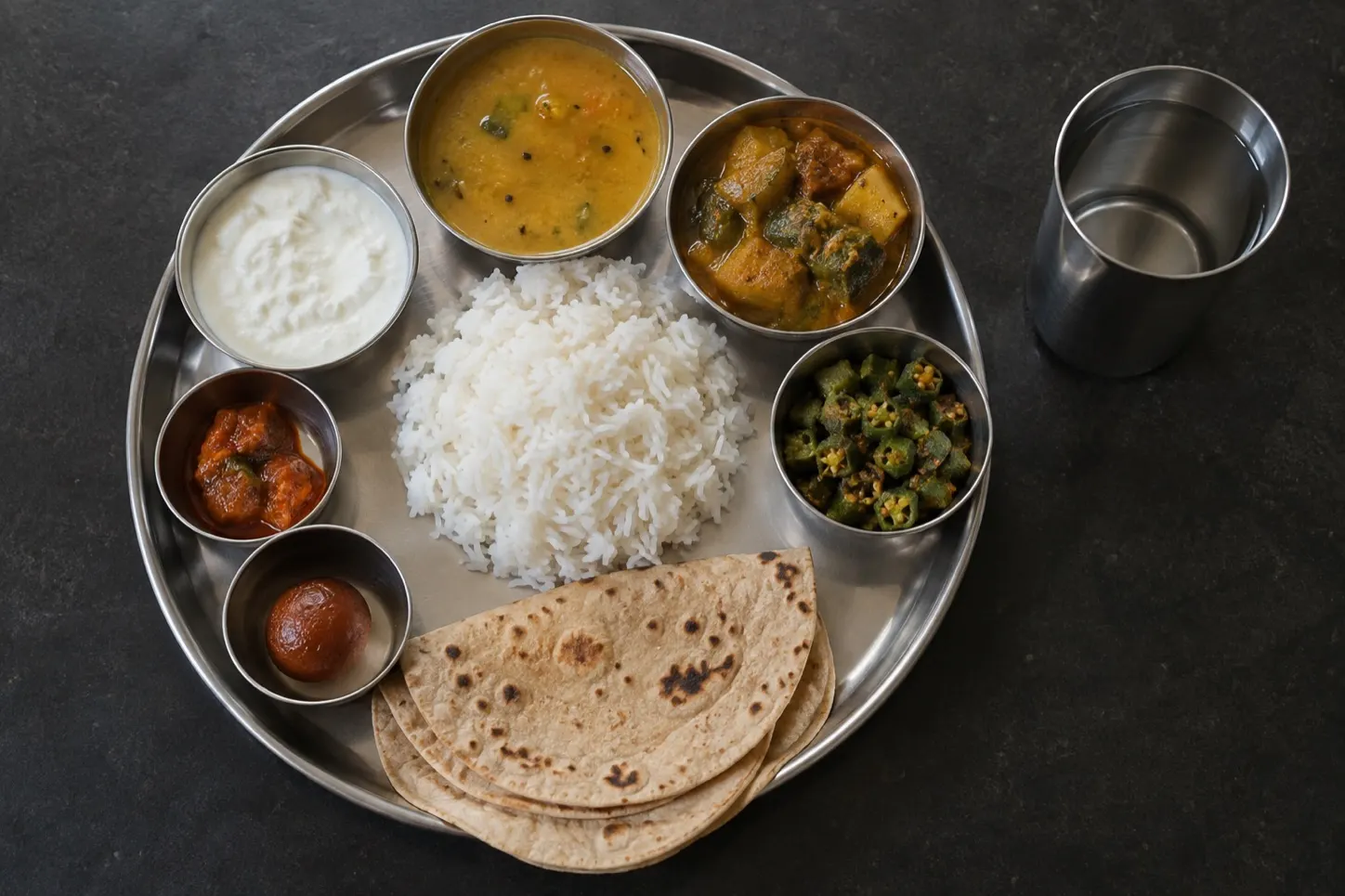 The thaliWhat a thali is, how its components are arranged and why, how the six tastes shape it, and how it differs across Gujarat, Tamil Nadu and Bengal.
 BengaliHow a Bengali meal is structured course by course, the role of fish, mustard oil and panch phoron, and how Bangladeshi and West Bengali cooking differ.
 GujaratiWhat makes Gujarati cooking distinct — the thali structure, the sweet-salt-sour balance, Jain influence, and the differences between Kathiawar, Surat and Kutch.
 PunjabiWhat Punjabi cooking actually is at home, how it differs from the restaurant version, the role of dairy and wheat, and what Partition did to the cuisine.
 RajasthaniHow Rajasthani cooking is shaped by desert conditions — dried lentils, gram flour, ghee and long-keeping dishes — and how Marwari and Rajput food differ.
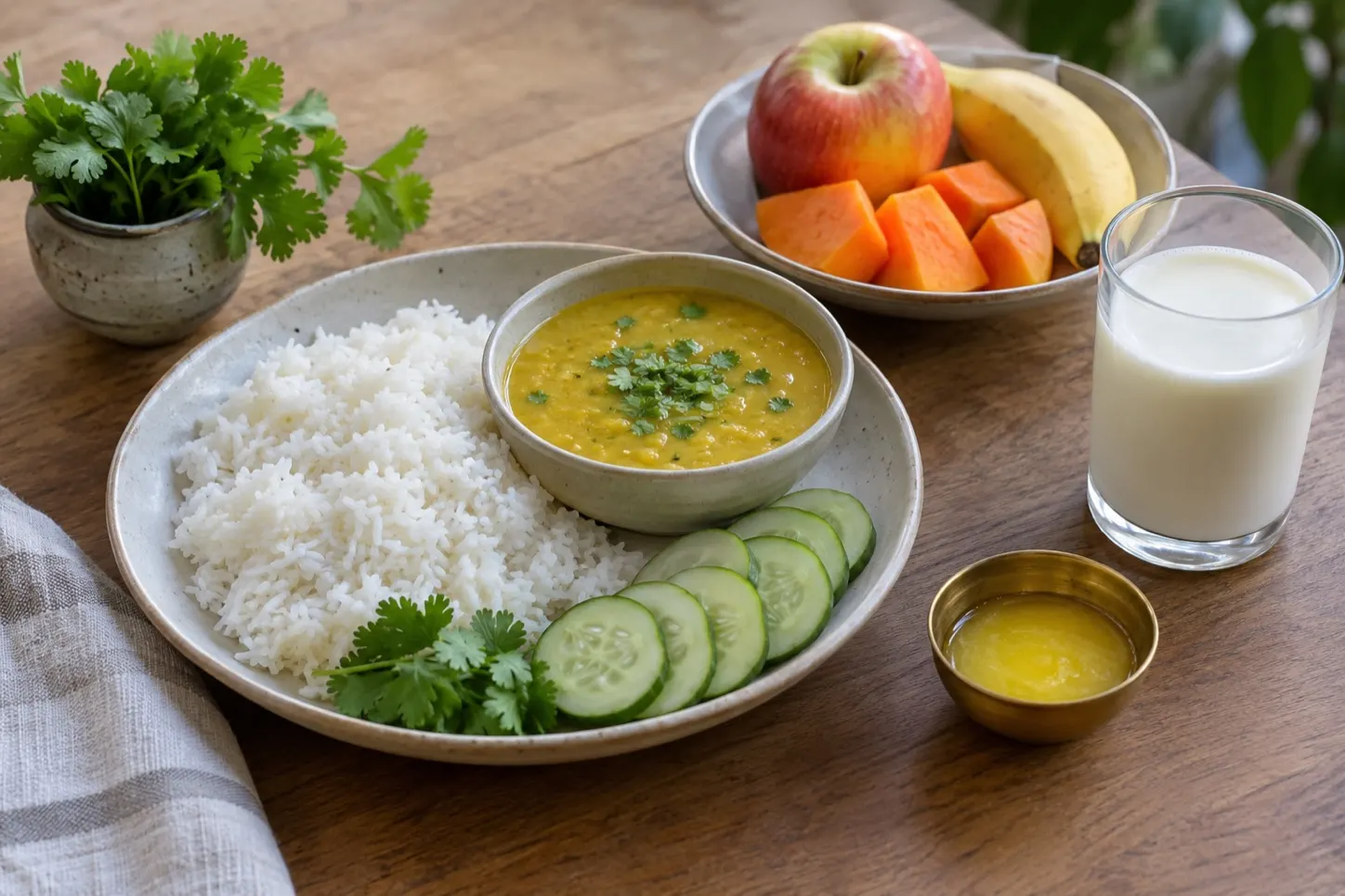 Sattvic foodWhat sattvic means in Indian dietary thought, the three-guna scheme behind it, what it includes and excludes, and how it differs from vegetarianism.
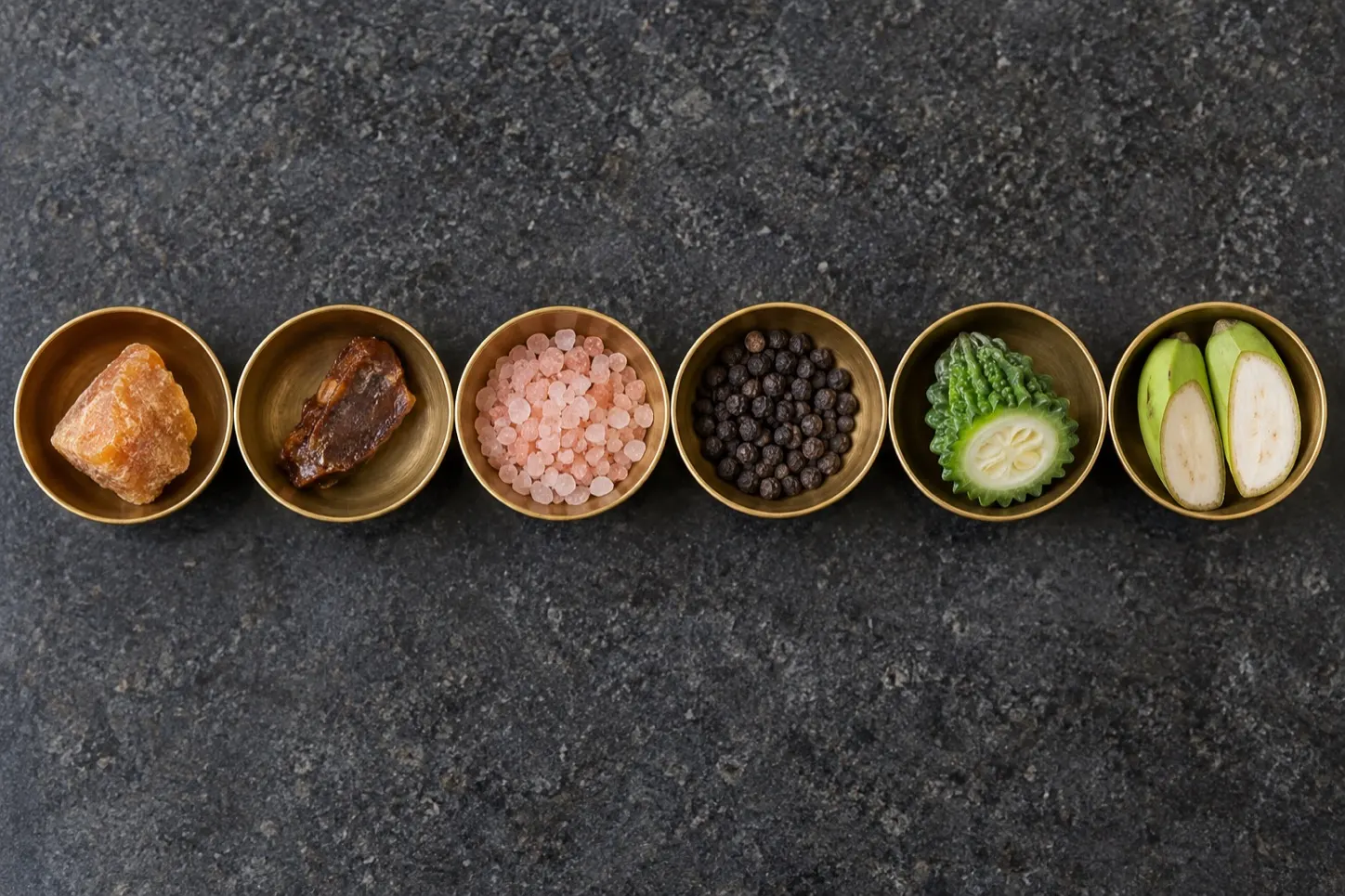 The six tastesWhat the six tastes are in Ayurvedic thought, how they relate to the doshas, how they shape the order of a meal, and where the framework's claims end.
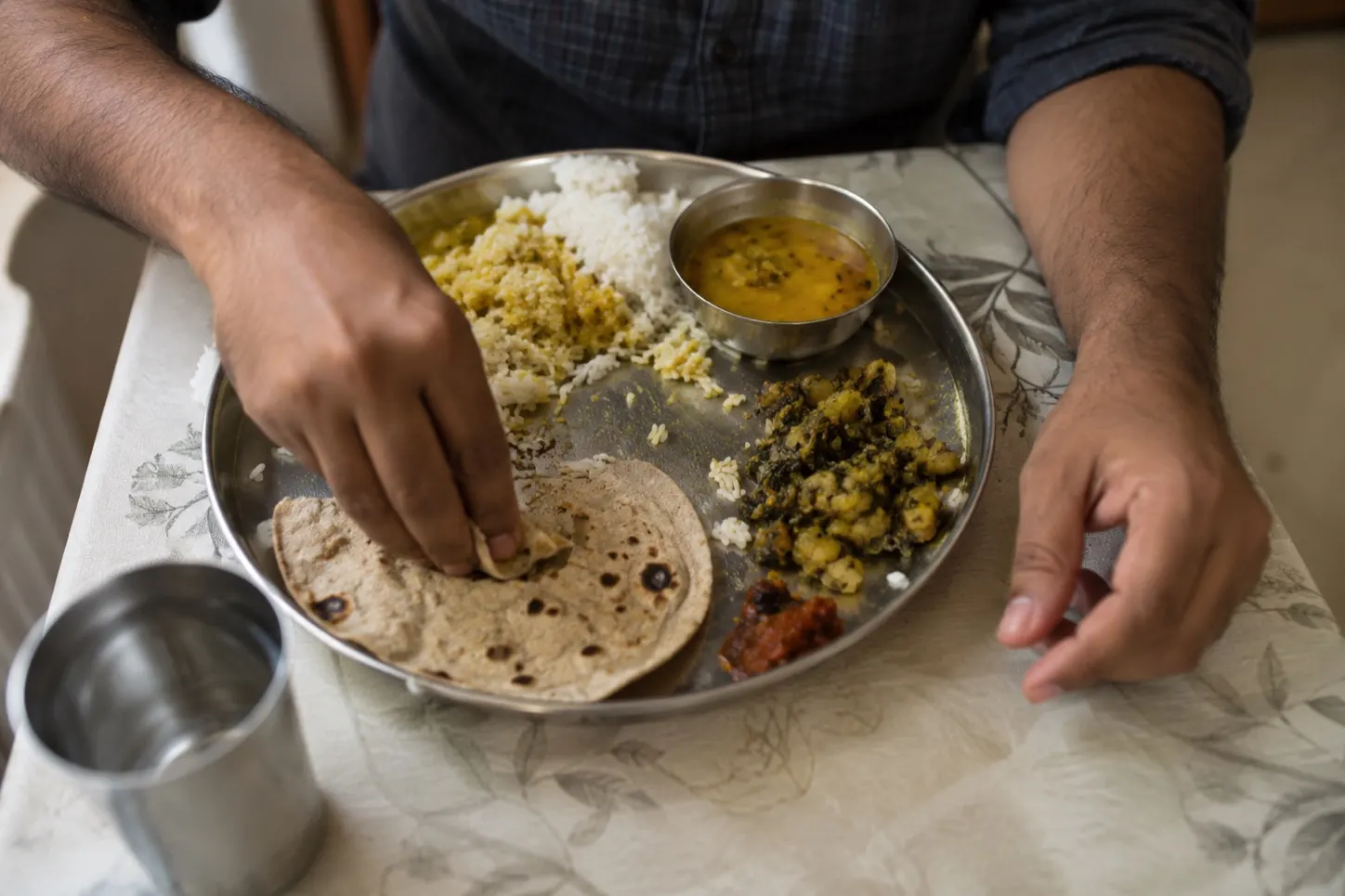 Eating with handsThe real reasons for eating with the hands in India, which hand is used and why, and how the technique differs between north and south.
Questions people ask
Is there such a thing as Indian food?
Yes, but it is an umbrella term rather than one cuisine. Punjabi, Bengali, Gujarati, Tamil, Assamese, Goan and many other traditions share ingredients and histories while keeping distinct meal structures, techniques and flavour patterns.
Why is North Indian food the version most restaurants abroad serve?
Restaurant cooking abroad was shaped largely by Punjabi and Mughlai-influenced traditions, and later by Delhi restaurant food, carried outward by migration and commercial restaurant networks. That made naan, tandoori dishes and rich gravies unusually visible abroad, though they represent only part of Indian cuisine.
Is Indian food vegetarian?
Indian cuisine includes some of the world's most developed vegetarian traditions, but India is not uniformly vegetarian. Fish, chicken, goat and other meats are central to many regional and community cuisines, and vegetarian practice itself varies by religion, region, household and individual choice.
What is the difference between a regional cuisine and a famous dish?
A regional cuisine is a larger food system — its staples, ingredients, meal patterns, techniques and customs. A dish such as dosa, litti, dhokla or rogan josh belongs within one or more of those systems and may later travel far beyond where it started.
Why do neighbouring states eat so differently?
Political borders do not determine cuisine. Rainfall, crops, coastlines, altitude, language, religion, trade routes, migration and community history can change sharply over a short distance, while some culinary traditions cross state borders entirely.
Where should I start if I know nothing about Indian food?
Start with regions rather than a list of famous dishes. Compare North and South Indian food first, then pick one regional tradition — Punjabi, Bengali, Gujarati or Rajasthani — and learn how an everyday meal is built there.
Sources (7)
- V. Manikanta, S. S. Kumara, P. Harsha and P. Manilal, 'Regional Food Diversity of Traditional Indian Cuisines — A Perspective Based on the Database of Indian Cuisines', Information Studies 18, no. 3 (2012): 177–188 — For regional ingredient-group mapping, and for the finding that cuisines within a region share substantial features across state boundaries
- Anupam Jain, Rakhi N. K. and Ganesh Bagler, 'Analysis of Food Pairing in Regional Cuisines of India', PLOS ONE 10, no. 10 (2015): e0139539 — For the eight regional cuisines analysed, and for each having a recognisable ingredient and flavour-pairing signature
- Jeremy A. Simmons, 'Indian Ocean Trade', Oxford Research Encyclopedia of Food Studies (Oxford University Press, 17 July 2024) — For the Indian Ocean network, the spice trade, and the movement of foodstuffs and people
- Vishu Antani and Santosh Kumar Mahapatra, 'Evolution of Indian Cuisine: A Socio-Historical Review', Journal of Ethnic Foods 9 (2022) — For the incorporation of chilli, potato, tomato and cashew into Indian cooking after the Columbian Exchange
- Angma Dey Jhala, 'Trans-Regional Chefs, Kitchens and Cookbooks: Food in the Colonial and Postcolonial Zenana', in Royal Patronage, Power and Aesthetics in Princely India (Pickering & Chatto, 2011), 69–100 — For chefs, cookbooks and royal women carrying culinary styles between regions
- Charu Gupta, 'Kitchen Hinduism: Food Politics and Hindi Cookbooks in Colonial North India', Modern Asian Studies 58, no. 3 (2024): 739–763 — For cookbooks as carriers of ideas about religion, caste, gender and national identity rather than neutral records
- K. T. Achaya, A Historical Dictionary of Indian Food (Oxford University Press, 1998) — General reference for ingredients, dishes, food terminology and regional variation
Fact-checked by Ajay Gupta on 8 September 2026.
Something wrong here? Tell us — corrections are made in the open, and our editorial standards set out what checking a page involves.