Food & Cuisine
What is sattvic food?
A category from Indian philosophy that became a diet, and is now often sold as a wellness product with the philosophy removed.
The short answer
Sattvic food is one of three categories in a scheme that classifies food by the mental state it is held to produce. Sattvic food is fresh, mild and vegetarian; rajasic food is stimulating; tamasic food is heavy, stale or fermented. It is a philosophical category, not a nutritional one.
Key facts
- The scheme
- Three guṇas — sattva (clarity), rajas (activity), tamas (inertia) — applied to food as to everything else
- Sattvic
- Fresh vegetables and fruit, whole grains, legumes, milk and ghee, nuts, mild spices, honey
- Rajasic
- In the lists as they now circulate: onion, garlic, chilli, strong spices, coffee, and heavily salted or sour foods. Chilli and coffee reached India in the sixteenth and seventeenth centuries, so their place here is a later assimilation
- Tamasic
- In the lists as they now circulate: meat, fish, eggs, alcohol, food already eaten from, and in most accounts mushrooms and fermented foods
- The source
- Bhagavad Gītā 17.7–10 classifies food by guṇa — but by quality, not by item: it names no food at all. The lists above come from later commentary and from Manusmṛti; the Ayurvedic texts develop the scheme separately
The scheme it comes from
Sattva, rajas and tamas are the three guṇas — qualities or strands — of Sāṃkhya philosophy. Everything in the material world is held to be a mixture of them: clarity and lightness; activity and agitation; heaviness and inertia.
Applied to food, the claim is that what you eat affects which quality predominates in the mind. The Bhagavad Gita's seventeenth chapter sets this out directly, classifying foods by the state they produce as well as by the disposition of the person who prefers them.
That is the whole basis of sattvic eating. It is a claim about mental clarity, not about calories.
What is on each list
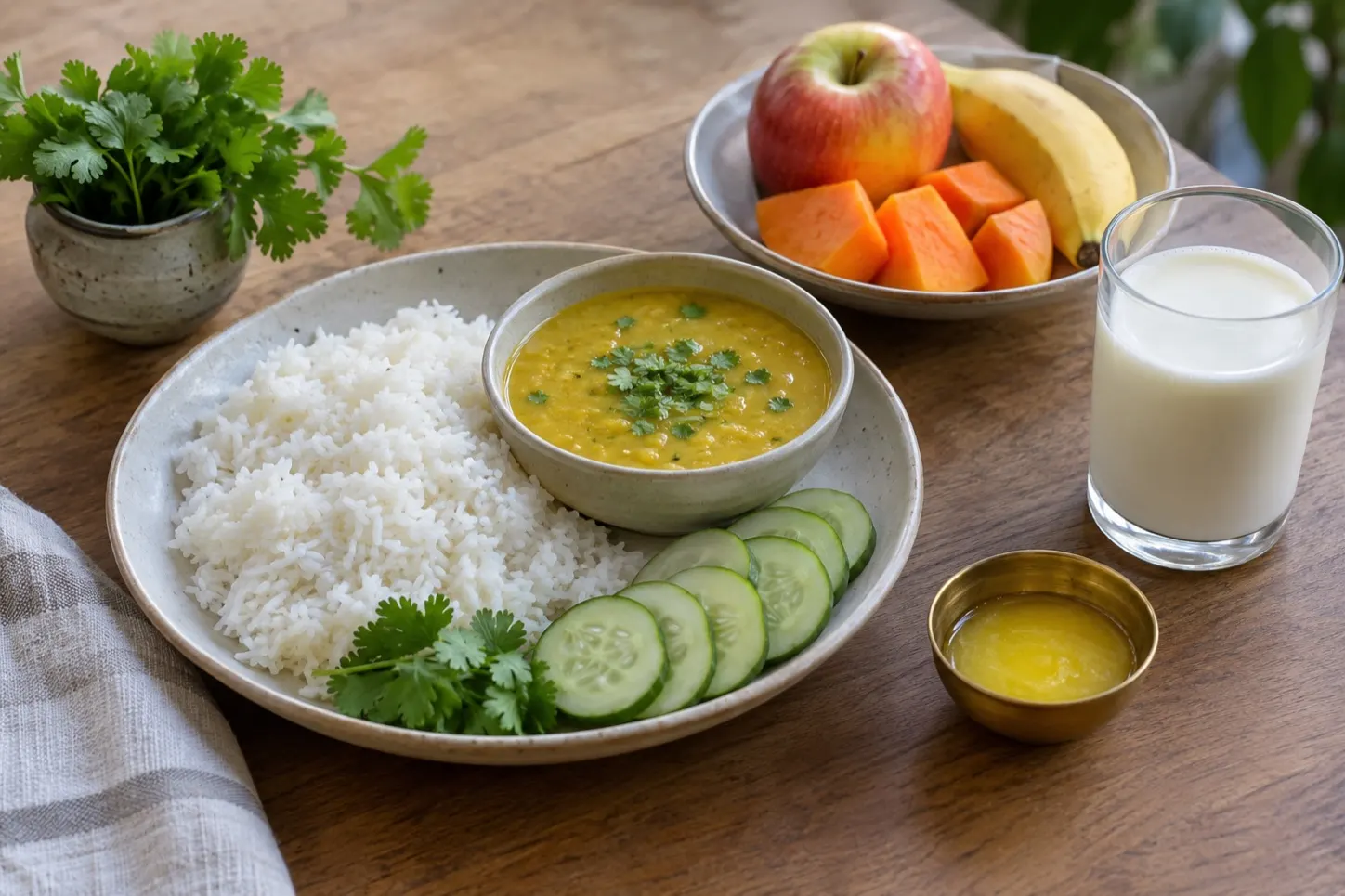
Sattvic. Fresh fruit and vegetables, whole grains, legumes, milk, ghee, nuts, seeds, honey, mild spices — ginger, turmeric, cumin, coriander. Cooked fresh and eaten the same day.
Rajasic. Onion, garlic, chilli, strong spices, coffee, very salty and very sour food. Stimulating, and in classical terms unhelpful to a mind trying to settle.
Tamasic. Meat, fish, eggs, alcohol; stale, reheated or overripe food; and in most lists mushrooms and fermented foods.
The stale-food exclusion is the one that surprises people, and it is also the one most often mistranslated. The Gita's term at 17.10 is ucchiṣṭa, which does not mean reheated: it means food someone else has already eaten from. That is a rule about purity and about who may eat after whom, not about how long something has been in the pan. The modern reading of it as a freshness rule is a substitution, and a convenient one.
Where it is actually practised
Temple kitchens, particularly Vaishnava ones, where offerings are cooked without onion and garlic. Ashrams. Households during specific vows and fasts. And practitioners in periods of intensive meditation, where the diet is treated as part of the practice rather than as a lifestyle.
Cooking well without onion and garlic is a genuine technique, and the traditions that do it lean on asafoetida, ginger, green chilli where permitted, and long handling of the base. Gujarati and Jain cooking are the best places to see it done properly.
How this changes across traditions
| Tradition | What it means in practice |
|---|---|
| Vaishnava temple kitchens | No onion, no garlic; everything cooked fresh and offered before it is eaten. |
| Jain households | Sattvic principles plus the exclusion of root vegetables and, in strict practice, no eating after sunset. |
| Yoga ashrams | Fresh, simple and light, timed around practice; often two meals rather than three. |
| Ayurvedic practice | The guṇa scheme is used, but constitution and season modify it — the same food is not right for everyone. |
| Ordinary Hindu households | Sattvic eating adopted temporarily for a fast, a vow or a festival period, and set aside afterwards. |
Questions people ask
Is sattvic just a strict vegetarian diet?
No. A vegetarian diet with onion, garlic, chilli and coffee is not sattvic, and a sattvic diet excludes leftovers and reheated food. The organising question is not animal versus plant but what a food is held to do to the mind.
Why are onion and garlic excluded?
They are classed as rajasic — stimulating, and in some accounts specifically agitating to the mind and body in ways held to interfere with meditation and celibacy. The exclusion is strongest in monastic, temple and Vaishnava contexts, and many lay households ignore it entirely.
Is there evidence for these effects?
The claims are about mental states and are not framed in terms modern nutrition tests. Some incidental overlaps exist — a diet of fresh whole foods without stimulants is unremarkable dietary advice — but the guṇa scheme is a philosophical taxonomy, not an empirical finding, and presenting it as one misrepresents both.
Who actually eats this way?
Ashram residents, temple kitchens, many Vaishnava and Jain-influenced households, people during specific fasts and observances, and practitioners preparing for intensive meditation. It is a mode people move into and out of rather than a permanent identity for most.
Sources (3)
- Bhagavad Gītā 17.7–10 — which classifies food by quality and names no food item; the familiar lists are commentary, not text — For the classification of food by guṇa
- Caraka Saṃhitā and Suśruta Saṃhitā — For the Ayurvedic treatment of food qualities, which is related but not identical
- Sāṃkhya Kārikā — For the guṇa scheme itself, which predates its application to diet
Fact-checked by Ajay Gupta on 7 September 2026.
Something wrong here? Tell us — corrections are made in the open, and our editorial standards set out what checking a page involves.