History & Civilization
Indian history and civilization
The long background to everything else on this site, told the way the evidence supports it rather than as a single line running from Delhi.
2 pages
India's history is difficult to tell in a straight line.
There was rarely one kingdom called "India" ruling the whole subcontinent. There was rarely one language, one political system, one religious practice, or one centre from which everything else spread. The history unfolded across many regions at once.
Cities rose in the Indus basin while other communities lived quite differently elsewhere. Vedic traditions developed in the north while other cultures continued in parallel. Great empires such as the Mauryas connected enormous territories, and then regional kingdoms became the centres of political power, trade, literature, architecture and religious life again.
Tamil kingdoms looked toward the Indian Ocean. Kingdoms of the Deccan connected north and south. Bengal and Bihar became major centres of Buddhism and learning. Kashmir developed influential traditions of philosophy and literature. Odisha created its own temple and political cultures. Assam was shaped for centuries by kingdoms that most general histories barely mention.
This matters because Indian history is not the story of who ruled Delhi.
How far back it goes
Human occupation of the subcontinent runs far deeper than any city in it, and the record of that is archaeological throughout — the painted rock shelters at Bhimbetka among the clearest cases. By the third millennium BCE one of the ancient world's great urban civilizations had emerged in the northwest, usually called the Indus or Harappan Civilization, its settlements running from Rakhigarhi in Haryana to Lothal and Dholavira in Gujarat.
Much about it remains unknown, and for one specific reason: the Harappan script has not been securely deciphered. No Harappan text can be read on their politics, their beliefs or how they understood themselves, so everything said about them is inferred from what they left behind.
That distinction runs through this whole section. Archaeology shows what people built and used; interpretation attempts to say what it meant; the two are not the same thing.
The detail — the cities, the script, the Vedic period, the Mauryas and the Guptas, what the evidence supports and where scholarship is divided — is in Ancient India.
The arguments that shaped everything after
By roughly the middle of the first millennium BCE, northern India held a number of substantial states, cities were expanding, and trade was growing. It was also one of the most consequential periods in Indian intellectual history — a crowded field of teachers and renunciants arguing in public about what the self is, what makes an action right, and what happens after death. The Buddha and Mahavira belong to that field, alongside teachers whose schools did not survive.
Those questions became karma, dharma, moksha and the Upanishads, and the pattern established around them recurs for the rest of Indian history: traditions living beside one another, arguing with one another, borrowing from one another, and competing for royal and popular support.
What followed for Buddhism in particular is easy to underestimate from the present. For something like a thousand years it was a major presence across much of the subcontinent — endowed by rulers including Ashoka, carved into the rock at Ajanta and Ellora, and taught at monastic centres such as Nalanda that drew students from outside India. It later receded in the land of its origin, for reasons historians still argue about, while continuing to grow across Asia. A history of India that treats it as an episode between Vedic religion and Hinduism has the proportions wrong.
Empire, and what empire did not cover
The Mauryan Empire, founded by Chandragupta Maurya in the late fourth century BCE, was the largest political formation the subcontinent had yet seen. Its most famous ruler, Ashoka, is unusual among ancient rulers because his own messages survive: edicts carved onto rock and pillar across the empire, telling us directly how he wanted his rule and his idea of dhamma understood. Several centuries later the Gupta dynasty formed another major northern empire, associated with major work in Sanskrit literature, mathematics, astronomy and art.
The phrase sometimes used for the Gupta centuries — "the Golden Age of India" — needs care. It is useful for the achievements. It is misleading if it suggests that the Guptas ruled everywhere, or that life was uniformly prosperous and peaceful. Southern India and the Deccan had their own political and cultural histories running in parallel on their own chronologies. There was no single classical Indian experience.
Neither empire permanently unified the subcontinent, and after each one, regional histories returned to the foreground.
South India was never a footnote
One of the easiest mistakes in telling Indian history is to narrate the Gangetic plain and then look south occasionally. That reverses reality.
Southern India had its own ancient political systems, literature, trade networks and religious cultures. The early Tamil literature associated with the Sangam tradition preserves a world of kings, poets, warriors, merchants and landscapes. Over later centuries the Pallavas, Chalukyas, Rashtrakutas, Pandyas and Cholas became major powers.
The imperial Cholas built an extensive state from their Tamil heartland and projected power across Indian Ocean routes under rulers such as Rajaraja I and Rajendra I. Their most visible legacy is not a battlefield but stone and bronze: the Brihadisvara temple at Thanjavur, the temple at Gangaikondacholapuram and the Airavatesvara temple at Darasuram, inscribed together by UNESCO as the Great Living Chola Temples. What that inscription covers is not three buildings but a body of work — the towers themselves, the sculpture worked into them, the painting, and the bronze casting that went with them.
Their UNESCO name points to something unusual about these monuments: worship still takes place within them. Buildings raised roughly a millennium ago remain part of religious life today — one of the clearest examples of Indian history surviving as practice rather than as a museum object.
Between the empires
Large empires attract attention, but much of Indian civilization developed in the centuries when no single empire dominated. Important political and cultural centres emerged in Kashmir, Rajasthan, Gujarat, Bengal, Odisha, Assam, the Deccan, Karnataka, Tamil Nadu, Kerala, the Telugu country and the Himalayan regions, among others. The Palas, Chalukyas, Rashtrakutas, Hoysalas, Kakatiyas and Eastern Gangas supported distinctive traditions of architecture, religion, literature and political culture.
Some of India's most famous monuments belong to these regional worlds rather than to any imperial centre — Khajuraho, the sun temple at Konark, the monuments of Pattadakal, the Hoysala temples. This is why dynastic timelines are useful but insufficient. To understand India you also have to follow regions.
Temples in this period became institutions as well as sacred spaces. Depending on place and period, a great temple might hold land grants, employ priests and artisans, commission art, support festivals, deal with merchants and rulers, and anchor local social life. Architecture developed differently across regions, and different dynasties patronised Shaiva, Vaishnava, Shakta, Jain and Buddhist institutions. Religion and political power often intersected — but temples cannot be reduced to political monuments, because many remained, and remain, places where people worship.
That is where this section meets Sacred India. History asks how these institutions developed; Sacred India asks what the places mean and why people still go. The same division applies to India's stepwells, which were water infrastructure, architecture and sacred space at once.
The Sultanate, the Mughals, and the centuries that get flattened
Muslim contact with India did not begin with the Mughal Empire. Arab merchants had long been part of Indian Ocean trade along the western coast. The Delhi Sultanate, established in the early thirteenth century and ruled successively by several dynasties, became a major northern power. Its history includes warfare and conquest, and conquest alone does not explain the centuries that followed. Building changed: the true arch and the dome entered Indian construction and were worked by Indian masons into something neither wholly imported nor wholly local, and as the Sultanate fragmented its successor states in Bengal, Gujarat, Jaunpur, Malwa and the Deccan each developed a distinct idiom of their own — regional architectures as different from one another as the temple styles were. Persian became enormously influential in court and literary culture. Muslim communities became part of Indian society, and Sufi traditions developed important centres and followings — while older religious and regional traditions continued.
In the south the Vijayanagara Empire became one of the great powers of the late medieval period, its capital surviving in ruins at Hampi. Its rulers patronised major temples and literary traditions while competing and trading with the neighbouring states of the Deccan. That region was politically complex: Hindu and Muslim-ruled kingdoms fought one another, and also fought co-religionists, employed people across religious boundaries, exchanged artistic influences and shared political conventions. Reducing the period to a single Hindu-versus-Muslim confrontation obscures more than it explains.
In 1526 Babur defeated Ibrahim Lodi at the first battle of Panipat and founded the dynasty that became the Mughal Empire, which under Akbar, Jahangir, Shah Jahan and Aurangzeb became one of the most powerful states in the early modern world. Its administration, painting, architecture and court culture left a lasting imprint. Akbar expanded the empire and experimented with new forms of imperial accommodation; Shah Jahan's reign produced the most famous Mughal architecture; Aurangzeb extended Mughal territory further, over a reign whose religious and political policies remain the subject of historical argument.
The Mughals matter enormously, and Mughal history is still not the whole history of early-modern India. Powerful states and communities existed across the subcontinent throughout, and as Mughal authority weakened in the eighteenth century they became decisive. The Marathas built one of the most powerful political networks in India from the kingdom Shivaji established. Sikh political power developed in Punjab through a different history, reaching the Sikh Empire under Ranjit Singh in the nineteenth century. Mysore emerged as a formidable southern state, alongside Hyderabad, Awadh, Bengal, the Rajput kingdoms, and the Ahom kingdom that had already governed the Brahmaputra valley for centuries.
India on the eve of British supremacy was therefore not an empty space waiting to be conquered.
Two things this section does not do, and will not. It does not rule on which account of a contested reign is the right one — where historians are still arguing, that is what it says. And it does not treat the religion of a dynasty as an explanation of its conduct, in either direction. Rulers of every faith in this period built, endowed, taxed, allied and destroyed, and a page that sorted those acts by the ruler's religion would be making an argument rather than reporting a history.
Company, Crown, and independence
The British did not arrive as rulers. The English East India Company arrived as a commercial enterprise, one of several European companies competing for access to India's very large trading economy, and became a political and military power by degrees. Plassey in 1757 and Buxar in 1764 were important stages in that shift in Bengal and the north; expansion continued through war, alliance, annexation and negotiated arrangements with Indian states, over decades and against Maratha, Mysorean, Sikh and other resistance.
After the uprisings of 1857, the British Crown replaced Company rule in 1858. Colonial rule then transformed India profoundly — railways, modern bureaucracies and legal structures, English-language education, new industries and cities — while colonial economic policy redirected resources and trade, established industries came under enormous pressure, racial hierarchy structured imperial government, and devastating famines occurred.
Indians were not passive in any of this. Reformers, religious thinkers, writers, entrepreneurs, workers, revolutionaries and political leaders responded in very different ways, and new arguments emerged about caste, women's rights, education, religious reform, economic exploitation, political representation and the meaning of India itself. Those arguments grew into movements for self-government.
India became independent on 15 August 1947, alongside Partition — which created India and Pakistan and set off one of the largest and most traumatic population movements of the twentieth century. Hindus, Muslims and Sikhs were displaced, communal violence killed very large numbers of people, and families and communities were divided by new borders. The Constitution of India came into effect on 26 January 1950, and independent India set about something historically unusual: a large democratic republic across extraordinary linguistic, religious, regional and social diversity.
The British period is one part of a much longer history. Indian civilization did not begin when Europeans started documenting it.
History does not belong to one religion
India's past is deeply connected with religion, and it cannot be reduced to the history of any single tradition.
Hindu traditions developed over millennia and became woven through the civilization. Buddhism began in India and transformed religious thought across Asia. Jain communities made lasting contributions to philosophy, trade, literature, art and architecture. Islam became part of Indian life through trade, migration, conquest, settlement and centuries of cultural development. Sikhism emerged in Punjab with its own distinctive religious and historical tradition. Christian communities in India include some that long predate European colonial rule as well as those that grew during and after it.
These are not separate chapters running in parallel. Their histories repeatedly intersect. Religion and philosophy in India covers what each tradition teaches; this section covers how they moved through time.
History does not belong to one dynasty either
Textbooks rely on dynasties — Maurya, Gupta, Chola, Delhi Sultanate, Mughal, Maratha, British — because the names are useful. They also create an illusion.
While one dynasty ruled in one place, millions of people lived under entirely different political systems elsewhere. When a Gupta emperor ruled part of the north, southern kingdoms had their own histories. When the Delhi Sultanate held Delhi, other states flourished. When Mughal power was at its height, important kingdoms lay outside Mughal control. And when historians describe the decline of one empire, that decline is often the rise of a region.
Indian history looks different depending on where you stand. Stand in Delhi and one chronology appears. Stand in Thanjavur, Hampi, Guwahati, Srinagar, Bhubaneswar, Pune or Madurai and another does. All of them belong to India.
How anyone knows any of this
The further back you go, the more careful the claims have to become. Historians reconstruct India's past from several kinds of evidence, and each answers a different question.
- Archaeology — cities, buildings, pottery, tools, coins, burials and other physical remains.
- Inscriptions — texts carved into rock, pillars, temple walls, copper plates and monuments.
- Manuscripts and literature — religious texts, poetry, philosophical works, chronicles, administrative records.
- Foreign accounts — Greek, Chinese, Arab, Persian and European visitors recording what they encountered.
- Art and architecture — temples, stupas, mosques, forts, sculpture and painting, which preserve evidence of patronage, technology and belief.
- Oral traditions — memory, genealogy, song and legend, which can carry important cultural knowledge, though historians distinguish memory from independently verifiable events.
No source is neutral. Kings presented themselves as powerful and righteous. Court poets praised patrons. Travellers misunderstood what they saw. Colonial historians brought their assumptions, and modern writers bring theirs. Even an inscription commissioned by a ruler tells us mainly what that ruler wanted proclaimed.
So the working principle in this section is simple. First ask what the evidence shows. Then ask what historians think it means. Where scholars disagree, say so. Where the evidence is incomplete, say that too.
History and memory are not the same thing
Some of the most important stories Indians tell about the past sit between history, religion and cultural memory. The Ramayana and Mahabharata have shaped the civilization for centuries. Places across India are associated with events in them. Families hear these stories, festivals re-enact them, artists paint them, temples embody them.
They are historically important whatever any individual claim about their chronology turns out to be. But religious significance and archaeological proof answer different questions. A sacred tradition can tell us why a place matters to millions of people; archaeology can tell us when structures there were built; textual scholarship can tell us how versions of a story changed. Those are not the same knowledge and they do not have to be collapsed into one another.
Respecting a tradition does not require pretending evidence exists where it does not. Historical caution does not require treating a living tradition with contempt. This site holds both, and where it cannot, it says which one it is reporting.
Continuity is not sameness
Languages changed. Kingdoms disappeared. Religious traditions developed. Communities migrated, new foods arrived, trade routes shifted, temples were built, rebuilt and added to over centuries, philosophical schools argued, foreign peoples entered India and became part of its history, and political borders moved repeatedly.
Across all of that, real continuities survived. Sanskrit texts composed before the Common Era are still recited. Tamil literature written many centuries ago is still part of a living literary culture. Pilgrimage places still draw worshippers. Festivals with deep historical roots still fill streets. Rituals continue inside temples built a thousand years ago. Ideas such as dharma, karma and moksha are still argued about.
India is therefore neither an unchanged ancient civilization nor a modern invention. It is something more interesting than either: a civilization repeatedly transformed without ever quite losing the conversation with its own past.
Where to begin
There is no single correct path through Indian history.
For the earliest cities and the textual traditions that followed them, and for how confidently any of it can be dated, start with Ancient India. For what the built environment can tell you on its own, read India's stepwells. For the religious traditions as traditions rather than as chronology, go to Religion and philosophy in India; for the places where that history is still practised, Sacred India.
And do not hurry toward the modern period. Much of what makes India understandable happened long before it.
The larger story
Who ruled India first, who conquered whom, which empire was greatest — those questions have their place, and they are not enough. A civilization is larger than its rulers. What this section is actually following is what people built, believed, argued about, traded, wrote, worshipped, remembered and handed on. Kings changed, borders changed, capitals moved, and the conversation continued.
Everything in History & Civilization
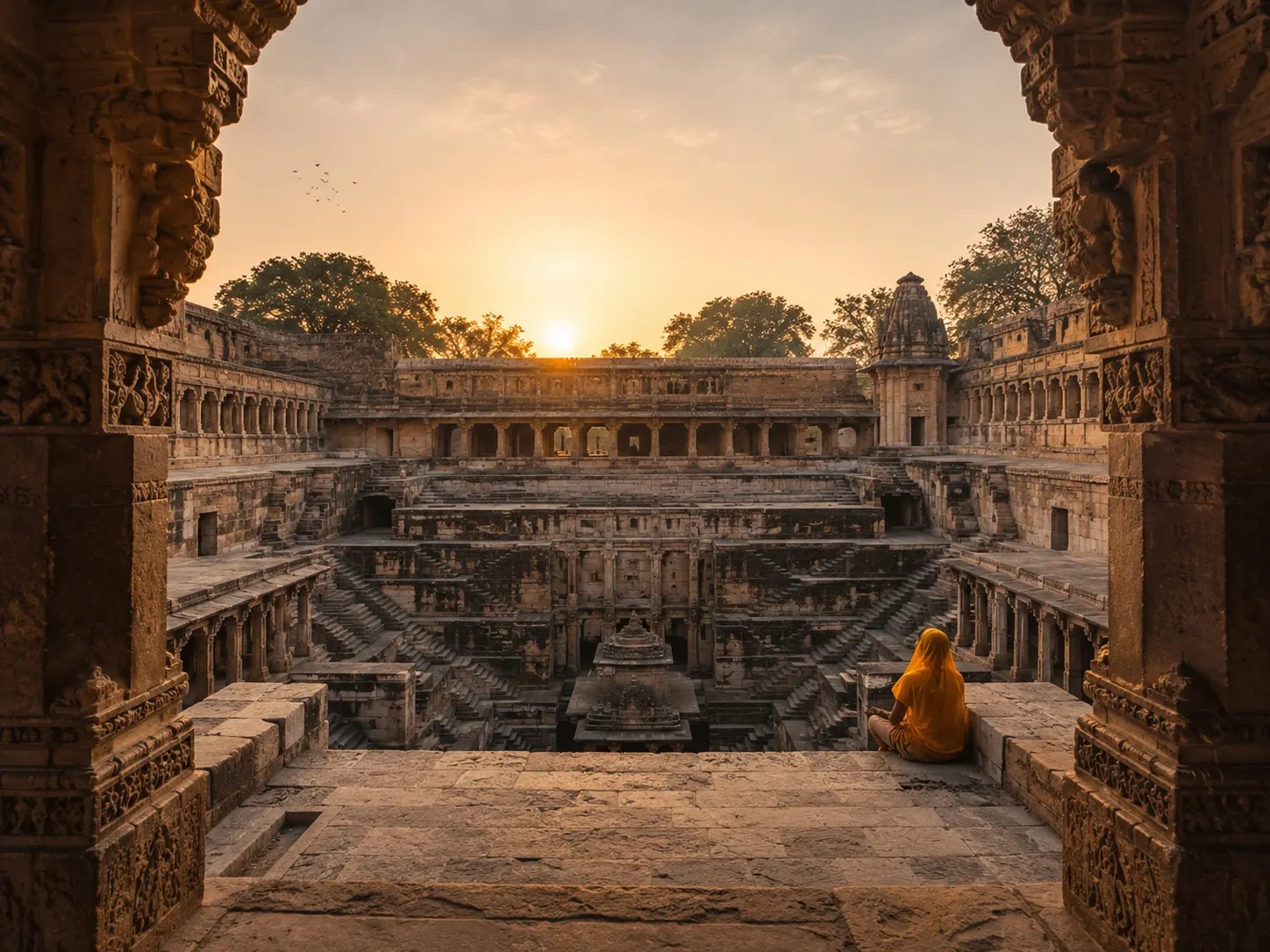 Ancient IndiaEarly Indian history from the first rock shelters to the Guptas — what the evidence supports, where scholarship is divided, and why dates come as ranges.
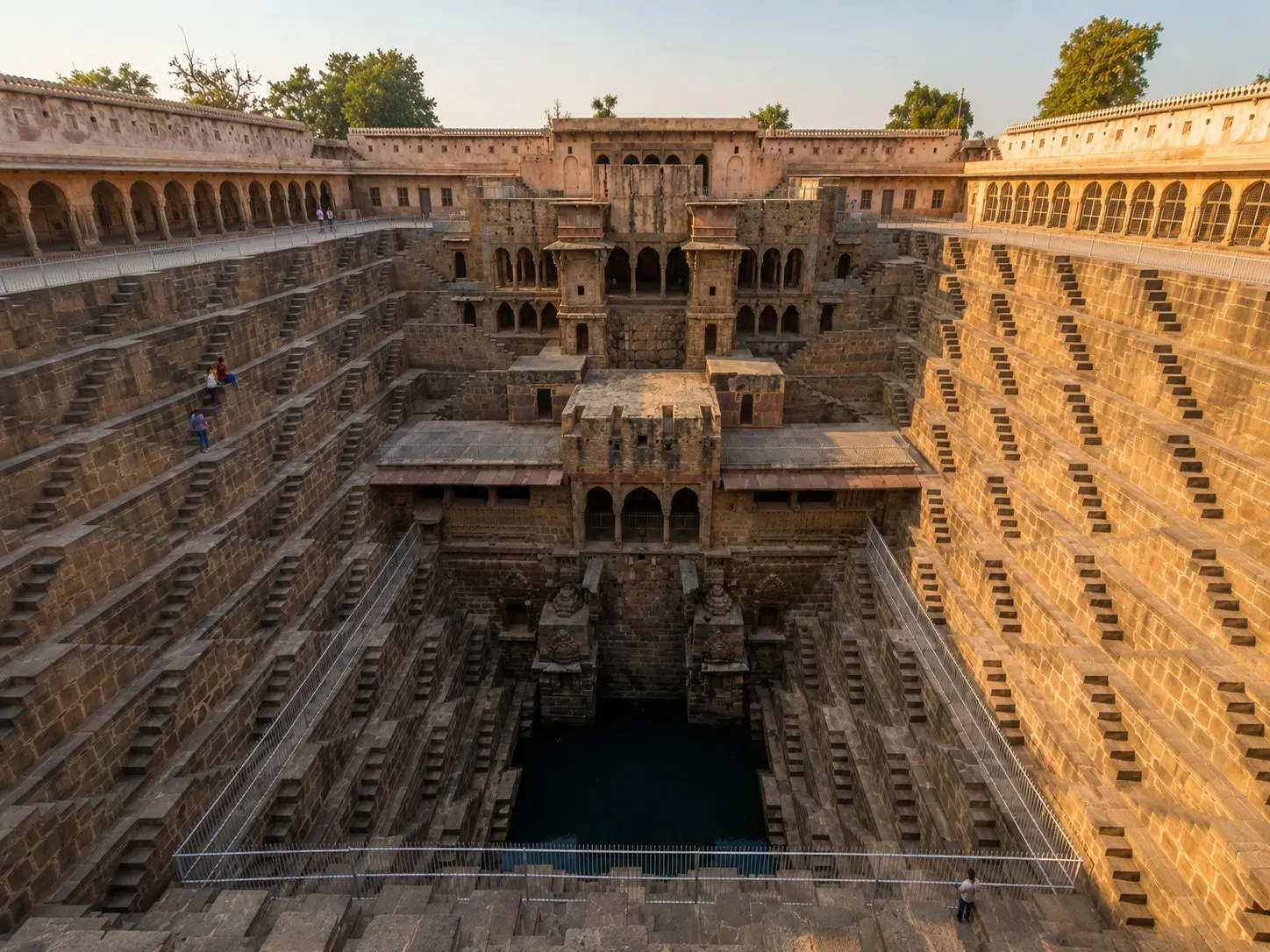 StepwellsWhat stepwells are, how they worked, why they were built where they were, the great surviving examples, and what happened to them.
Questions people ask
Why are dates here given as ranges?
Because that is how they are known. Indian chronology before roughly 500 BCE is reconstructed from texts that were composed orally and from archaeology, and honest ranges are wide. A single confident year is usually a sign that someone has picked a side in an argument without saying so.
Who ruled India first?
The question assumes something that was rarely true. For most of its history the subcontinent held many states at once, and no dynasty ruled all of it. The Mauryas assembled the first very large empire in the late fourth century BCE, but even they did not govern the whole of the south, and regional kingdoms remained the normal political form before and after them.
Was there a golden age of Indian history?
The phrase is usually attached to the Gupta centuries, and it is useful for the achievements in literature, mathematics, astronomy and art that belong to that period. It becomes misleading when it implies that the Guptas ruled everywhere or that life was uniformly prosperous. Southern and Deccan India had their own histories running at the same time.
Does Indian history begin with the Indus cities?
Written history does not begin there either — the Harappan script has not been securely deciphered, so no Harappan text can be read. Human occupation of the subcontinent runs far further back than the cities do, and rock-shelter sites such as Bhimbetka preserve evidence of it.
How do historians know what happened before writing?
From archaeology, inscriptions, manuscripts, foreign travellers' accounts, art and architecture, and oral traditions — each of which answers a different kind of question and none of which is neutral. The section below on evidence sets out what each can and cannot show.
Sources (9)
- Upinder Singh, A History of Ancient and Early Medieval India: From the Stone Age to the 12th Century (Pearson, 2008) — The standard scholarly survey for the periods covered here, with the evidence for each set out rather than summarised
- Romila Thapar, Early India: From the Origins to AD 1300 (Penguin, 2002) — For historiography, the interpretation of textual sources, and the argument against reading Indian history as a single dynastic line
- Hermann Kulke and Dietmar Rothermund, A History of India, 6th ed. (Routledge, 2016) — For the medieval, early-modern and regional chronology used on this page
- Richard M. Eaton, India in the Persianate Age, 1000–1765 (University of California Press, 2019) — For the Delhi Sultanate, the Deccan and the Mughal centuries, and for the argument against reading the period as a confrontation between two religions
- Catherine B. Asher and Cynthia Talbot, India Before Europe (Cambridge University Press, 2006) — For the architecture of the Sultanate and its successor states, and for the regional idioms that followed the Sultanate's fragmentation
- Robert Eric Frykenberg, Christianity in India: From Beginnings to the Present (Oxford University Press, 2008) — For Christian communities in India predating European colonial rule, and for Indian Christianity as indigenous rather than an import of empire
- Barbara D. Metcalf and Thomas R. Metcalf, A Concise History of Modern India, 3rd ed. (Cambridge University Press, 2012) — For the Company period, Crown rule from 1858, independence and Partition
- UNESCO World Heritage Centre, 'Dholavira: A Harappan City' (inscribed 2021) — For the inscription in 2021 and for occupation of roughly 3000–1500 BCE
- UNESCO World Heritage Centre, 'Great Living Chola Temples' (inscribed 1987, extended 2004) — For the three temples covered by the inscription of 1987 and its 2004 extension
Fact-checked by Ajay Gupta on 10 September 2026.
Something wrong here? Tell us — corrections are made in the open, and our editorial standards set out what checking a page involves.