Festivals
Janmashtami — Krishna's birth, kept at midnight
The one Hindu festival timed to a specific hour of the night, and the reason your family's date may differ from your neighbour's.
The short answer
Janmashtami marks Krishna's birth, kept at midnight on the eighth day of the waning fortnight — the month is Bhadrapada in the north's reckoning and Shravana in the south's, for the same night. In some years it falls on two consecutive dates: Smarta practice takes the night whose midnight window carries the eighth tithi, while Vaishnava practice takes the day whose sunrise carries it together with the Rohini nakshatra, which is why the Vaishnava date is the later one.
Key facts
- Also called
- Kṛṣṇa Janmāṣṭamī, Gokulashtami, Sri Krishna Jayanti; Gokulashtami in Maharashtra
- When
- Ashtami of the waning fortnight — Bhadrapada under the north's purnimanta reckoning, Shravana under the south's amanta, for the same night. Kept at midnight: the hour, not the day, is the fixed point
- Two dates
- Smarta takes the night whose midnight carries the tithi; Vaishnava takes the day whose sunrise carries the tithi with Rohini. When those differ the festival is kept on consecutive days, Vaishnava second
- The fast
- Kept through the day and broken after the midnight worship; some households break it the following morning
- Dahi handi
- The pot-breaking, held the day after in Maharashtra; now a large organised event with prize money and safety regulation
The story
Kamsa, king of Mathura, was told that his sister Devaki's eighth child would kill him. He imprisoned Devaki and her husband Vasudeva and killed their children as they were born.
The eighth was born at midnight in the prison. The guards slept, the doors opened, and Vasudeva carried the newborn across the flooded Yamuna to Gokul, where he exchanged him for a girl born that night to Yashoda and Nanda. Kamsa seized her and dashed her against a stone — and this is the part usually left out: she slipped from his hands, rose into the air as an eight-armed goddess, and told him that the one who would kill him was already born elsewhere (Bhāgavata Purāṇa 10.4.7–13). Krishna grew up among cowherds.
Almost everything else people know about Krishna — the butter, the flute, the cows, and much later the Bhagavad Gita — comes after that night. Radha comes later still, and from elsewhere: she appears in neither the Bhāgavata Purāṇa nor the Harivaṃśa, arriving with Jayadeva's twelfth-century Gīta Govinda and the traditions built on it.
What it means
Janmashtami is a birth kept at the hour of birth. That is unusual: most Hindu festivals are day-long observances, and this one is a vigil with a specific moment at its centre.
Most traditions read the vigil through avatāra — the descent of the divine into the world, in a form that is not a disguise but a real childhood, with a mother, a village and a set of neighbours who are exasperated by him. The stolen butter is not a decorative anecdote; it is the tradition insisting that the divine arrives as a particular child in a particular place.
How it is kept
- The fastKept through the day by many households — fruit, milk, and grain-free food, or nothing at all.
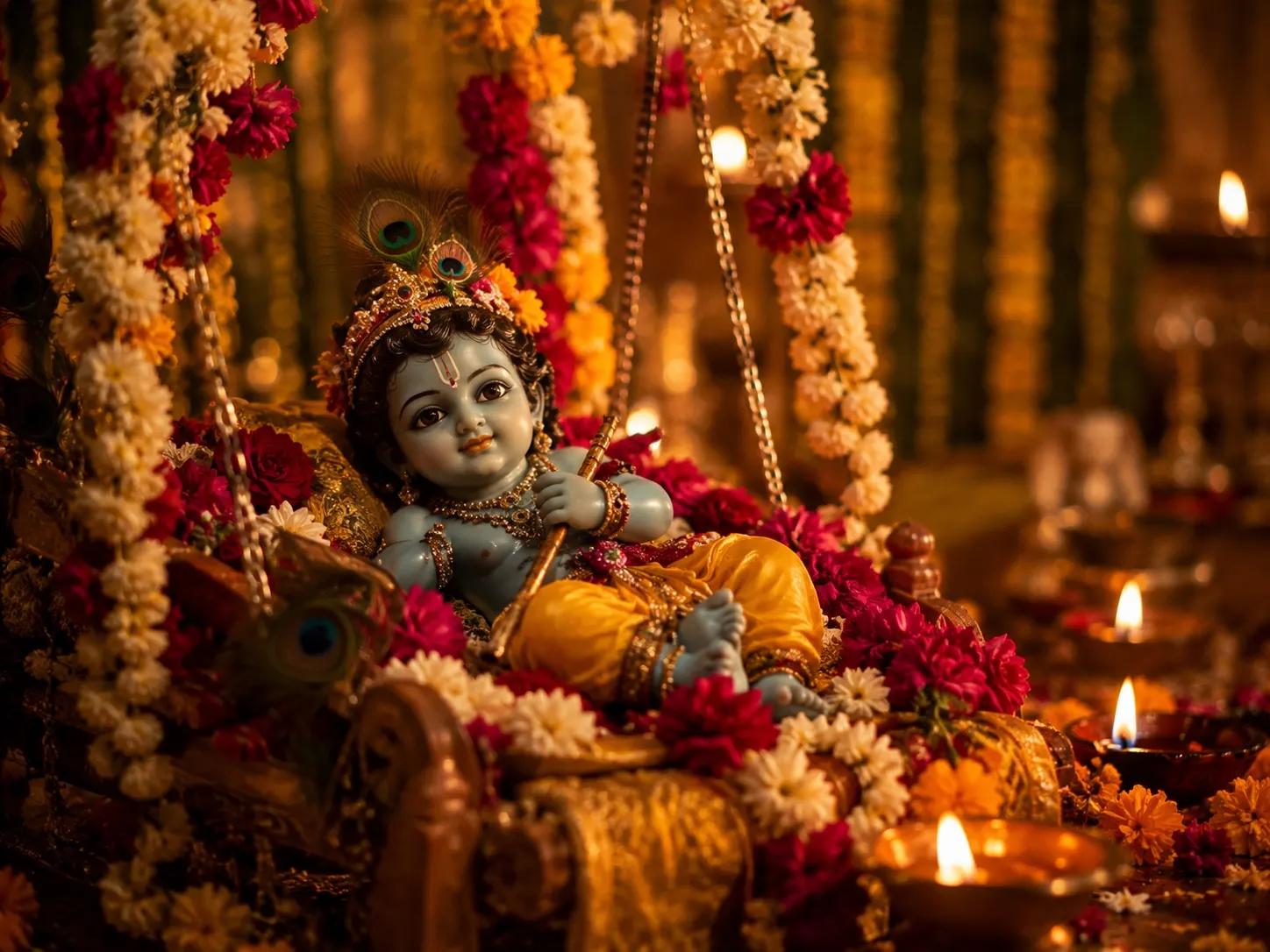
- The house is preparedA cradle is set up, tiny footprints in rice flour are sometimes drawn from the door inward, and sweets are made — butter, milk-based mithai, and in the south, seedai and murukku.
- The midnight worshipThe infant image is bathed in milk, curd, honey and ghee, dressed, laid in the cradle and rocked. The conch is blown; songs are sung; the fast is broken.
- Dahi handi, the next dayIn Maharashtra and parts of Gujarat, teams build a pyramid to break a pot of curd strung above the street.
How this changes across India
Janmashtami in Mathura, Vrindavan and Braj
The festival's home ground. Temples hold night-long worship, and the Krishna Lila performances run for days around it.
Janmashtami in Maharashtra
Gokulashtami, dominated by dahi handi the following day; large organised competitions in Mumbai and Thane, with a minimum participant age of 14 and no court-imposed height limit since 2017.
Janmashtami in Gujarat
Fasting and night worship, with Makhan Handi pot-breaking; Dwarka's temple observance draws large crowds.
Janmashtami in Tamil Nadu
Gokulashtami: rice-flour footprints drawn from the doorway to the puja room, and specific savoury sweets — seedai, murukku, appam — made for the day.
Janmashtami in Odisha and Bengal
Fasting and midnight worship, with Nanda Utsav the following day; in Bengal, readings from the Bhāgavata.
Janmashtami in Manipur
Kept by the Vaishnava Meitei tradition with night worship and raas dance forms distinctive to the region.
Keeping it abroad
The midnight timing is the difficulty. A vigil that ends at one in the morning on a Tuesday is hard to keep with school and work the next day, and most diaspora households compress it: an evening puja with children present, the cradle rocked before bed, and the actual midnight moment marked by whoever is still awake.
Temples abroad usually hold the full observance, and it is one of the better festivals to take children to precisely because the ritual is legible — there is a baby, a cradle, and food that was withheld all day and is now allowed.
Questions people ask
Why are there two dates?
Because the observance depends on two things at once — the eighth lunar day and the Rohini nakshatra — and the two do not always coincide. The two rules are different, not vague. Smarta practice takes the night whose *nishita* window, the middle of the night, carries the eighth tithi. Vaishnava practice takes the day whose *sunrise* carries the eighth tithi with Rohini alongside it, and refuses a day whose sunrise is still the seventh. The sunrise test is the later of the two, which is why the Vaishnava date falls a day after the Smarta one when they diverge. Neither is wrong, and families follow whichever their tradition has always followed.
What happens at midnight?
The image of the infant Krishna is bathed, dressed and placed in a cradle, which is rocked; a conch is blown; sweets made that day are offered and then eaten, and the day's fast is broken. Temples in Mathura and Vrindavan hold a full night of it.
What is dahi handi about?
It re-enacts the child Krishna and his friends stealing curd hung out of reach. A pot is strung high over a street and teams build a human pyramid to break it. In Mumbai it became a large competitive event with sponsorship and prize money, and injuries are common. The legal position has moved and is often reported out of date: the Bombay High Court capped pyramids at twenty feet and barred under-18s in 2014, but removed the height cap in 2017 after the state classified the event as an adventure sport, and the minimum age now stands at 14. Maharashtra has since treated it as an official sport and insures registered participants.
Do people fast the whole day?
Many do, on fruit and milk, and break it after the midnight worship. Others keep a partial fast or none. As with most Hindu fasting there is no single rule, and health, age and pregnancy are ordinary reasons to keep a lighter version.
Sources (3)
- Bhāgavata Purāṇa, book 10 — For the birth narrative, the escape to Gokul, and the childhood episodes
- Harivaṃśa — For an earlier layer of the Krishna story
- Printed panchang for the year and location — For which night carries the observance under each tradition
Fact-checked by Ajay Gupta on 7 September 2026.
Something wrong here? Tell us — corrections are made in the open, and our editorial standards set out what checking a page involves.