Spirituality
Bhagavad Gītā: a beginner's guide
A dialogue reported at second hand, on a battlefield, that its three greatest commentators could not agree about.
The short answer
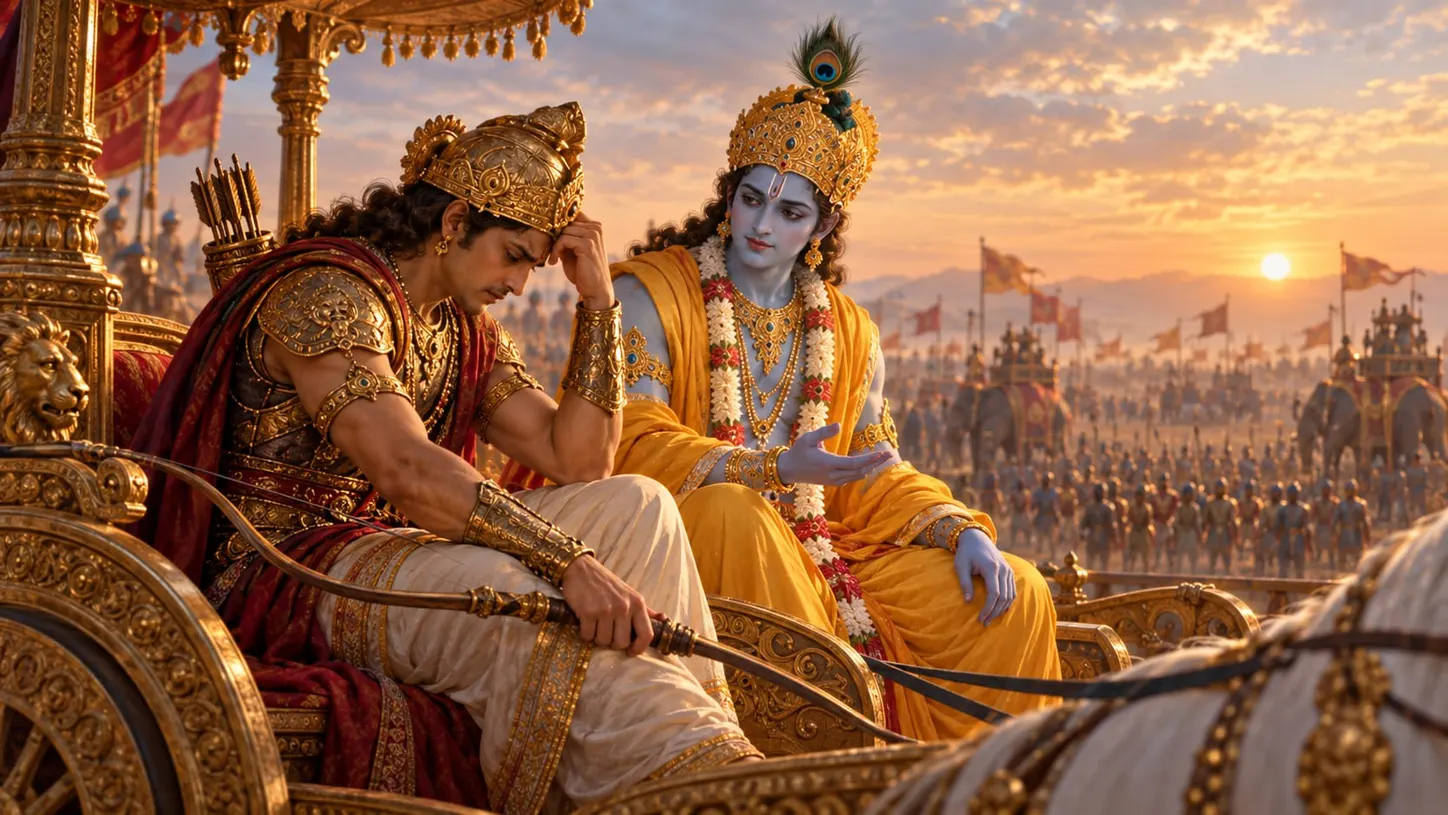
The Bhagavad Gītā is a dialogue between Krishna and Arjuna set in the Bhīṣma Parva of the Mahābhārata, reported by the narrator Sanjaya. Beginning with Arjuna's moral collapse before the Kurukshetra war, it develops into a discussion of action, dharma, knowledge, devotion, the Self and liberation. It has 18 chapters and about 700 verses, and Śaṅkara, Rāmānuja and Madhva read it in significantly different ways.
Key facts
- Where it sits
- Inside the Bhīṣma Parva of the Mahābhārata — not a standalone book, though it circulates as one
- Length
- 18 chapters, about 700 verses in the received text. Other recensions exist; the Kashmiri version runs somewhat longer
- Who is speaking
- The whole dialogue is reported speech. Sanjaya is answering the blind king Dhṛtarāṣṭra, and closes in his own voice in chapter 18
- Dating
- Traditionally ascribed with the epic to Vyāsa. Scholarly estimates run roughly from the 2nd century BCE to the 2nd century CE
- The three commentaries
- Śaṅkara (Advaita), Rāmānuja (Viśiṣṭādvaita), Madhva (Dvaita) — working from identical Sanskrit and reaching incompatible conclusions
Where it sits, and who is speaking
The Gītā is among the most influential religious and philosophical texts of India, and its setting is unusual: the teaching begins on a battlefield rather than in a monastery.
Arjuna asks Krishna, his charioteer, to place their chariot between the two armies. Seeing relatives, teachers and friends on the opposing side, his resolve collapses.
A detail most standalone editions lose: the entire dialogue is reported speech. The Gītā opens with the blind king Dhṛtarāṣṭra asking what his sons and the Pāṇḍavas did on the field, and everything that follows is Sanjaya's answer, delivered at a distance and closing in Sanjaya's voice in chapter 18. You hear Krishna and Arjuna through a narrator.
The text sits within the Bhīṣma Parva of the Mahābhārata and runs to 18 chapters and about 700 verses in the received form. Other recensions exist; the Kashmiri version is somewhat longer.
Tradition ascribes it, with the epic, to Vyāsa. Scholarly estimates place its composition roughly between the second century BCE and the second century CE, the dating complicated by the epic's own long history.
It later circulated widely as a standalone work. Its modern standing as the representative Hindu scripture was strengthened substantially in colonial and nationalist-era reception, when reformers and political figures presented it as a concise statement of Hindu thought. That prominence is real, but it should not be projected backward.
The argument, in the order it arrives
Krishna's reply runs to seventeen chapters, and it does not come in the order most summaries give it. Verse numbers are marked throughout so you can check any of this against whichever translation you are holding; the quoted wording is Telang's, for the reason set out at the foot of this page.
Arjuna refuses. Gītā 1.28–47 presents his collapse. By 2.7 he says his understanding of dharma is confounded — dharma-sammūḍha-cetāḥ — and asks Krishna to teach him as a student. The text begins in uncertainty, which is a large part of why it has lasted.
The self is not what dies. Krishna's opening move is not about duty at all. It is metaphysical, and it is blunt (2.11–2.30): the thing Arjuna is grieving over is not the thing actually at stake.
It is not born, nor does it ever die … it is not killed when the body is killed.
Bhagavadgītā 2.20, tr. Telang
Lifted out of the argument around it, this is the most easily misused passage in the text.
And the fight is his to fight. Then a second argument, which readers who meet the Gītā through its modern admirers often never encounter: Arjuna is a warrior, this work is his own, and walking away would bring disgrace rather than honour (2.31–2.38). The martial case is made plainly, and made early.
So the question becomes how. Only now does the formula everyone knows arrive — niṣkāma karma, action performed because the situation requires it, without grasping at a particular result (2.47–2.48).
Your business is with action alone; not by any means with fruit. Let not the fruit of action be your motive (to action).
Bhagavadgītā 2.47, tr. Telang
The result is not yours to control. The action is.
Withdrawal is not on offer. Arjuna is unpersuaded and opens chapter three by asking again: if knowledge is the better thing, why push him into a horrible deed? Krishna's answer is that abstention is not a position anyone can occupy (3.3–3.8). Refusing to fight is itself an act with consequences, and merely keeping a body alive requires acting.
For nobody ever remains even for an instant without performing some action; since the qualities of nature constrain everybody, not having free-will (in the matter), to some action.
Bhagavadgītā 3.5, tr. Telang
And there is more than one road. Gītā 3.3 describes two long-established orientations — a discipline of knowledge for those inclined to contemplation, and a discipline of action for those inclined to work. Devotion grows more prominent as the text proceeds: 12.6–8 describes those who dedicate their actions to Krishna and fix their minds on him as especially dear to him.
Whether these are equal roads or a ranked sequence is one of the things the commentators disagree about. The familiar four-path scheme of karma, bhakti, jñāna and rāja yoga is a modern arrangement, not the Gītā's own.
With a theophany in the middle. In chapter eleven Krishna grants Arjuna a vision of his universal form, in which worlds, beings and destruction appear together. Arjuna is frightened rather than consoled (11.15–11.31).
I am death, the destroyer of the worlds, fully developed, and I am now active about the overthrow of the worlds.
Bhagavadgītā 11.32, tr. Telang
This is where the text stops being a philosophical dialogue and becomes something else. Any reading that treats the Gītā as pure ethics has to account for it.
And it ends in surrender. Chapter eighteen returns to action, and to the claim that one's own work badly done is better than another's done well (18.45–18.48). Its most discussed passage is 18.66, the call to take refuge, which Śrīvaiṣṇava tradition treats as the caramaśloka — the final verse.
Is it about war?
The battlefield is real within the Mahābhārata narrative and should not be dissolved into pure metaphor. At the same time, the dialogue expands well past military duty into action, grief, knowledge, devotion, meditation, God and liberation.
The setting is what makes those questions urgent. Arjuna cannot postpone them.
Śaṅkara, Rāmānuja and Madhva did not read the same Gītā
The Gītā's history is partly the history of its commentaries, and the three most influential differ substantively. All three work from identical Sanskrit.
Śaṅkara — Gītā Bhāṣya, the earliest extant commentary — reads the text through Advaita Vedānta. His central move is the rejection of jñāna-karma-samuccaya, the combination of knowledge and ritual action as a joint means to liberation. Action purifies and qualifies; knowledge alone liberates.
Rāmānuja reads it through Viśiṣṭādvaita. The individual self is real and eternally related to the Supreme as body to embodied. Karma yoga is a valid continuing discipline, and devotion is not a lesser path for the unqualified. He gives decisive weight to 18.66.
Madhva — Gītā Bhāṣya and Gītā Tātparya — reads it through Dvaita, holding the distinction between God and individual souls to be real and permanent, so that no reading of the text can end in identity.
This page describes how each reads the Gītā. Which account of reality is correct is a different question, and not one this page answers.
If you read the Gītā with a commentary, you are reading one of these arguments. It is worth knowing which.
Why it has lasted
Its questions remain recognisable. How does one act when every option carries a cost? How much should outcome govern one's sense of self? What is owed, and to whom?
The Gītā's power lies partly in declining to reduce those questions to a single answer — which is why its major commentators could disagree so thoroughly while all claiming the text.
How this changes across India
| Where | What differs |
|---|---|
| Tamil Nadu (Śrīvaiṣṇava) | Read through Rāmānuja, with the Tamil devotional tradition of the Āḻvārs beside it; the Gītā sits within a larger devotional canon rather than standing alone. |
| Kerala and the Śaṅkara tradition | Read through Advaita commentary; often approached after the Upanishads rather than before them. |
| Maharashtra | The Jñāneśvarī, Jñāneśvar's thirteenth-century Marathi commentary, is for many households the Gītā — read and recited in Marathi rather than Sanskrit. |
| Bengal (Gauḍīya) | Read with Krishna as the supreme person; 18.66 is central, and Chaitanya's tradition shapes the emphasis. |
| Gujarat and the north | Strong association with Gandhi's Anāsakti Yoga reading, in which the war is understood allegorically as the struggle within. |
A note on the quotations
The English quoted above is Kāshināth Trimbak Telang's, published in 1882 as volume 8 of the Sacred Books of the East. It is quoted here because it is out of copyright, so this page can print it in full rather than paraphrasing around a translation it is not free to reproduce.
That is a licensing reason, not a recommendation. Telang is Victorian, literal to the point of stiffness, and his parenthetical insertions — not by any means with fruit, (to action) — are him filling gaps in the Sanskrit, which is honest of him and awkward to read. For actually reading the Gītā, start with Barbara Stoler Miller's translation.
One consequence worth knowing: Telang's text runs as continuous prose without verse numbers. The numbers on this page are the standard numbering of the Sanskrit, which every translation shares, so they will find the passage in any edition — but you will not see them printed in Telang himself.
What this page does not cover
- Karma as doctrine — What is karma?
- Dharma and svadharma — What is dharma?
- Liberation — What is moksha?
- The Gītā read as a text about work — The Gītā on work
- Atman, and adjudication between the Vedānta schools — both forthcoming; meanwhile Vedānta sets out what the schools disagree about
Questions people ask
Who wrote the Bhagavad Gītā?
Tradition ascribes it, with the Mahābhārata as a whole, to Vyāsa. Scholars place its composition roughly between the second century BCE and the second century CE, with the dating debated and complicated by the epic's long compositional history.
How long is it?
Eighteen chapters and about 700 verses in the commonly received text. Other recensions exist — the Kashmiri version runs somewhat longer.
Is it a standalone book?
It circulates as one and has done for centuries, but it is part of the Mahābhārata's Bhīṣma Parva. Van Buitenen argued it is a creation of the epic itself rather than a work that wandered into it later.
Is the Gītā the Hindu Bible?
No. Its standing as *the* representative Hindu scripture owes a great deal to colonial and nationalist-era reception, when reformers and political figures presented it as a concise statement of Hindu thought. That prominence is real but should not be projected backward — Hindu textual authority has always been plural, spanning Vedas, Upanishads, epics, Purāṇas, Āgamas and sectarian scriptures.
Does the Gītā tell everyone to fight?
No. Arjuna's situation is particular and the text issues no general licence for violence. Nor should the battlefield be erased into pure metaphor. The live question is why Krishna concludes that withdrawal is not Arjuna's dharma in this setting — debated for centuries, including by readers who reached pacifist conclusions from the same text.
Which translation should I read?
For reading rather than citation, Barbara Stoler Miller's is readable and scholarly. This page quotes Telang's 1882 translation for a licensing reason, not a recommendation — see the note at the foot.
Sources (9)
- Bhagavad Gītā, especially chapters 1–3, 11, 12 and 18; Mahābhārata, Bhīṣma Parva — The primary text, with verse numbers given throughout so any quotation can be checked
- Kāshināth Trimbak Telang, tr., The Bhagavadgītā, Sacred Books of the East vol. 8 (Oxford, 1882) — The translation quoted on this page; public domain, and quoted for that reason rather than as the recommended reading
- Śaṅkara, Gītā Bhāṣya — The earliest extant commentary, and the Advaita reading
- Rāmānuja, Gītā Bhāṣya — For the theistic reading, which differs sharply from Śaṅkara's on the same verses
- Madhva, Gītā Bhāṣya and Gītā Tātparya — For the Dvaita reading, in which no interpretation can end in identity
- J.A.B. van Buitenen, The Bhagavadgītā in the Mahābhārata (University of Chicago Press, 1981) — For the dating, the recensions, and the argument that the Gītā is a creation of the epic rather than a work that wandered into it
- Angelika Malinar, The Bhagavadgītā: Doctrines and Contexts (Cambridge University Press, 2007) — For the doctrines read against their epic setting
- Richard H. Davis, The Bhagavad Gita: A Biography (Princeton University Press, 2014) — For the reception history, including the nineteenth- and twentieth-century reinterpretations
- Barbara Stoler Miller, The Bhagavad-Gita: Krishna's Counsel in Time of War — For a readable English text with a scholarly introduction
Fact-checked by Ajay Gupta on 7 September 2026.
Something wrong here? Tell us — corrections are made in the open, and our editorial standards set out what checking a page involves.