Sacred India
Varanasi — the city, the ghats, and what happens there
A city organised around dying well, which is not what most visitors arrive expecting.
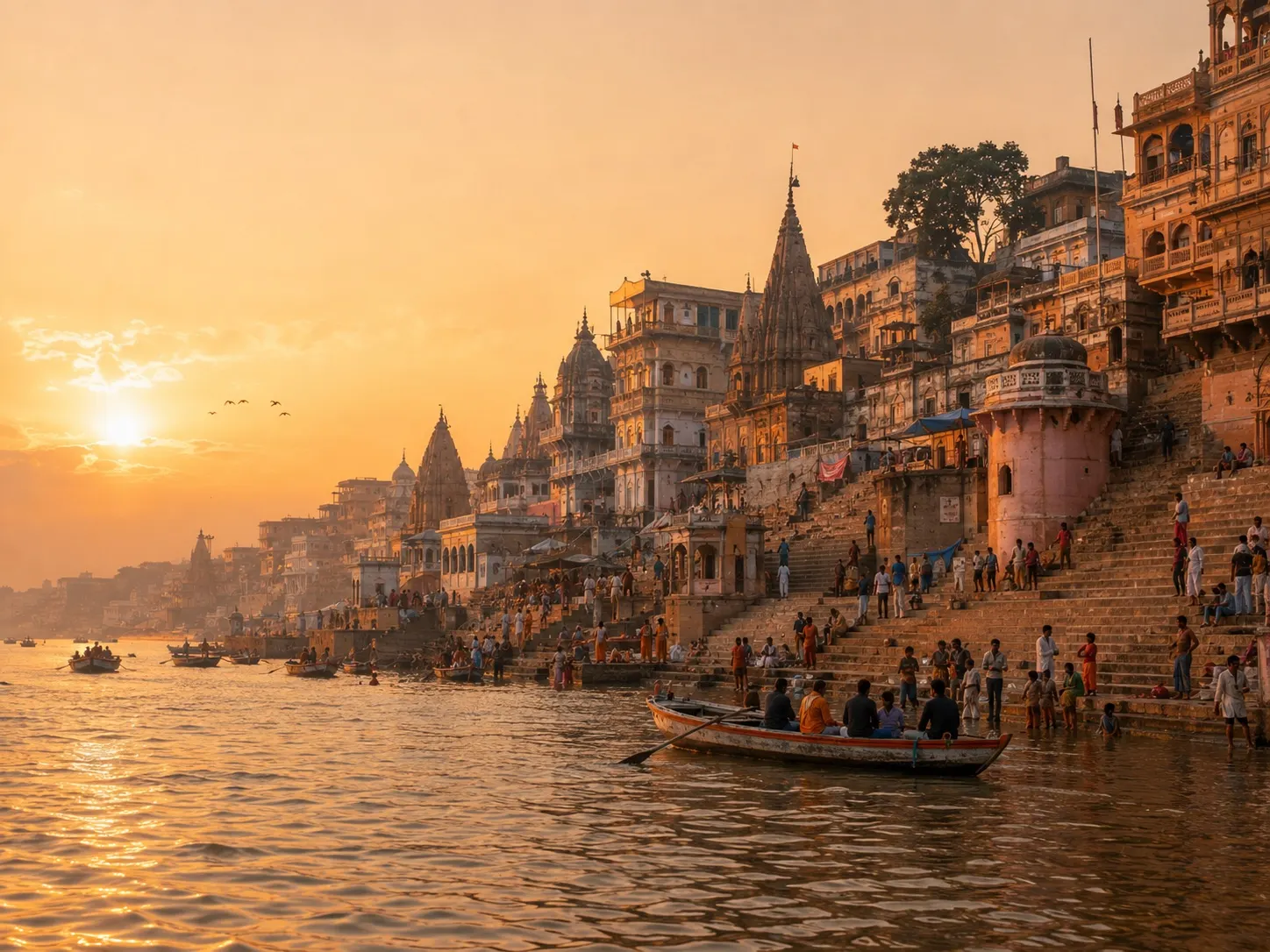
The short answer
Varanasi is held to be Shiva's city and a place where dying brings release from rebirth. Its eighty-odd ghats are working religious infrastructure — for bathing, for worship, and at two of them, for cremation, which happens continuously and in public.
Key facts
- Also called
- Kāśī, the city of light; Banaras or Benares; Avimukta, 'the never-forsaken', in older texts
- Presiding deity
- Shiva as Vishwanath; the Kashi Vishwanath temple is one of the twelve Jyotirlingas
- Why people come
- Bathing in the Ganga, worship, śrāddha rites for the dead, and to die in the city, which is held to grant mokṣa
- The ghats
- Eighty-four stepped embankments along the western bank — a traditional figure rather than a count; Dashashwamedh and Assi are the busiest, Manikarnika and Harishchandra are the cremation ghats
Before you go
- best time
- October to March. Summer is punishing and the monsoon floods the lower steps
- dress
- Covered shoulders and knees. Modest clothing matters more here than in most Indian cities
- photography
- Not at the cremation ghats. Treated as prohibited rather than discouraged — police complaints over images from Manikarnika are filed most years, and people present will stop you
- the river
- Faecal coliform at the ghats runs well above the CPCB bathing criterion of 2,500 MPN/100 ml. Pilgrims bathe; visitors should think carefully
Timings and rules at living temples change, and are set by the temple, not by us. Check with the temple before travelling.
Why here
Varanasi is very old, though not as old as the tourist literature says. Excavation at Rajghat, on the northern edge of the modern city, puts the earliest settlement at around the 8th century BCE — which makes it a contemporary of other early historic cities rather than the oldest of anything. Its claim on Hindu imagination is specific rather than general: it is Shiva's city, and it is a good place to die.
The tradition holds that the city sits outside ordinary space — that Shiva never abandons it, and that death within its boundary brings release from the cycle of rebirth. That single belief organises much of what a visitor sees: the death hostels — Mukti Bhawan and others, which are inland in the city rather than on the river — the constant funeral processions through the lanes, and the fact that the cremation grounds are not on the outskirts but at the centre of the waterfront.
The ghats
Eighty-four stepped embankments run along the western bank — a figure that is traditional rather than counted, twelve times seven, and actual tallies land anywhere from 84 to 88. They are working infrastructure rather than a view.
At dawn they fill with people bathing, priests under palm umbrellas, wrestlers, laundry, and boats. Through the day they are also where barbers work, where śrāddha rites for the dead are performed, and where the city's religious business is conducted in the open.
Two of them are cremation ghats. Manikarnika is the larger and burns continuously; Harishchandra is smaller and has an electric crematorium alongside. Wood is stacked in tiers above the steps and sold by weight, and the economics of a funeral there are visible to anyone standing nearby.
What to do, and what not to
Do take a boat at dawn. The river gives you the city's whole face at once, and early morning is when the ghats are doing what they are for rather than performing.
Do walk the lanes behind the ghats. The old city is a dense grid of alleys, shrines and shops, and the Kashi Vishwanath temple sits within it — since December 2021 surrounded by the Kashi Vishwanath Dham corridor, which cleared a great deal of the older fabric and about which locals hold strong and divided views. Manikarnika is being rebuilt on the same pattern as this page is written, with new pyre platforms and a designated viewing area, so the ghat you arrive at may not be the one described here.
Do not photograph cremations, or the mourners. Do not accept a guide who appears beside you at Manikarnika and offers to take you to the "best view" or asks for a donation for wood for the poor; this is a standard and persistent scam.
Do not treat the aarti as the point of the city. It is a nightly ceremony with a crowd; the more interesting thing is what happens at six in the morning.
How this changes across the sacred geography
| Place | What differs |
|---|---|
| Varanasi | Death and liberation. The whole city is organised around a claim about dying, and the cremation grounds are central rather than peripheral. |
| Haridwar and Rishikesh | The Ganga where it leaves the mountains — bathing and ashram life rather than death rites, and a very different atmosphere. |
| Gaya | Śrāddha rites for ancestors specifically; people come to perform them for the dead rather than to die. |
| Prayagraj | The confluence, and the Kumbh Mela cycle; a periodic sacred centre rather than a continuous one. |
| Ujjain | Another Jyotirlinga city with its own Kumbh, and the bhasma aarti at Mahakaleshwar, where ash from the cremation ground is used in worship. |
Questions people ask
Can I watch a cremation?
You can be present at a distance and quietly, and people are, including visitors. What you must not do is photograph, film, approach the pyres, or accept an offer from someone to guide you closer for a fee — that last is a well-known scam that preys on discomfort.
What is the Ganga aarti?
A nightly ritual of lamps offered to the river, performed at Dashashwamedh ghat by trained priests to a large crowd, and in smaller form at Assi. It is genuinely devotional and it is also a spectacle with a boat-hire economy around it; both descriptions are accurate.
Is the water safe to bathe in?
Well above the bathing standard, repeatedly and by a wide margin. The Central Pollution Control Board's criterion for outdoor bathing is 2,500 MPN of faecal coliform per 100 ml; readings at Varanasi have run several times that and occasionally an order of magnitude higher. Official and academic measurements of the same stretch routinely disagree, so treat any single figure with care. Pilgrims bathe regardless, as an act of faith. A visitor who is not doing it for that reason has no comparable reason to accept the risk.
Why do people come here to die?
The tradition holds that dying within the sacred boundary of Kashi brings release from the cycle of rebirth — in one account, because Shiva himself speaks the liberating word into the ear of the dying. Hospices near the ghats exist specifically for people who have come for this.
Sources (3)
- Diana Eck, Banaras: City of Light — The standard scholarly treatment of the city's sacred geography
- Kāśī Khaṇḍa of the Skanda Purāṇa — For the traditional account of the city's sanctity and its boundary
- Central Pollution Control Board, primary water quality criteria for outdoor bathing, and Ganga monitoring at Varanasi — For measured water quality at the bathing ghats
Fact-checked by Ajay Gupta on 7 September 2026.
Something wrong here? Tell us — corrections are made in the open, and our editorial standards set out what checking a page involves.