Sacred India
The 12 Jyotirlingas and why they matter
Twelve shrines spread from Gujarat to Tamil Nadu, held to be places where Shiva appeared as a column of light.
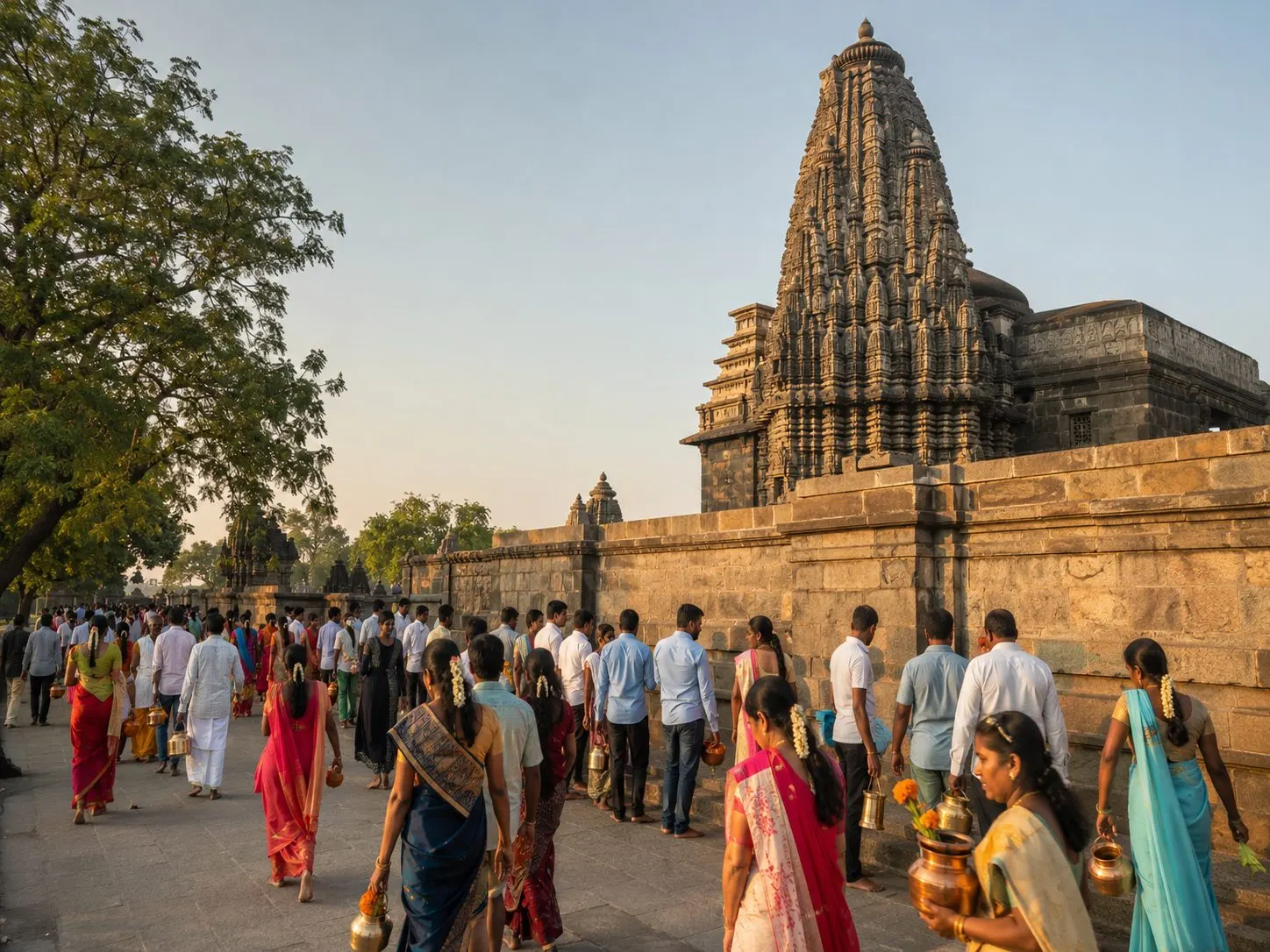
The short answer
A Jyotirlinga is a shrine where Shiva is held to have manifested as an infinite column of light. Twelve are recognised across India, from Somnath in Gujarat to Rameswaram in Tamil Nadu, and visiting all twelve is a recognised pilgrimage undertaken over years.
Key facts
- What it means
- Jyotir-liṅga — the liṅga of light; the form in which Shiva is said to have appeared as a pillar without beginning or end
- How many
- Twelve, listed in the Śiva Purāṇa; local traditions sometimes identify a shrine differently, and two entries are disputed between sites
- The list
- Somnath, Mallikarjuna, Mahakaleshwar, Omkareshwar, Kedarnath, Bhimashankar, Kashi Vishwanath, Trimbakeshwar, Vaidyanath, Nageshwar, Rameswaram, Grishneshwar
- Spread
- Gujarat (two), Andhra Pradesh, Madhya Pradesh (two), Uttarakhand, Maharashtra (three), Uttar Pradesh, Jharkhand, Tamil Nadu
- Seasonality
- Kedarnath is open roughly May to November only; the rest are open year-round, with Shivaratri the peak everywhere
What a Jyotirlinga is
The story is in the Shiva Purana. Brahma and Vishnu fell into an argument about which of them was supreme. Shiva appeared between them as a column of light with no visible top or bottom, and told them to find its ends. Vishnu went down, Brahma went up; neither found anything. Brahma claimed he had, and was cursed for lying.
A Jyotirlinga is a place where that column is held to have manifested. Not a representation of it — a site of appearance, which is why the pilgrimage is to places rather than to objects.
The twelve, and where they are
| Shrine | Where | Worth knowing |
|---|---|---|
| Somnath | Prabhas Patan, Gujarat | On the coast; destroyed and rebuilt many times, most recently in 1951, and heavily freighted with modern political meaning. |
| Mallikarjuna | Srisailam, Andhra Pradesh | In forested hills above the Krishna; also a Shakti Peetha, which is unusual. |
| Mahakaleshwar | Ujjain, Madhya Pradesh | The bhasma aarti at dawn, using ash; one of the four Kumbh Mela cities. |
| Omkareshwar | Mandhata island, Madhya Pradesh | On an island in the Narmada shaped, by tradition, like the syllable Om. |
| Kedarnath | Uttarakhand | The highest, seasonal, reached on foot; see Kedarnath. |
| Bhimashankar | Sahyadri hills, Maharashtra | In a wildlife sanctuary; a walk in, and green in a way none of the others are. |
| Kashi Vishwanath | Varanasi, Uttar Pradesh | In the old city; see Varanasi. |
| Trimbakeshwar | Nashik, Maharashtra | At the source of the Godavari; a Kumbh city. |
| Vaidyanath | Deoghar, Jharkhand — also claimed at Parli, Maharashtra | The Shravan month kanwar pilgrimage brings enormous crowds carrying Ganga water. |
| Nageshwar | Claimed by three sites: near Dwarka (Gujarat), Aundha Nagnath (Maharashtra), Jageshwar (Uttarakhand) | The Dwarka temple is the one most pilgrims visit, and is coastal, close to the Dwarka circuit. |
| Rameswaram | Tamil Nadu | Long corridors and 22 sacred wells; the southern anchor of the pan-Indian pilgrimage. |
| Grishneshwar | Near Ellora, Maharashtra | The smallest; next door to the Ellora caves, which most visitors combine. |
What the network does
Look at the map and something becomes obvious: the twelve are distributed across the subcontinent — north, south, east, west, coast, mountain, river.
That distribution is the point. Networks of shrines like this one — and the Shakti Peethas, and the Char Dham — knit a very large and politically fragmented territory into a single religious geography. A pilgrim from Tamil Nadu who undertakes the twelve travels to Gujarat, Uttarakhand and Jharkhand, and a Gujarati pilgrim ends up in Rameswaram.
Long before there was an Indian state, this is one of the things that made India a coherent space to think in.
Doing the pilgrimage
Most people do not do it in one journey. It accumulates: a shrine visited on a family trip, two more on a wedding journey, Kedarnath when someone in the family is fit enough to walk.
The practical constraints, if you are planning it deliberately:
- Kedarnath sets the calendar. It is open roughly May to November and needs a trek or a helicopter.
- Shivaratri is the peak everywhere. Extraordinary, and the queues are extraordinary too.
- Several cluster usefully. Grishneshwar with Ellora; Trimbakeshwar with Nashik; Somnath with Dwarka and Nageshwar; Omkareshwar with Mahakaleshwar.
- The Shravan month brings the kanwar pilgrimage in the north, with roads carrying very large numbers of walkers.
Questions people ask
What is the story behind the light?
Brahma and Vishnu argued over which of them was supreme. Shiva appeared between them as a column of light with no visible beginning or end, and challenged them to find its ends. Neither could. The Jyotirlingas mark places where that column is held to have manifested.
Are all twelve agreed on?
Nine are uncontested. Three are claimed by more than one site. Vaidyanath is identified with Deoghar in Jharkhand, with Parli in Maharashtra, and by some with Baijnath in Himachal Pradesh. Nageshwar is claimed by the temple near Dwarka in Gujarat, by Aundha Nagnath in Maharashtra, and by Jageshwar in Uttarakhand. And at Omkareshwar the question is which of two shrines on the same site carries it — the island temple or Mamleshwar on the south bank — often resolved as two halves of one linga. Different traditions and regions settle these differently, and this site does not adjudicate between them.
How long does the full pilgrimage take?
There is no fixed itinerary. Some people take a month-long organised tour; many more visit them over a lifetime, a few at a time, as travel allows. Kedarnath is the constraint, being seasonal and requiring a trek.
What is offered at a Jyotirlinga?
The same as at any Shiva shrine — water, milk, curd, honey, ghee and sugar poured over the linga, with bilva leaves. Tulsi is not offered to Shiva, and turmeric is generally avoided on the linga. Several of these temples restrict who may touch the linga directly.
Sources (3)
- Śiva Purāṇa, Koṭirudra Saṃhitā — For the Jyotirlinga list and the narratives attached to each site
- Diana Eck, India: A Sacred Geography — For how such networks of shrines organise Indian sacred space
- Archaeological Survey of India records for Somnath, Grishneshwar and Mahakaleshwar — For the physical history of individual sites, which differs from the traditional accounts
Fact-checked by Ajay Gupta on 7 September 2026.
Something wrong here? Tell us — corrections are made in the open, and our editorial standards set out what checking a page involves.