Festivals
Maha Shivaratri — the night vigil
Most of what people picture as an Indian festival is absent from the core of this one: its form is staying awake. Though where there are processions — Mandi, Junagadh, a Shiva barat through a north Indian town — they are considerable.
The short answer
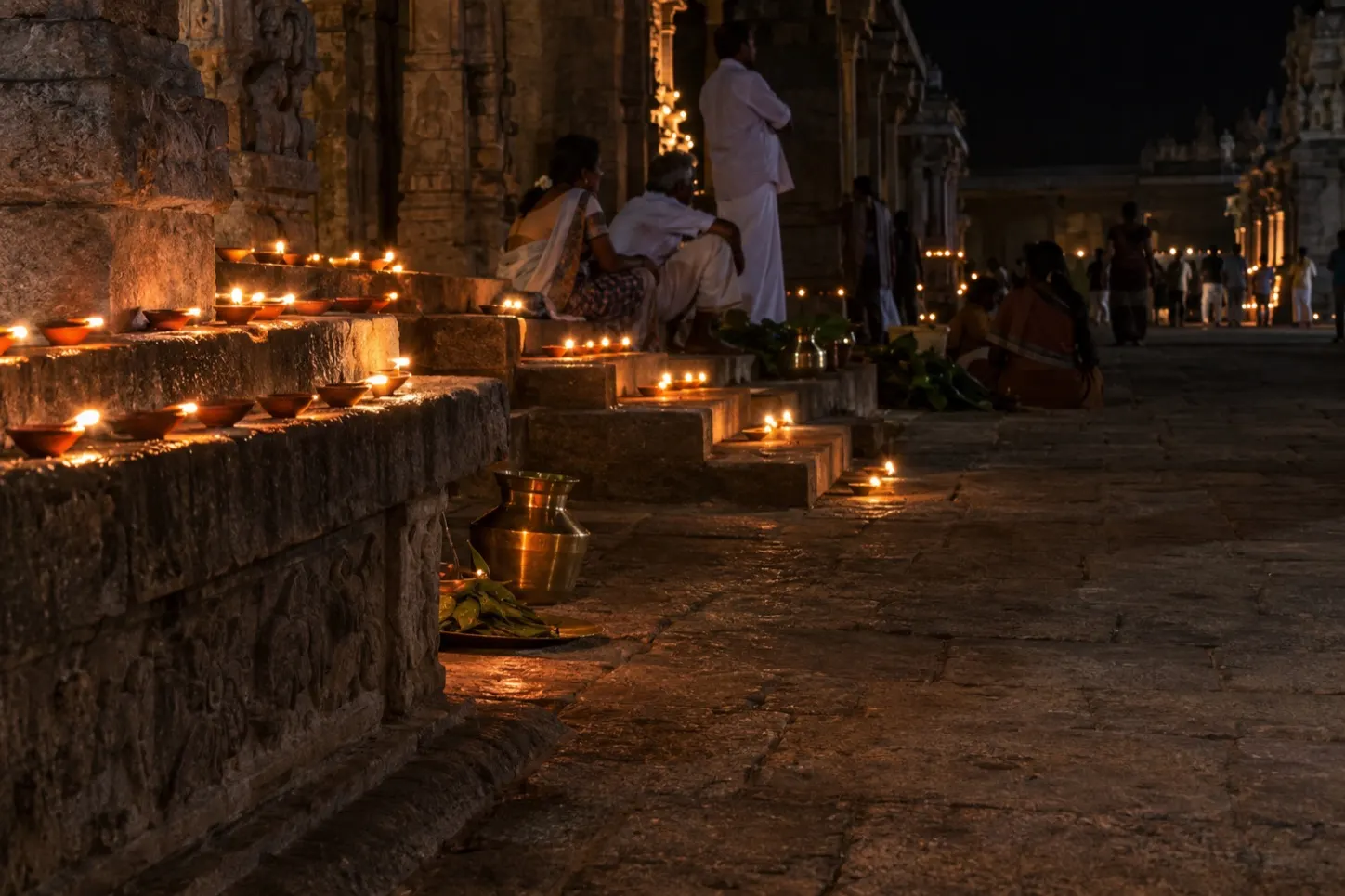
Maha Shivaratri is a night-long vigil to Shiva on the fourteenth night of the waning fortnight — the month is called Phalguna in the north and Magha in the south, for the same night. In most observing households people fast through the day, stay awake through the night, and offer water, milk and bilva leaves on the linga in four watches until dawn.
Key facts
- Also called
- Mahāśivarātri, the great night of Shiva; Herath in Kashmir; Sivarathri in the south
- When
- The fourteenth night of the waning fortnight, most often February or March. Under the north's purnimanta reckoning that month is called Phalguna; under the south's amanta reckoning the same night falls in Magha — one night, two month names
- Kept by
- Staying awake through the night, fasting through the preceding day, and worshipping in four watches
- Offered
- Water, milk, curd, honey, ghee and sugar over the linga; bilva (bael) leaves, and datura flowers. Datura is offered, never eaten — the plant is genuinely poisonous. Bhang is consumed in parts of North India, not everywhere
- Not offered
- Tulsi, which is not used in Shiva worship, and turmeric, which is generally avoided on the linga
The story
More than one, and the tradition is comfortable with that.
At the churning of the ocean, a poison surfaced that would have destroyed everything. Shiva drank it and held it in his throat, which turned blue — the night is kept in gratitude, and the gods stayed awake with him.
In another account it is the night of Shiva's marriage to Parvati. In a third, Shiva appeared as a column of light without beginning or end, which Brahma and Vishnu failed to find the ends of — the origin of the linga as a form.
A fourth, told in the Puranas as a story about the observance itself, concerns a hunter who spent a night in a bael tree, dropping leaves onto a linga below without knowing it was there, and fasting because he had caught nothing. The point of that story is that the vigil works even when it is accidental.
What it means
Almost every other Hindu festival is diurnal, social and full of food. Shivaratri is the opposite of all three: it is nocturnal, quiet, and defined by not eating and not sleeping.
That inversion is what the vigil is usually taken to be about. Shiva is the ascetic among the great deities — the one on the mountain, covered in ash, outside the ordinary social order — and the festival's form matches its subject. What is asked of the devotee is wakefulness, which in the tradition's own vocabulary is also what the practice of meditation asks for.
How it is kept
- The fastFrom sunrise on the day, water and fruit or nothing at all, broken the following morning.
- Abhisheka in four watchesThe linga bathed at each prahar of the night — water, then milk, curd, honey and ghee, with bilva leaves laid on it and the Panchakshara mantra recited.
- Staying awakeBhajans, recitation, temple queues that run all night, and in many places continuous chanting until dawn.
- Breaking the fastAfter the dawn worship. In much of the north the day after is ordinary; in some communities the fast breaks only after a final offering.
How this changes across India
Maha Shivaratri in Kashmir
Herath, a longer household festival among Kashmiri Pandits, running several days with distinctive rites centred on the vatuk pot — filled with water and walnuts, which are shared the next day. The main observance falls on the thirteenth of the fortnight rather than the fourteenth, and it is kept as Shiva and Parvati's wedding. The emphasis is domestic rather than temple-based.
Maha Shivaratri in Ujjain and the Jyotirlinga temples
Mass night-long queues. Mahakaleshwar's pre-dawn bhasma aarti runs every day of the year, not only at Shivaratri — what the festival changes is the size of the crowd, which is on a scale that requires planning. The temple also keeps a nine-day Shivnavratri run-up.
Maha Shivaratri in Tamil Nadu
Night-long temple worship, with Chidambaram and Tiruvannamalai as major centres; at Annamalaiyar the associated Karthigai Deepam is a separate festival but the same devotional world.
Maha Shivaratri in Nepal and the eastern border
Pashupatinath draws sadhus in large numbers, including many who travel from India for it, and the vigil there is the most visible ascetic gathering of the year.
Maha Shivaratri in Andhra and Telangana
Sivarathri jagarana at Srisailam and Kaleshwaram, with village temples keeping all-night recitation.
Maha Shivaratri in Diaspora temples
The four watches compressed into an evening programme, usually the nearest weekend, with a token late session for those keeping the full vigil.
If you are keeping it for the first time
Two practical notes. A full water fast plus a full night awake is a real physical demand — most households keep a fruit-and-milk version, and there is no tradition-wide rule that says otherwise. And if you are visiting a major Shiva temple on the night, expect queues measured in hours and plan for standing, water and heat, particularly at the Jyotirlinga temples.
Questions people ask
What is being commemorated?
Several things, and traditions differ. Shiva's marriage to Parvati; his drinking of the poison at the churning of the ocean, held in his throat; and his appearance as an infinite pillar of light. Some traditions treat it as the night Shiva performs the tāṇḍava. None is the single official reason.
Why four watches?
The night is divided into four *prahar*, and the full observance worships in each, with a fresh bathing of the linga at every watch. Households that cannot manage the whole night usually keep the first watch and the dawn.
Is bhang part of it?
In some traditions and at some temples, yes — cannabis is associated with Shiva in ascetic practice and is consumed as bhang at Shivaratri in parts of North India, Varanasi especially. The legal position is that the NDPS Act excludes the leaves from its definition of cannabis, so bhang is governed by state excise rules and licensed shops operate in some states and not others. One practical warning: eaten rather than smoked, it takes an hour or more to arrive and then lasts many hours, which is why visitors routinely misjudge it. Datura, which appears on the same offering tray, is not consumed at all — it is poisonous.
Can women keep this fast?
It is widely kept by women, and in several traditions unmarried women keep it specifically, associating it with Parvati's austerity to win Shiva. As with other fasts, practice varies and there is no obligation.
Sources (3)
- Śiva Purāṇa, Vidyeśvara and Koṭirudra saṃhitās — For the vigil, the linga worship, and the narratives attached to the night
- Skanda Purāṇa — For the pillar-of-light account and its temple associations
- Printed panchang for the year and location — For the night, which is fixed by the tithi at midnight rather than by the day
Fact-checked by Ajay Gupta on 7 September 2026.
Something wrong here? Tell us — corrections are made in the open, and our editorial standards set out what checking a page involves.