Cities
Gurugram, the Millennium City: How a Village Economy Became India's Corporate Launchpad
Gurugram is India's most visible experiment in private-led city-making: a former agricultural fringe that became North India's largest office market, a GCC magnet, and a daily test of whether talent can outrun infrastructure.
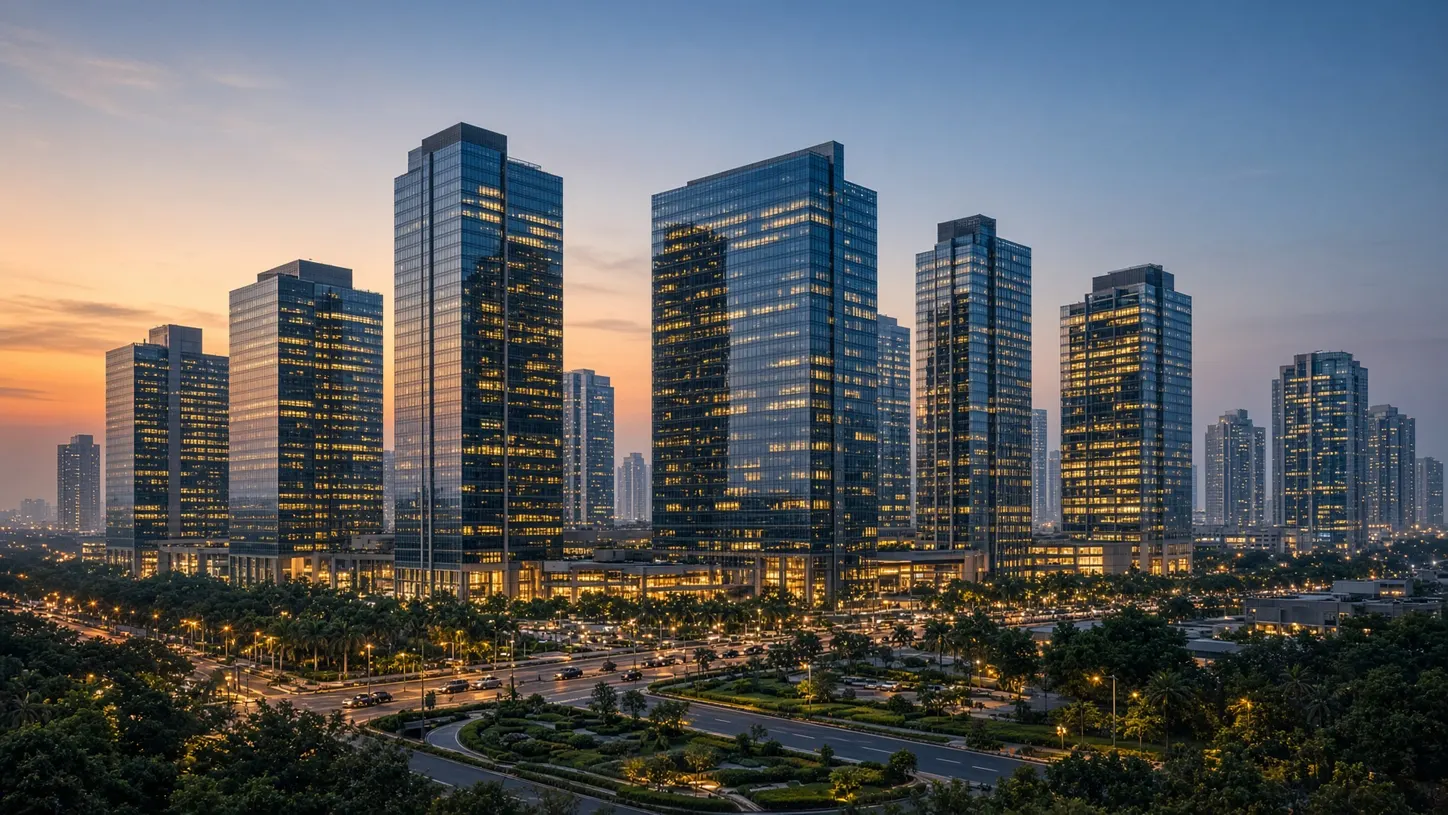
The short answer
Gurugram — still called Gurgaon in everyday speech — is North India's largest office market and the default address for global capability centres in the capital region. By mid-2026 it had more than 100 million square feet of office stock. The same private-led model that built Cyber City also left water, air and buses lagging the payroll.
Key facts
- Official name
- Gurugram (restored 2016). Everyday speech, HR portals and tickets still say Gurgaon.
- Also called
- Millennium City
- Office stock
- Crossed 100 million sq ft by mid-2026, the largest such market in North India. CBRE expects 120–125 million sq ft by 2030.
- Population
- 15.14 lakh in the 2011 Census; the urban agglomeration is now estimated near 30 lakh, with about 55 lakh projected by 2041.
- What it is for
- GCCs and product tech, consulting and BFSI, Indian IT services, and the Manesar–Sohna manufacturing rim — four labour markets on the same expressways.
- The centre of gravity
- DLF Cyber City — about 125 acres and more than 15 million sq ft of workspace, with Cyber Hub as the after-hours commons.
Ask a recruiter in Bengaluru where North India's best mid-career talent actually lives, and the answer is rarely "Delhi." It is Gurugram — still called Gurgaon in job posts, cab apps, and boardroom shorthand — the Haryana city that turned proximity to the capital into a self-contained corporate machine.
That machine is no longer a rumour. By mid-2026 Gurugram had crossed 100 million square feet of office stock, the largest such market in North India. Between 2021 and the first quarter of 2026 it leased about 40 million sq ft and added 21 million sq ft of new supply. CBRE expects the stock to reach 120–125 million sq ft by 2030. Roughly 59 million sq ft is now green-certified. International occupiers alone took more than 17 million sq ft over five years. Investment inflows into the city from 2018 to early 2026 were about USD 6 billion.
Those numbers explain the nickname "Millennium City." They do not explain how it feels to work here, who actually gets hired, or why the same glass towers that attract Google, Microsoft, American Express and Deloitte also sit above a city that floods, chokes on winter air, and still runs on private generators. This piece is for the professional who is considering a move, the founder sizing a GCC, and the reader who wants Gurugram without the brochure.
From Guru-gram to Gurgaon to Gurugram
The official story is older than the skyline. Local tradition links the land to Guru Dronacharya of the Mahabharata; the Pandavas are said to have given him a village as gurudakshina, hence Guru-gram. In 2016 the Haryana government restored that name as Gurugram. Everyday speech never fully followed. Residents, HR portals and airline tickets still say Gurgaon. Both names are correct in practice; Gurugram is the gazette name.
The economic story is more recent and less poetic. After Independence the area sat in Punjab; it became part of Haryana when the state was carved out in 1966. It was still a cluster of villages and a few old colonies when Maruti Suzuki planted a factory here in the late 1970s. That plant did two things at once: it created a manufacturing payroll, and it told private capital that land south of Delhi could be industrialised at speed.
The second shock was liberalisation plus developer-led urbanism. Unlike Noida, which was largely assembled by a public authority that laid drains and roads before selling plots, Gurugram grew as a mosaic of private townships and commercial islands — DLF's colonies first, then Cyber City, Golf Course Road, Udyog Vihar, Sohna Road, and later the Dwarka Expressway and Southern Peripheral Road belts. That model delivered Grade-A offices faster than almost any Indian city. It also left civic systems playing catch-up for three decades.
The 2011 Census counted 15.14 lakh people. Current official-facing estimates put the urban agglomeration near 30 lakh, with the Gurugram Metropolitan Development Authority projecting about 55 lakh by 2041. Haryana still draws a large share of its tax revenue from this one district. Growth is not a phase. It is the city's operating system.
The corporate map: not one hub, four economies
Gurugram is often described as an "IT city." That is incomplete. It is four overlapping labour markets sharing the same expressways.
1. Global capability centres and product tech. Haryana already hosts more than 270 GCCs — about 16 percent of India's GCC base — and an IT/ITeS economy valued above ₹1.55 lakh crore. The state's 2026 GCC policy aims to pull in 100 more centres and 30,000 jobs, with incentives aimed at AI, cybersecurity, engineering and analytics rather than only back-office work. Gurugram is the default address for that expansion because the talent, landlords and international schools are already here.
2. Consulting, BFSI and professional services. Cyber City and Golf Course Road are dense with the Big Four, American Express, and a long list of banks, insurers and strategy firms. This is the North Indian capital of client-facing corporate work: slide decks at 11 p.m., Saturday townhalls, and a labour market that pays a premium for people who can sit between a global HQ and an Indian operating team.
3. Indian IT services at scale. TCS, Infosys, HCL, Tech Mahindra, Wipro, Cognizant, Capgemini and Accenture keep large delivery centres in and around the city. Delhi-NCR's combined tech workforce is commonly estimated in the 9–11 lakh range. Gurugram's slice of that is the higher-cost, higher-visibility end: client partners and GCC engineers more than the pure volume BPO floor, though annotation and AI-ops shops have also multiplied in NCR.
4. Manufacturing, auto and the new industrial rim. Maruti, Hero and the Manesar–Sohna belt never left. HSIIDC's plans for fresh industrial clusters on roughly 1,800 acres around Pataudi and Farrukhnagar, plus IMT Sohna, are an attempt to keep blue-collar and logistics jobs from being priced out of the core city. For talent, that means Gurugram is still one of the few Indian metros where a plant manager, a chip-design engineer and a private-equity associate can live in the same 20-kilometre radius.
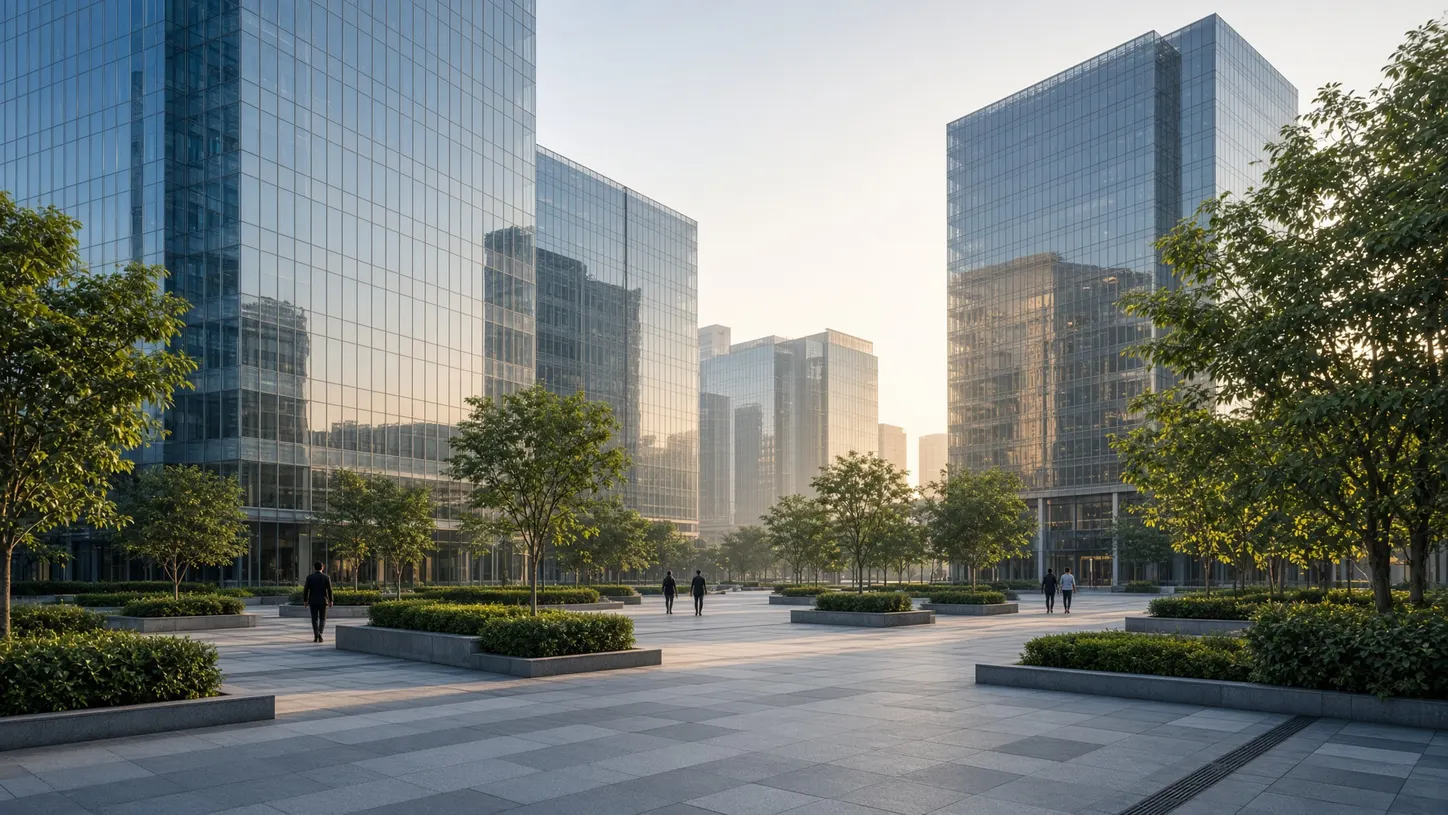
The physical centre of gravity is still DLF Cyber City: about 125 acres, more than 15 million sq ft of workspace, LEED-certified towers, and Cyber Hub as the after-hours commons. Google, Microsoft, IBM, Amex, Deloitte, KPMG, Accenture and a rotating cast of product firms treat that address as a signal. Talent treats it the same way. People will accept a longer commute to work there.
What corporate life actually looks like
A useful way to read Gurugram is not by sector but by day.
The morning is a logistics problem. NH-48, Golf Course Road, SPR and the newer Dwarka Expressway absorb a workforce that does not all live in DLF Phase 5. Many professionals come from Dwarka, South Delhi, Faridabad, Sohna, New Gurugram sectors, and the urban villages that still house a large share of support staff. The city has only a thin public-bus network relative to its population; private cars, app cabs and the Rapid Metro / Delhi Metro Yellow and Magenta lines do the rest. Congestion is not an inconvenience. It is a tax on every billed hour.
The office is international by design. Large campuses now compete on wellness rooms, green ratings, in-house crèches and "flexibility" — hybrid weeks, hot desks, and the ability to fly a team to Singapore or New York without changing time-zone logic. Occupiers are no longer only taking floors; they are taking large-format campuses. Life sciences and aviation are beginning to show up in leasing conversations that used to be only IT and BFSI.
The evening is the city's real product. Cyber Hub, Sector 29, Galleria, Ambience and the high streets along Golf Course Road turned after-work life into an economic sector of its own. Gurugram took a majority share of Delhi-NCR retail leasing in recent quarters. That is not lifestyle fluff. It is how the city retains 28-year-old engineers who could otherwise move to Pune or Hyderabad for cheaper rent.
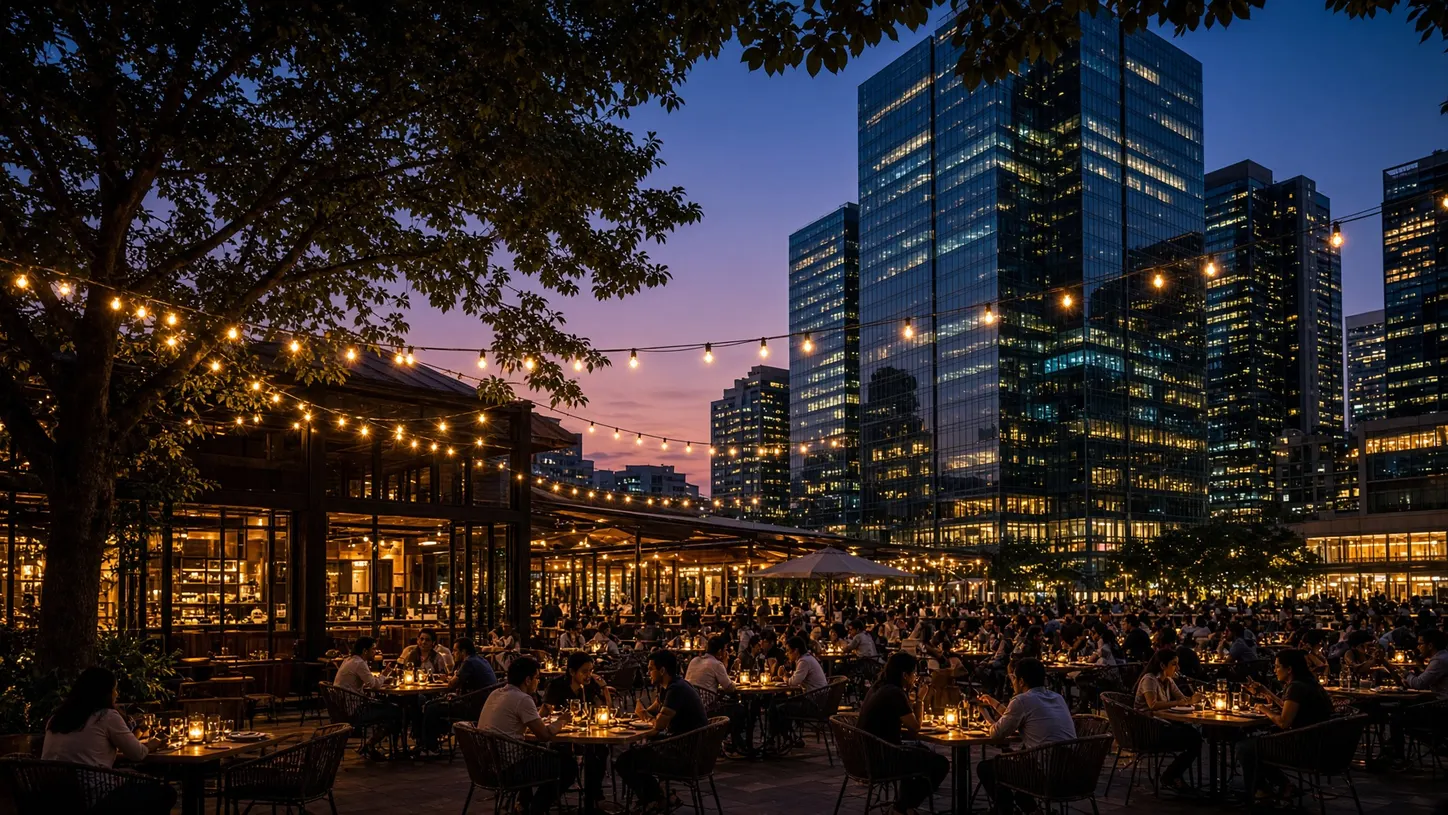
The culture has a North Indian corporate flavour that visitors from Bengaluru notice immediately: more client-facing polish, more hierarchy in older Indian IT firms, more American-office casualness inside GCCs, and a social calendar built around gated-society weekends, school runs and "let's just meet at Hub." It is not a campus town. It is a deal town that happens to employ engineers.
Where the talent comes from
Gurugram does not grow all of its workforce locally. It harvests North India.
Universities on the doorstep. The district itself now lists on the order of 12 universities and 78 colleges. Names that matter to hiring managers include Management Development Institute (MDI), BML Munjal University (Hero Group), Amity University Haryana, Gurugram University, IILM, K.R. Mangalam, and the practitioner-heavy Masters' Union, which in 2026 won approval to scale into a full university campus in the city. A short drive north sits Ashoka University and O.P. Jindal Global University in Sonipat; IIM Rohtak and IIIT Sonipat feed the same catchment. IIT Delhi and DTU sit across the state line. That is an unusually thick pipeline for a city this young.
The migrant professional class. A typical GCC pod in Cyber City is a mix of Delhi-NCR graduates, engineers from Tier-2 North Indian colleges, and returnees from the US or UK who want grandparents nearby and an international school for the children. Salaries for software and fintech roles in Gurugram sit in the same band as Bengaluru for senior specialists — commonly cited in the ₹18–32 lakh range depending on stack and firm — with Noida often 15–20 percent cheaper for equivalent titles. Attrition in NCR tech is high, in the mid-to-high teens, because the next offer is usually one metro stop or one WhatsApp forward away.
Skills the city is short of. India-wide GCC reports keep flagging the same gaps: generative AI and MLOps, platform engineering, cloud FinOps, cybersecurity. Gurugram feels those shortages acutely because so many centres are moving up the value chain at the same time. That is good news if you have those skills. It is a warning if your plan is to arrive with a generic "three years of Java" résumé and expect 2015-era hiring velocity.
The other workforce. The city also runs on construction labour, drivers, house-help, security staff and a growing layer of AI data-annotation work that pays far less than the GCC story admits. Over 40 percent of residents still live in crowded urban villages such as Nathupur, Wazirabad and Sikanderpur. Any honest talent map has to hold both pictures: the LEED tower and the village that services it.
Opportunity, by who you are
If you are early-career in tech or consulting. Gurugram is one of the fastest places in India to collect brand names on a CV. Campus placements from MDI, BMU and nearby private universities still feed the Big Four and product firms. The risk is cost of living. Rents near Golf Course Road and Cyber City punish a first salary. Many starters live with family in Delhi, share flats in older sectors, or start in Noida and interview across.
If you are mid-career (8–15 years). This is Gurugram's sweet spot. GCCs want people who can own a product slice, a risk function, or a regional P&L without flying to New Jersey every month. Lateral moves between Amex, a Big Four firm, a unicorn HQ and a global bank are common. Stock, variable pay and international travel matter more here than in a pure services city.
If you are building a company. The city is expensive but liquid. Investors, enterprise customers, lawyers, and a deep bench of operators are all in the same 15-kilometre box. Haryana's 2026 industrial and GCC policies are explicitly trying to keep that box from losing deals to Hyderabad or Pune on cost. For a founder, the question is not "Is there talent?" It is "Can I afford the talent and the office and the two-hour school-run culture that comes with hiring parents?"
If you are in manufacturing, logistics or operations. Watch Manesar, Sohna and the Pataudi–Farrukhnagar industrial plans. White-collar Gurugram gets the headlines; the next employment wave is as likely to be warehouses, auto-ancillaries and data centres on the rim.
If you are considering a move from another Indian metro. Come for the density of global employers. Budget for air-purifiers, a car or a brutal commute, and school fees if you have children. Do not come expecting a walkable European quarter. The livable pockets are real — and they are priced like it. The NRI life and life abroad pages on this site are written for the other direction of that move; the same questions, inverted, apply here.
The corridors that will decide the next decade
Corporate Gurugram is no longer only MG Road and Cyber City. Capital is following four belts:
- Golf Course Road and its extension — still the prestige address, now more mixed-use than pure office.
- Southern Peripheral Road (SPR) — offices, tech parks, retail and housing arriving together.
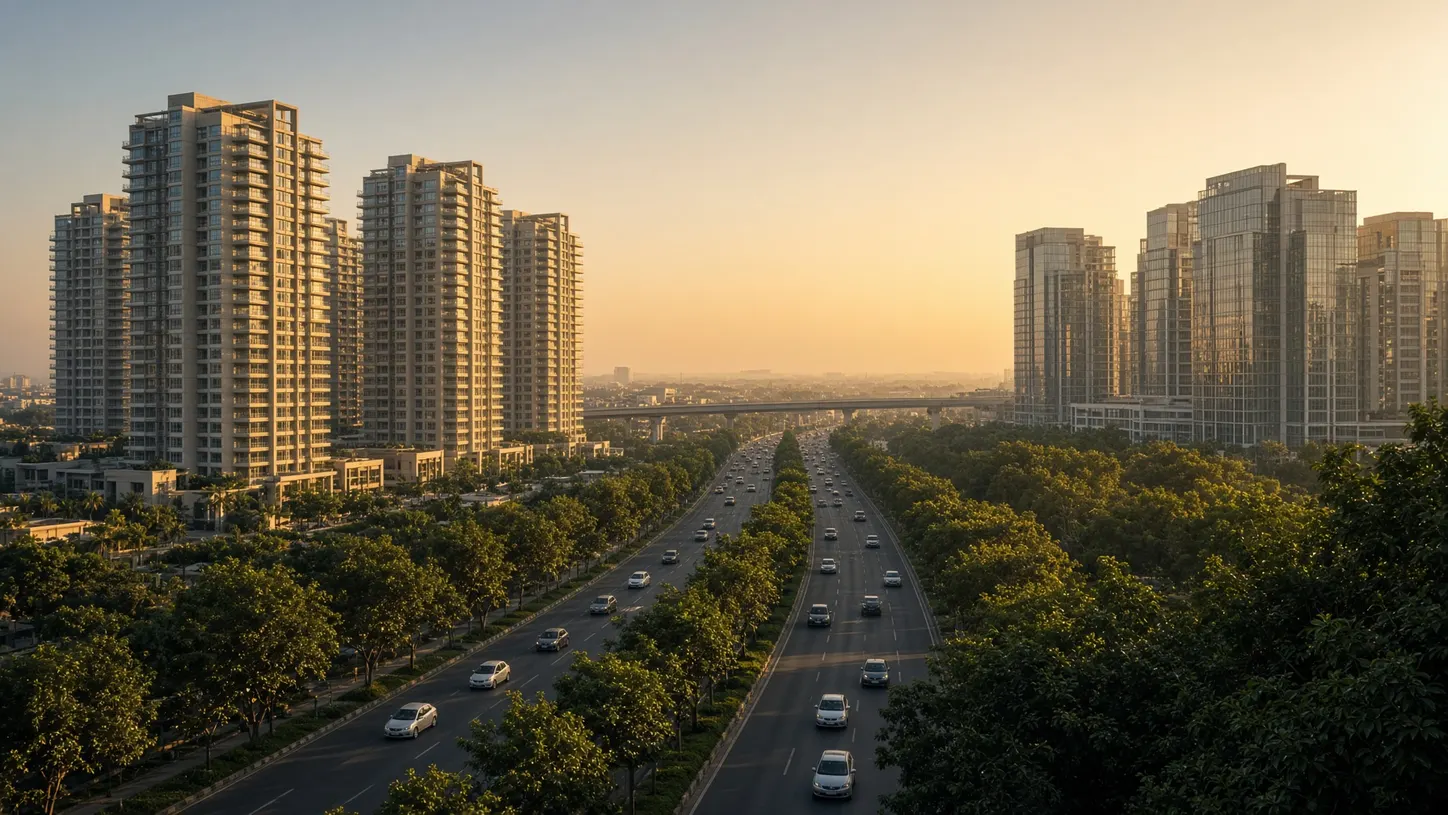
- Dwarka Expressway — the 16-lane corridor, fully operational since mid-2025, that rewired access to Delhi and set off a residential price surge.
- Sohna and New Gurugram — the overflow valve, with Colliers among those projecting sharp price appreciation as metro and industrial plans land.
Those corridors are why non-NCR developers (Lodha, Godrej, Birla, Oberoi, Sobha and others) have piled in, and why ultra-luxury housing sales in 2025 ran into the tens of thousands of crores. Jobs pull homes. Homes pull retail. Retail pulls the next intern who wants a city that feels "already global."
The bill that growth has not paid
A valuable article cannot stop at absorption numbers. Gurugram's opportunity is real because the problems are also real.
Water and rain. Every monsoon, arterial roads and underpasses from Cyber City to Sohna Road still go under. Drainage capacity in older pockets has not been rebuilt at the scale of the population that now sits on top of it. Hundreds of crores have gone into "fixes" that residents experience as temporary.
Air. Analyses of 2025 put Gurugram among India's most polluted large cities, with well over a hundred days of air that failed national PM2.5 standards. "Smog vacations" are now part of the professional calendar. That is not a lifestyle footnote. It is a retention risk for anyone who can work from Goa or Bangalore in November.
Waste and water supply. A municipal solid-waste emergency, leaking groundwater, and more than 10,000 diesel generators filling power gaps are the unglamorous machinery behind the LEED plaques. Peak power demand has already pushed past 2,500 MW.
Mobility. Cars per thousand residents are high; buses per lakh are low; footpaths are incomplete. The economic cost is hidden in late stand-ups and declined dinner invitations.
None of this means the city is "failing." It means Gurugram is what happens when private real estate outruns public systems for forty years. The next phase of opportunity — life-sciences campuses, aviation offices, AI labs, foreign-university floors inside tech parks — will only stick if the city becomes breathable and movable. Policy is starting to talk that language. Delivery is the test.
How to use Gurugram, instead of being used by it
A few practical rules that hold up in 2026:
- Treat "Gurgaon" and "Gurugram" as one labour market. Search both words. Companies have not standardised.
- Pick a corridor, not a city. Living in Sohna and working in Cyber City is a different life from living in DLF Phase 5 and walking to Hub.
- Price the winter. If your role is hybrid, negotiate November–January flexibility before you sign.
- Build skills the GCCs are actually buying. AI product work, cloud cost, security, and domain knowledge in BFSI or healthcare travel farther than generic coding certificates.
- Use the education belt. If you are a parent or a mid-career professional considering an MBA or a second degree, MDI, Masters' Union, BMU and the Sonipat universities are part of the same ecosystem as the offices.
- Do not ignore Noida and the rim. Equivalent roles can be cheaper; the interview loop is the same NCR loop.
- Watch policy, not just glass. The 2026 GCC and industrial policies, new industrial land, and metro extensions are the leading indicators of where the next 30,000 jobs will sit.
If the trip is a visit rather than a move, start with travelling in India and treat Gurugram as a working city, not a sightseeing one.
The honest verdict
Gurugram is not India's most beautiful city, its most planned city, or its kindest city to the lungs. It is one of the most useful cities if your aim is a global career without leaving North India.
It took a mythic village name, a car factory, a generation of aggressive developers, and the post-1991 hunger of Indian professionals, and produced a labour market that Fortune 500 firms trust with core work — fraud models, product engineering, regional headquarters — not only call scripts. That trust is the actual asset.
The opportunity in front of the city is no longer to add another 20 million square feet. It is to make the people inside those feet stay: to turn a commuting machine into a city that can hold 55 lakh residents without drowning every July or disappearing every November. If it manages that, Gurugram will not just be the Millennium City of a marketing deck. It will be the template for how the next ring of Indian urban India grows.
Until then, the bargain is clear. The city will give you density of employers that few places on earth can match at this price-to-opportunity ratio. You will give it your commute, your air, and your patience. For a large and growing share of India's corporate talent, that trade still wins.
Questions people ask
Why is Gurugram called the Millennium City?
The nickname tracks the office boom, not a calendar gimmick. By mid-2026 Gurugram had the largest office market in North India — more than 100 million square feet — and had become the default address for global capability centres in the capital region.
Is it Gurugram or Gurgaon?
Both, in practice. The Haryana government restored the gazette name Gurugram in 2016. Residents, recruiters, cab apps and airline tickets still say Gurgaon. Search both words: companies have not standardised.
How big is Gurugram's office market?
It crossed 100 million square feet of office stock by mid-2026. Between 2021 and the first quarter of 2026 it leased about 40 million sq ft and added 21 million sq ft of new supply. CBRE expects 120–125 million sq ft by 2030. Roughly 59 million sq ft is now green-certified.
Why do companies put GCCs in Gurugram rather than Delhi?
Talent, landlords and international schools are already there. Haryana hosts more than 270 GCCs — about 16 percent of India's GCC base — and Gurugram is the default address for that expansion. Delhi is the political capital; Gurugram is the corporate machine south of it.
What are the downsides of moving to Gurugram for work?
Congestion is a tax on every billed hour. Drainage still fails in the monsoon. Winter air is bad enough that 'smog vacations' are part of the professional calendar. Public buses are thin relative to the population. The livable pockets exist, and they are priced like it.
Where should I live if I work in Cyber City?
Pick a corridor, not a city. Living in DLF Phase 5 and walking to Cyber Hub is a different life from living in Sohna and crossing the Southern Peripheral Road every morning. Dwarka, South Delhi, Faridabad and the newer expressway belts are all in the same labour market and not the same commute.
Sources (6)
- CBRE India, Gurugram / Delhi-NCR office market reporting, 2021–2026 — For office stock, leasing, supply, green-certified area, international occupier take-up and the 2030 stock range as cited in this piece
- Census of India, 2011 — Gurugram district — For the 15.14 lakh population count
- Gurugram Metropolitan Development Authority, population projections to 2041 — For the 55 lakh projection
- Government of Haryana, GCC policy 2026 — For the more-than-270 GCC count, the 16 percent share of India's GCC base, and the stated aim of 100 more centres and 30,000 jobs
- Haryana State Industrial and Infrastructure Development Corporation (HSIIDC), industrial cluster plans — For the roughly 1,800 acres around Pataudi and Farrukhnagar, and IMT Sohna
- Haryana government notification restoring the name Gurugram, 2016 — For the gazette name; everyday usage is observed, not gazetted
Fact-checked by Ajay Gupta on 8 September 2026.
Something wrong here? Tell us — corrections are made in the open, and our editorial standards set out what checking a page involves.