Festivals
Diwali — what it marks, and how it is kept
Five days, several different reasons depending on where your family is from, and one shared instruction: light the house.
The short answer
Diwali is a five-day festival of lights held on the new moon of Kartika. What it commemorates depends on where your family is from — Rama's return in the north, Lakshmi's arrival for merchants and much of the west, Krishna's defeat of Narakasura in the south, and Bandi Chhor Divas for Sikhs.
Key facts
- Also called
- Dīpāvalī (row of lamps), Deepavali in the south, Bandi Chhor Divas among Sikhs
- When
- The new moon of Kartika. Under the north's Purnimanta reckoning this falls in the month called Kartika; in the south's Amanta reckoning the same night sits at the end of Ashvina
- Length
- Five days in most of the north and west; two to three days in much of the south and east
- Central acts
- Lighting lamps, cleaning the house, Lakshmi Puja, new clothes, sweets, and settling the year's accounts in trading communities
- Not observed by
- Many Bengali households keep Kali Puja on the same night instead, which is a different festival with a different deity
The story
There is no single story, and the honest version of this page has to start there. What Diwali commemorates depends on where a family is from.
In much of North India it marks Rama's return to Ayodhya after fourteen years of exile and the defeat of Ravana, with the lamps standing for the city lit to welcome him. In the south, the same night is associated with Krishna's killing of Narakasura, and the day before Lakshmi Puja is Naraka Chaturdashi. In Gujarat and among trading communities across the west, the festival is Lakshmi's, and the lamps are lit to bring her in. Bengal, on the same new moon, keeps Kali Puja.
For Sikhs the day is Bandi Chhor Divas, marking Guru Hargobind's release from imprisonment at Gwalior, and it is not a version of the Hindu festival but its own observance held on the same night. Jain households mark the day as Mahavira's attainment of nirvāṇa.
These are not competing claims to be resolved. They are what different communities are doing on the same night.
What it means
The one thing common to all of them is the light, and what the light is doing.
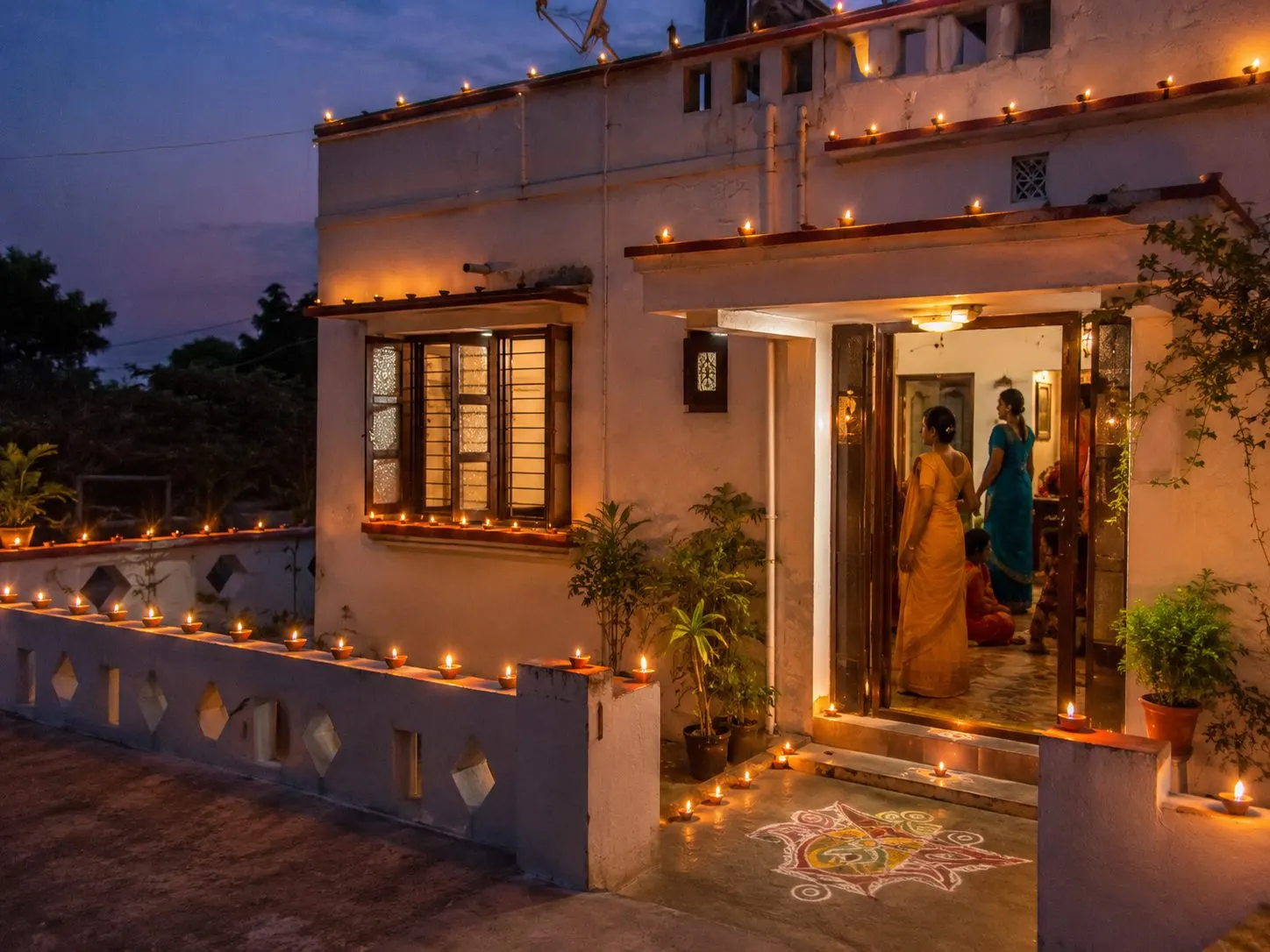
A lamp lit inside marks a space as consecrated. A row of lamps facing the street is an announcement, and in the Lakshmi-centred reading, an invitation: the house has been cleaned, the accounts are settled, the door is open. The scrubbing of the house in the weeks before is not a domestic detail attached to the festival — in the merchant tradition it is part of the ritual, and so is the closing of the year's books.
The other common element is the new moon. Diwali is deliberately held on the darkest night of the month, and the whole visual argument of the festival depends on that.
How it is kept
The five-day sequence, as kept in most of the north and west:
- DhanterasMetal is bought — a spoon will do — and lamps are lit at the door. Associated with Dhanvantari, and in practice the day the shopping happens.
- Naraka ChaturdashiAn oil bath before dawn in the south, where this is the main day; Choti Diwali in the north, with a smaller lighting.
- Lakshmi PujaThe new moon. The house is lit fully, Lakshmi and Ganesha are worshipped, and in trading families the new account books are opened.
- Govardhan Puja or AnnakutA mountain of food offered, marking Krishna lifting Govardhan; in Gujarat, the commercial new year.
- Bhai DoojSisters and brothers; a tilak, a meal, and a gift.
How this changes across India
Diwali in Uttar Pradesh, Bihar, Delhi
Rama's return is the story; five days kept; Lakshmi and Ganesha worshipped together on the new moon.
Diwali in Gujarat and Rajasthan
Strongly Lakshmi-centred and commercial. Chopda Pujan — worship of the account books — and the new business year the following day.
Diwali in Tamil Nadu
Deepavali is one main day, kept mainly the morning before the new moon, with a pre-dawn oil bath, new clothes and firecrackers early.
Diwali in Bengal
Kali Puja on the same night — a night-long worship of the Goddess, with a very different mood from the Lakshmi version.
Diwali in Punjab and Sikh households
Bandi Chhor Divas; the Golden Temple is lit, and the day marks a release from imprisonment rather than a return from exile.
Diwali in Maharashtra
Five days including Vasubaras for cows and Padwa for the husband-and-wife exchange, and faral — the specific set of Diwali snacks — made at home.
Keeping it abroad
The practical problems are the same everywhere in the diaspora: the festival lands mid-week, nobody gets the day off, and the lamps meet a smoke alarm.
What most households settle on is a split — the puja on the actual night, however brief, and the social celebration on the nearest weekend. Councils and temples in most large diaspora cities now run public events, which do the job of the street that a suburban house does not have. Electric lamps at the window, an oil lamp for the puja itself, and the sweets ordered rather than made are all extremely normal compromises, and none of them are what makes it Diwali or not.
Questions people ask
Is Diwali the Hindu new year?
For some. Gujarati households begin their commercial new year the day after Lakshmi Puja, and in parts of the north and west the year turns here. In Tamil Nadu, Kerala, Bengal, Punjab and Maharashtra the new year falls at other times entirely. There is no single Hindu new year.
Why do the dates on different calendars disagree?
Because the festival is set by a lunar day, the tithi, which begins and ends at times that vary by longitude — so a Diwali date computed for Chennai can differ from one computed for New Jersey. Panchangs also differ in which moment of the tithi they follow. Always use a computation made for where you actually are.
What is done on each of the five days?
Dhanteras (buying metal, and Dhanvantari's day), Naraka Chaturdashi or Choti Diwali, Lakshmi Puja on the new moon, Govardhan Puja or Annakut, and Bhai Dooj. Not every household keeps all five, and southern practice compresses the sequence.
Are fireworks part of the festival?
They became a large part of it, and in India they are now regulated: the Supreme Court has restricted the sale and timing of firecrackers, and several cities ban them outright on air-quality grounds. Plenty of households have dropped them and kept the lamps.
Sources (4)
- Vālmīki Rāmāyaṇa, Yuddha Kāṇḍa — For the return to Ayodhya, which is the northern association
- Bhāgavata Purāṇa, book 10 — For the Narakasura episode, which is the southern association
- Sikh accounts of Guru Hargobind's release from Gwalior — For Bandi Chhor Divas, which coincides with Diwali and is a distinct observance
- Printed panchang for the year and location — Required for the date — this page states the reckoning, not a date
Fact-checked by Ajay Gupta on 7 September 2026.
Something wrong here? Tell us — corrections are made in the open, and our editorial standards set out what checking a page involves.