For NRIs
Keeping Indian festivals abroad
The festival falls on a Tuesday, nobody has the day off, and the smoke alarm is directly above the puja shelf. Here is what families actually do.
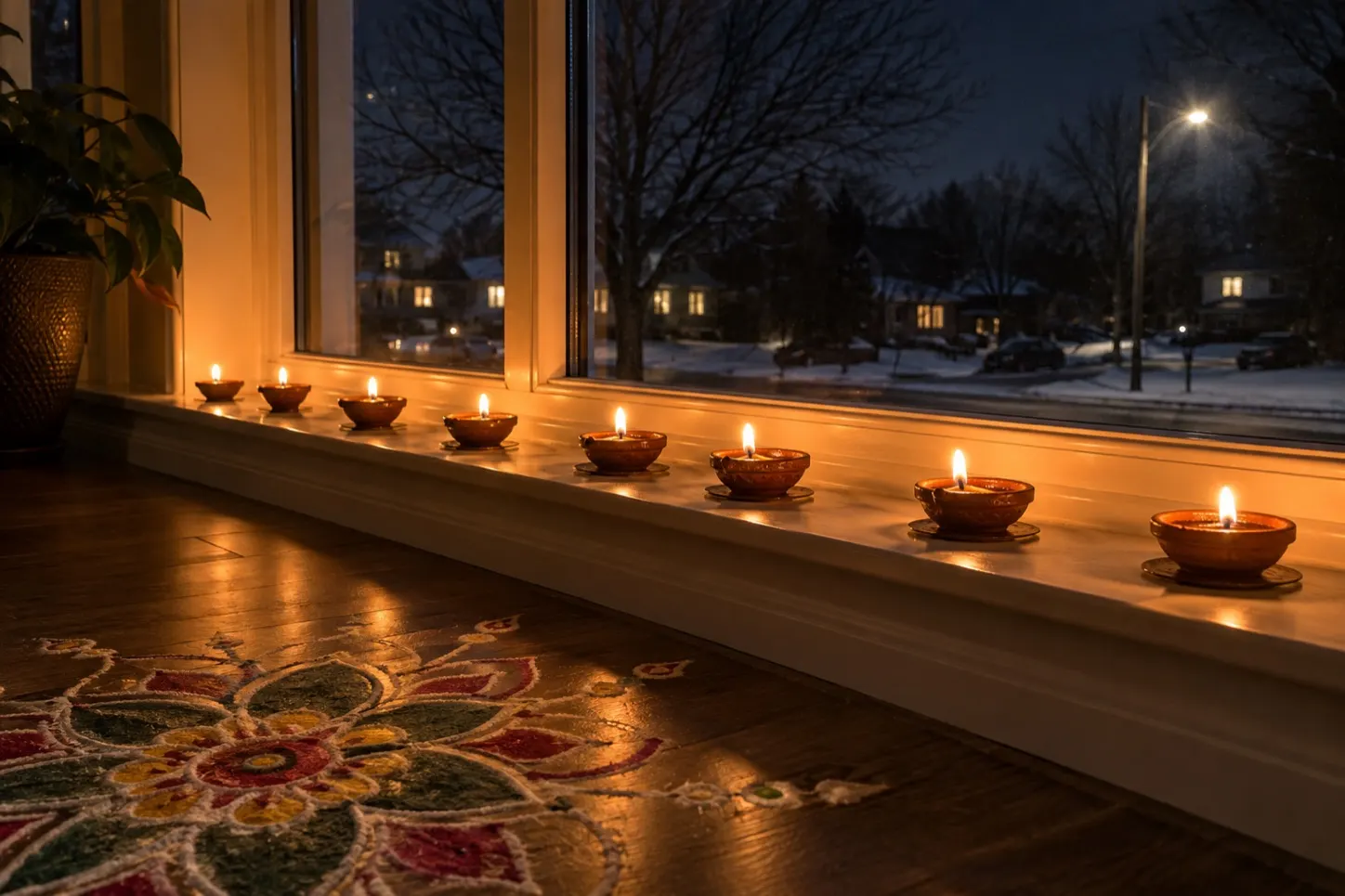
The short answer
Most diaspora households split the festival: the ritual on the actual day, however brief, and the celebration on the nearest weekend. That split is not a compromise anyone needs to feel bad about — it is what keeping a lunar calendar inside a Gregorian working week requires.
What actually has to happen on the day
Very little, in most traditions, and this is the practically useful fact.
A lamp lit. A short puja. The specific food, or a version of it. A call to parents in India, which for most families is the real fixed point of the day.
Everything else — the gathering, the clothes, the cooking, the sweets, the visiting — moves to the weekend without any tradition objecting. Festivals in India also stretch across days and are compressed or extended by circumstance; the diaspora version is doing the same thing under different constraints.
The compressions that work
Diwali on a Tuesday. Puja and lamps at home on the night. Sweets to colleagues on the day, which is the single most effective piece of quiet explaining available. Dinner and the gathering on Saturday.
Navratri. The garba nights are organised and ticketed almost everywhere with a sizeable Gujarati community, and they run across the actual nine nights. Fasting is kept by whoever wants to keep it; the household lamp takes a minute.
Janmashtami. The midnight timing is the hardest of the year. Most families do an evening puja with the children present, rock the cradle before bed, and leave the midnight moment to whoever is awake.
Ganesh Chaturthi. A clay image, kept for one and a half days rather than eleven, immersed in a bucket or a garden tank with the water and clay then given to the earth. Small, complete, and environmentally better than the version in Mumbai.
Holi. Almost always an organised weekend event at a temple, hall or park. Powder in packets, old clothes, and oil in the hair beforehand.
Sourcing the things
- Sweets. Order from an Indian grocer or a home cook; most cities have both, and the home cook is usually better. Ordering rather than making is normal, including in India.
- Diyas and puja items. Indian grocery shops, the temple shop, or online well in advance — the fortnight before Diwali sells out everywhere.
- A priest. Local temples arrange house visits for major pujas and for life-cycle rituals; book several weeks ahead for festival season.
- Flowers. Marigolds are the one thing that is genuinely hard to get in some countries. Households substitute what is available, which is what households in India do too.
The school and workplace part
Two practical moves, both underused.
Tell the school in writing, early, and offer material. Many schools have a calendar of religious observances and a policy of authorised absence for them, and a great many teachers would happily include something and have nobody to ask.
Ask about floating holidays at work. In North America these are now common and are the standard mechanism for exactly this. In the UK it is usually annual leave, and asking in September for a November day gets a different answer from asking on the Friday before.
The part that is genuinely hard
A festival in India is public. The street is lit, the sweets are in every shop, the neighbours are doing it too, and a child absorbs it without anyone teaching.
Abroad, none of that infrastructure exists, and the household has to supply all of it deliberately. That is the real work, and it falls disproportionately on whichever adult in the house was raised with it.
The thing that most reliably helps is other families. A festival kept by one household is a chore; kept by four households together it is a festival again. Finding those four families is the actual problem to solve, and it is worth more effort than getting any individual ritual detail right.
Questions people ask
Can I take the day off work for Diwali?
In the United States and Canada, most large employers now have floating holidays that cover it, and several school districts close for Diwali. In the UK, it is not a public holiday and is usually taken as annual leave. Ask early rather than the week before — the answer is often yes and the process is slow.
What do I tell my child's school?
Give them notice in writing, name the festival, and offer to send something in — a short explanation, sweets for the class, a five-minute talk. Schools are generally receptive and are frequently short of anyone willing to explain. It also does something useful for the child, who otherwise carries the explaining alone.
How do you light lamps in a flat with a smoke alarm?
A single oil lamp in a still room with the alarm temporarily covered — and uncovered immediately afterwards — or an electric lamp for the display and one oil lamp for the puja itself. Households do both, everywhere, and no tradition treats it as a failure.
We are not religious. Is there a point in keeping any of it?
That is a family question rather than one this page can answer. What can be said is that the festivals carry a good deal that is not doctrinal — the food, the calendar, the people who come — and that children who grow up with none of it often report the absence later, which is a common enough pattern to be worth knowing about.
Sources (1)
- School district and employer holiday policies in the US, UK and Canada — These vary widely and change; check your own rather than a general account
Fact-checked by Ajay Gupta on 7 September 2026. Due for review by 23 August 2027.
Something wrong here? Tell us — corrections are made in the open, and our editorial standards set out what checking a page involves.