For NRIs
Raising children with Indian culture abroad
What survives into the next generation is mostly what the child experienced as ordinary, not what was explained to them.
The short answer
Language is the hardest thing to transmit and the most missed when it goes. Food and festivals transmit more easily because they are experienced rather than taught. Classes work when the child has a peer group in them and rarely when they do not.
The one that is hardest
Language, by a distance, and it goes fast. The common pattern: parents speak the language to each other, English to the child; the child understands everything and answers in English; by adolescence the comprehension is patchy; by adulthood it is gone except for food words and swearing.
What works, when it works:
- One parent, one language, consistently, or the household language rule — the language spoken at home, English outside. Both are hard to sustain and both are the only things that reliably produce speakers.
- Volume. Fluency takes thousands of hours, not classes on a Saturday.
- A reason to use it. Grandparents who speak no English are the single most effective language teacher available. Long summers in India do more in six weeks than a year of lessons.
- Media in the language, from early on — cartoons, songs, films — which supplies exposure without requiring an adult to be present.
What does not work: guilt, and starting at twelve.
Food is the easiest, and it does real work
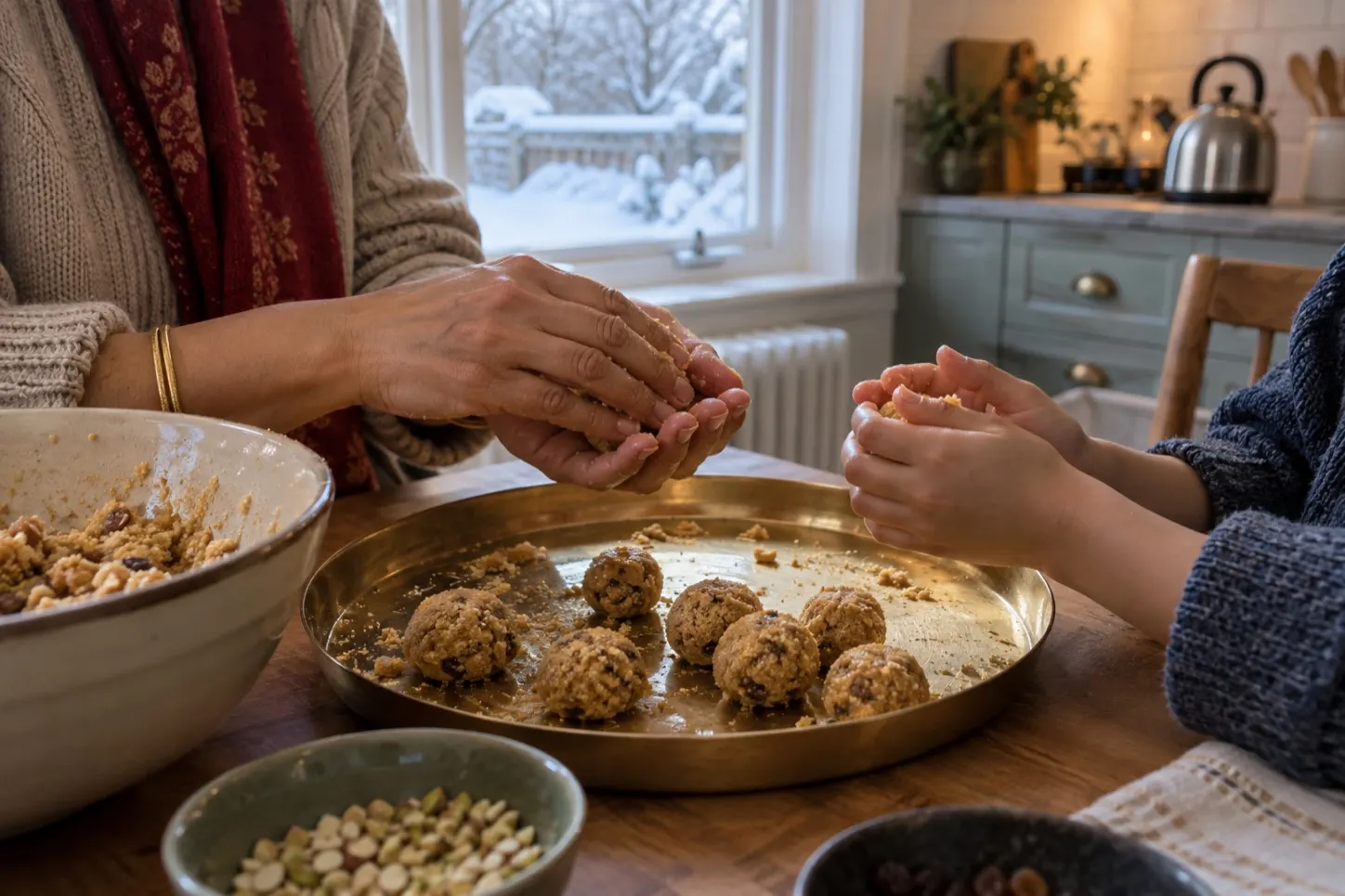
Children absorb food without being taught it, and a child who grows up eating the food will find it later, wherever they end up.
The practical advice is unglamorous: cook the everyday food rather than only the festival food. A weekday dal and rice does more for transmission than an elaborate annual meal, because it makes the cuisine ordinary rather than ceremonial.
Festivals, and why they need other families
See keeping festivals abroad for the mechanics. The part relevant to children is the peer group: a festival kept by one household is homework; kept by several together it is a party a child looks forward to.
Building that circle of families is more useful than any individual ritual, and it is the thing parents most often start doing too late.
Classes
Bharatanatyam, Kathak, Carnatic vocal, tabla, language school, temple classes. Two honest observations from how these tend to go.
The ones that last are the ones with friends in them. The art form matters less than whether the Saturday morning is something the child wants to attend.
And the arangetram problem is real: a debut recital that costs as much as a wedding, arriving in the middle of school exams, and treated as a family obligation rather than the student's own milestone. The recital is the tradition; the scale is not.
Visiting India
Long visits do more than short ones, and staying with family does more than hotels. A child who has been bored in a relative's house in the afternoon heat, been sent to the shop, and understood the layout of a street has a relationship to the place; a child who has done a two-week tour has photographs.
See visiting India for the practical side.
What parents say they regret
From what is a consistent pattern rather than a study: not the classes they did not enrol in, and not the festivals they compressed.
Language, almost always. And not having found other families sooner.
Questions people ask
Will speaking two languages at home confuse my child?
The research on childhood bilingualism is consistent: it does not cause language delay or confusion, and children raised with two languages sort them out. What it does require is consistent, substantial exposure — a few words at bedtime is not enough to produce a speaker.
My child refuses to speak the language back. What now?
Extremely common, and the pattern has a name — receptive bilingualism, where the child understands and answers in English. Keep speaking it. Comprehension retained through childhood is what makes later fluency recoverable, and a great many adults reactivate a language they never spoke as teenagers.
Are dance and music classes worth it if the child resists?
Sometimes, and the deciding factor is usually the peer group rather than the art form. A child who has friends in the class stays; one who is the only child there rarely does. Where a child is genuinely miserable, forcing it tends to produce an adult who associates the culture with obligation.
How do I answer "why do we do this and nobody else does?"
Honestly, and specifically. "Because my mother did it, and this is what it means" works better than an argument about tradition. A child can accept being different; what they resent is being different for reasons nobody will explain.
Sources (2)
- Research on heritage language maintenance and childhood bilingualism — For the language findings, which are consistent across studies
- Sociological literature on second-generation identity in the Indian diaspora — For patterns of retention and loss across generations
Fact-checked by Ajay Gupta on 7 September 2026. Due for review by 23 August 2027.
Something wrong here? Tell us — corrections are made in the open, and our editorial standards set out what checking a page involves.