Arts & Heritage
Indian classical dance — what your child is learning
Written for the parent in the back of the class who cannot explain what they are watching.
The short answer
The Sangeet Natak Akademi recognises eight classical dance forms; the Ministry of Culture's own list is longer. Each combines pure rhythmic movement with narrative danced through a codified vocabulary of hand gestures, eye movement and facial expression, performed to its own regional musical tradition.
Key facts
- The eight
- Bharatanatyam, Kathak, Kathakali, Kuchipudi, Odissi, Manipuri, Mohiniyattam, Sattriya
- The two modes
- Nṛtta — pure rhythmic movement with no narrative; nṛtya — expressive dance that tells something
- The vocabulary
- Hasta mudrās, codified hand gestures; abhinaya, expression through face and eyes; adavus or equivalent, the basic step units
- The text behind it
- Nāṭyaśāstra, attributed to Bharata, usually dated between the 2nd century BCE and the 2nd century CE
- The debut
- Arangetram in the Bharatanatyam tradition, rangapravesham in others — a full solo recital, danced when the teacher judges the student ready rather than after a fixed term
What you are watching
Two things alternate through a classical Indian dance recital, and once you can tell them apart the whole performance becomes legible.
Nṛtta is pure movement — rhythm, geometry, footwork — with no story attached. The dancer is playing the rhythm with the body, in conversation with the drummer.
Nṛtya is narrative. The dancer takes the role of a character, or several in turn, and tells something: a verse, an episode, an emotional situation. This is where the hands and face do the work.
The hand gestures — hasta mudrās — are a codified vocabulary, not improvisation. A single hand shape can mean a deer, a flower, a flame or a refusal depending on placement and context. The eyes are trained separately and deliberately, and a trained dancer moves them independently of the head.
The eight forms
| Form | From | What distinguishes it |
|---|---|---|
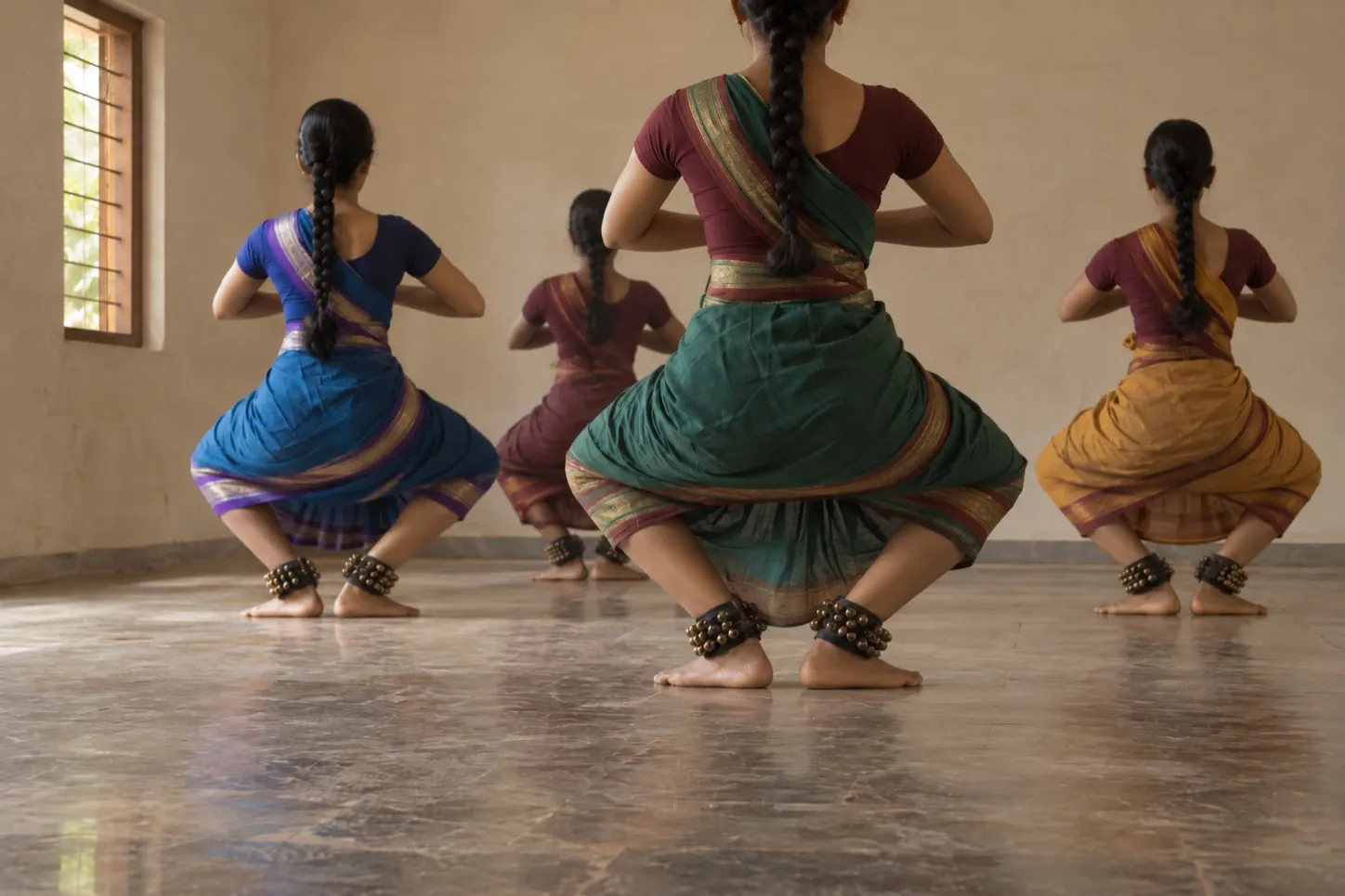
| Bharatanatyam | Tamil Nadu | Geometric and grounded; deep bent-knee stance, sharp lines; solo repertoire; Carnatic music. |
| Kathak | North India | Upright and turning; extended spins, intricate footwork with heavy ankle bells; Hindustani music; the repertoire shaped by the Mughal and Rajput courts. |
| Kathakali | Kerala | Dance-drama with elaborate makeup and costume; male-dominated historically; night-long performances of epic episodes. |
| Kuchipudi | Andhra Pradesh | Related to Bharatanatyam, with more narrative and speech; the tarangam, danced on the rim of a brass plate. |
| Odissi | Odisha | The tribhanga — the three-bend posture, and the sculptural quality that follows from it. |
| Manipuri | Manipur | Soft, circular, without the percussive footwork of the others; Vaishnava devotional material. |
| Mohiniyattam | Kerala | Slow, swaying, lyrical; a solo woman's form with its own repertoire. |
| Sattriya | Assam | From the Vaishnava monasteries of the Brahmaputra valley; recognised as classical only in 2000. |
The part that is usually left out
Bharatanatyam and Odissi as danced today were reconstructed in the twentieth century from traditions maintained by hereditary temple dancer communities — devadasis in the Tamil country, maharis in Odisha.
Those communities were subject to the anti-nautch campaign from the 1890s and then to legislation: the Bombay Devadasi Protection Act in 1934, and the Madras Devadasis (Prevention of Dedication) Act in 1947. The dance was rescued and re-presented as classical art largely by people from outside those communities. E. Krishna Iyer, a lawyer, campaigned publicly for the form through the 1930s. Rukmini Devi Arundale, a Brahmin and a Theosophist, founded Kalakshetra in 1936 and remade the repertoire as devotional, setting the śṛṅgāra material aside. T. Balasaraswati, who was of the hereditary lineage, argued that the erotic and the devotional could not be pulled apart in this form; the version that spread through schools and syllabuses was largely Rukmini Devi's. The women who held the tradition were left outside the revival.
It is not a story of outsiders acting alone. The abolition bill was introduced by Muthulakshmi Reddi — a doctor, one of the first women in an Indian legislature, and the daughter of a devadasi mother.
The dance is real and the training is serious. So is that history, and a page that describes only the mudras is telling you half of what the form is.
For a parent watching
- The bells are information. The dancer is producing rhythm with the feet and the drummer is answering; listen to them as a duet.
- Watch the eyes. In a narrative passage the eyes are doing more than the hands.
- Ask what the lyric says. The verses are in Sanskrit, Tamil, Telugu or Brajbhasha, and the meaning is the whole point of the expressive sections. A teacher will be glad to be asked.
- The training is athletic. The half-sitting stance is physically demanding, and years of it are what produce the line you are looking at.
How this changes across India
| Region | What it means for a student |
|---|---|
| Tamil Nadu | Bharatanatyam with Carnatic music; the arangetram tradition and a dense circuit of performance opportunities. |
| North India | Kathak, taught within Hindustani music culture, with gharana lineages that matter to how it is danced. |
| Kerala | Kathakali and Mohiniyattam, both with long formal training and a strong theatrical apparatus. |
| Odisha | Odissi, with a reconstructed repertoire and an active school tradition since the 1950s. |
| Diaspora | Taught through community schools, temples and private teachers rather than a professional circuit, and fitted around school terms. |
Questions people ask
Which form is oldest?
The question does not have a clean answer, and it is worth resisting. The Nāṭyaśāstra is old and describes principles all the forms draw on. The forms as danced today were codified much more recently — several in the twentieth century, from older temple and court traditions that had been disrupted.
What is an arangetram, and why does it cost so much?
A first full solo performance, typically two to three hours, after years of training — the student's public debut and the teacher's presentation of their work. Costs mount because families hire live musicians, a hall, costumes and jewellery, and often cater for hundreds of guests. The scale is a social choice; the recital itself does not require it.
My child is learning Bharatanatyam abroad. Is it the same as in India?
Broadly, yes — the vocabulary, the syllabus and the repertoire travel intact, and many diaspora teachers hold serious lineages. What differs is context: fewer live musicians, fewer performance occasions, and less exposure to the language of the lyrics, which is where meaning gets lost first.
What is the connection with temples?
Several forms, Bharatanatyam and Odissi in particular, descend from temple dance traditions performed by hereditary women dancers — devadasis in the Tamil country, maharis in Odisha. Those communities were dispossessed by anti-dedication legislation and by social reform in the early twentieth century, and the dance was reconstructed largely without them. That history is not decoration; it is the reason the forms look as they do today.
Sources (5)
- Bharata, Nāṭyaśāstra — For the theoretical foundation, including rasa and abhinaya
- Davesh Soneji, Unfinished Gestures: Devadasis, Memory and Modernity in South India — For the devadasi history and the twentieth-century reconstruction of Bharatanatyam
- Sangeet Natak Akademi documentation on the classical forms — For the official recognition of the eight
- Madras Devadasis (Prevention of Dedication) Act, 1947, and the Bombay Devadasi Protection Act, 1934 — For the legislation itself, and its dates
- S. Muthulakshmi Reddi, papers and Legislative Council record — For who introduced the abolition bill, and from what background and their regional traditions
Fact-checked by Ajay Gupta on 7 September 2026.
Something wrong here? Tell us — corrections are made in the open, and our editorial standards set out what checking a page involves.