Arts & Heritage
Indian classical music — Hindustani and Carnatic
Two systems from one root, and a way of listening that nobody explains before your first concert.
The short answer
Indian classical music is built on rāga — a melodic framework with fixed notes, characteristic phrases and rules of movement — and tāla, a cyclical rhythmic structure. Hindustani music in the north and Carnatic in the south share this basis and diverge in repertoire, structure and instruments.
Key facts
- Rāga
- Not a scale — a framework with permitted notes, characteristic phrases, rules about ascent and descent, and an associated mood. In Hindustani practice, often a time of day as well
- Tāla
- A rhythmic cycle of fixed length — tīntāl of 16 beats, ādi tāla of 8 — with a stressed first beat, the sam or samam, that everything returns to
- Hindustani
- North India; gharana lineages; sitar, sarod, sarangi, bansuri, tabla; long improvised ālāp before the composition
- Carnatic
- South India; the Trinity of Tyagaraja, Muthuswami Dikshitar and Syama Sastri; veena, violin, mridangam; composition-centred
- The drone
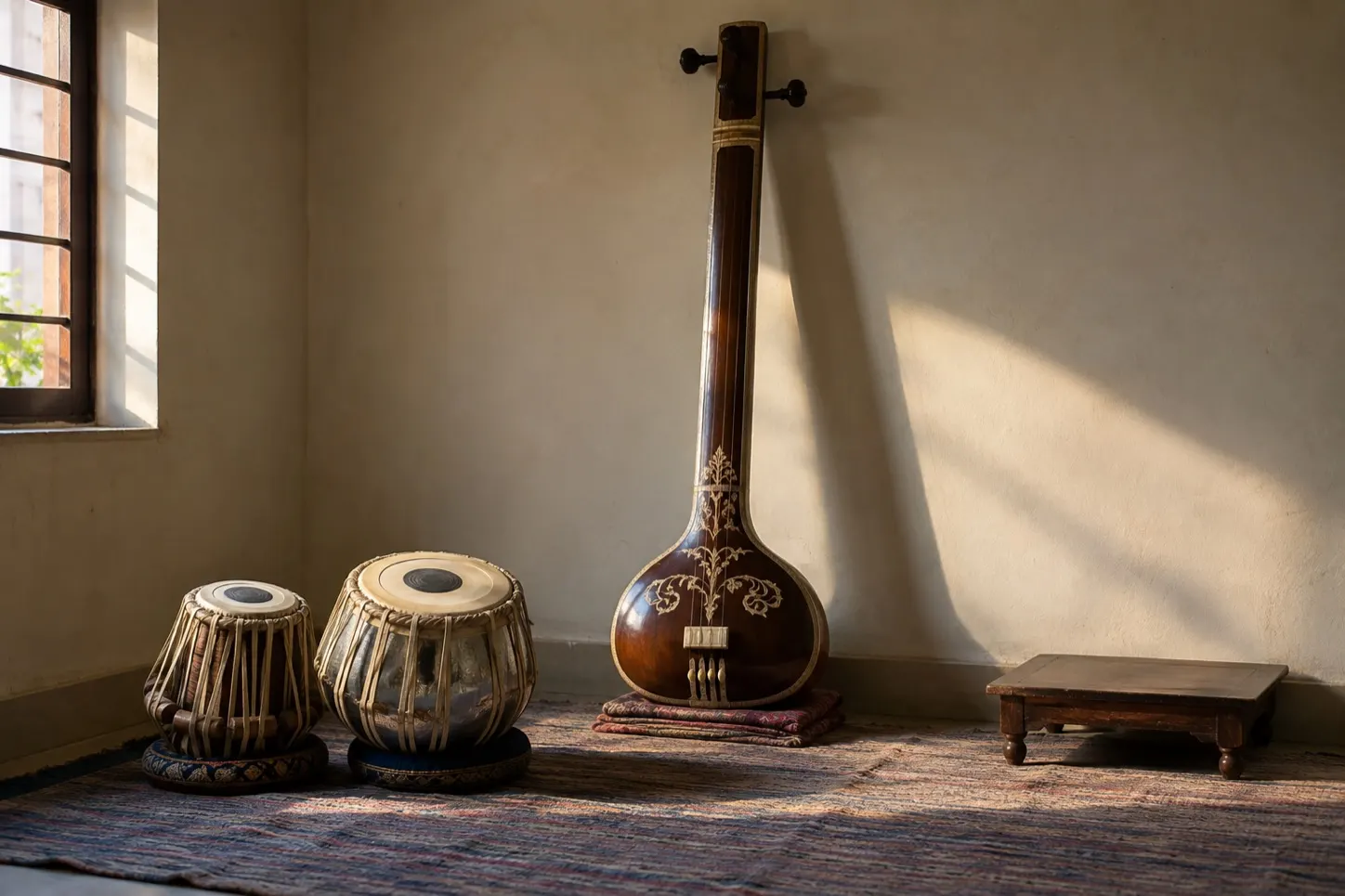
- The tanpura or śruti box, sounding the tonic continuously — the reference everything is heard against
Raga is not a scale
The most common mistake in English descriptions. A raga specifies which notes may be used, and also: which notes are emphasised, how you may move between them, which phrases are characteristic, how the ascent differs from the descent, and what it should feel like.
Two ragas can use identical notes and be entirely different ragas, because the grammar of movement differs. This is why a trained listener identifies a raga within a few phrases rather than by counting notes.
In Hindustani music many ragas carry an associated time of day, and performers observe it in recitals. Carnatic practice largely set the convention aside, and a sabha concert is not programmed by the hour. Whether the association is aesthetic convention or something more is argued about; what is not argued about is that Hindustani musicians take it seriously.
Tala is a cycle, not a bar
Rhythm is organised in cycles of fixed length — sixteen beats, eight, seven, ten and considerably more elaborate structures.
The first beat of the cycle, sam or samam, is the point of resolution. Improvisation departs from it and lands back on it, and the visible pleasure in an audience at a concert is very often the moment of arrival. Listeners keep the cycle with their hands, which is why the audience at a Carnatic concert looks like it is conducting.
The two systems
Hindustani, in the north, developed in the courts and absorbed Persian and Central Asian influence over centuries. A performance typically opens with a long unmetered ālāp, the raga explored slowly with only the drone, before the percussion enters and the composition begins. Lineage — the gharana — matters, and identifies a musician's aesthetic.
Carnatic, in the south, is more composition-centred. The core repertoire is a body of devotional works by named composers, above all the eighteenth and nineteenth-century Trinity — Tyagaraja, Muthuswami Dikshitar and Syama Sastri — and improvisation is built around them: raga exposition, then the composition, then variation on a chosen line, then a percussion solo.
A first concert
Hindustani. Long, slow start. Do not expect the rhythm for some time; the opening is the point rather than an introduction to it.
Carnatic. Faster in structure, more pieces, more visible interaction between the singer and the violinist, and a tani āvartanam — an extended percussion section — near the end.
In both: the drone is always there. Once you can hear the tonic in the drone, everything the soloist does is audible as a relationship to it, and the music stops being decorative and becomes structural.
How this changes across India
| Where | What differs |
|---|---|
| North India | Hindustani, gharana-based, with dhrupad as the older and more austere stream and khayal as the dominant modern form. |
| Tamil Nadu | Carnatic, centred on Chennai's December season — hundreds of concerts across several weeks, the largest classical music event in the world. |
| Karnataka and Andhra | Carnatic with distinct schools and repertoire; Telugu-language composition dominates much of the core canon. |
| Kerala | Sopana sangeetham, a temple-associated tradition distinct from concert Carnatic music, and the percussion ensembles of temple festivals. |
| Bengal and Assam | Rabindra Sangeet and Borgeet — devotional and literary song traditions that are not classical in the technical sense and are central to their regions. |
Questions people ask
What is the difference between Hindustani and Carnatic music?
They share the raga-and-tala foundation and diverge in almost everything built on it. Hindustani gives more time to unmetered improvisation before the composition and was shaped by Persian and Central Asian contact through the courts; Carnatic is more composition-centred, with a large devotional repertoire by named composers, and its improvisation is woven around those compositions.
Why is there no written score?
There is notation, and it is used for teaching, but it records the skeleton rather than the performance. The tradition is oral and the transmission is from teacher to student — what is written cannot capture the ornamentation, the microtonal inflection, or the choices a performer makes on the night.
What is a gharana?
A lineage in Hindustani music — a school descending from a particular teacher, with its own repertoire, aesthetic preferences and technical emphases. Which gharana a musician belongs to tells a listener a good deal about what to expect.
How do I listen to a concert without knowing anything?
Find the drone and the tonic. Notice when the tabla or mridangam enters — that is the shift from unmetered to metered. Watch the audience keeping tala with their hands, and follow it. And listen for the return to the first beat of the cycle, which is where the tension resolves and where the audience reacts.
Sources (3)
- Bharata, Nāṭyaśāstra (c. 200 BCE–200 CE) — for svara, jāti and tāla, which precede rāga; Matanga, Bṛhaddeśī (c. 6th–8th c. CE), where rāga is first defined; Śārṅgadeva, Saṅgītaratnākara (13th c.), the last treatise both systems recognise — Note the sequence — the Nāṭyaśāstra does not describe rāga; that begins with the Bṛhaddeśī, some centuries later
- Bonnie Wade, Music in India: The Classical Traditions — For a clear introduction to both systems
- Sangeet Natak Akademi and Music Academy Madras archives — For repertoire, lineage documentation and recorded performance
Fact-checked by Ajay Gupta on 7 September 2026.
Something wrong here? Tell us — corrections are made in the open, and our editorial standards set out what checking a page involves.