Festivals
Holi — the bonfire, the colour, and what it marks
Two days, two moods — a bonfire that burns something, and a morning that dissolves the ordinary order of things.
The short answer
Holi is a spring festival. The bonfire, Holika Dahan, is lit after sunset on the full moon of Phalguna — a date both month systems agree on. Colour is thrown the following morning, which the north calls the first day of Chaitra and the south still calls Phalguna, and the ordinary rules about who may approach whom are suspended for a few hours.
Key facts
- Also called
- Holī; Phaguwa in Bihar and the east; Dol Jatra or Dol Purnima in Bengal; Shigmo in Goa; Yaosang in Manipur
- When
- Full moon of Phalguna — late February or March. Holika Dahan is the night before, Holi the morning after
- Two parts
- Holika Dahan, the bonfire; and Rangwali Holi or Dhulandi, the colour
- The story
- Prahlada and Hiranyakashipu, from the Bhāgavata Purāṇa; Holika herself comes from later and vernacular tradition, not from that text; and separately, Krishna and Radha in Braj
- Colours
- Traditionally from flowers — palash, turmeric, beetroot, indigo. Most modern powders are synthetic
The story
The one told most often: Hiranyakashipu, a king who had secured a boon making him almost impossible to kill, demanded worship as a god. His son Prahlada kept worshipping Vishnu instead. After several failed attempts on the boy's life, the king's sister Holika — who had a boon protecting her from fire — sat in a fire holding him. She burned. He did not.
The bonfire the night before Holi is that fire, rebuilt annually.
Underneath sits a second story, and in the Braj region it is the main one: Krishna, dark-skinned, complaining to his mother that Radha is fair, and being told to go and colour her face however he likes. That is the story behind the throwing of colour, and it is why the Holi of Mathura, Vrindavan and Barsana is a different and much longer festival from the one played elsewhere.
Beneath both is a harvest. Holi falls at the end of the winter crop, new grain is roasted in the bonfire, and the agricultural layer is almost certainly older than either narrative.
What it means
Holi is a licensed inversion. For a few hours the rules about who may touch whom, who may address whom, and who may throw something at whom are suspended. Employees colour employers, younger people colour elders, women drive men around a courtyard with sticks at Barsana. The anthropological literature reads the festival as a controlled reversal that ends up reinforcing the ordinary order by suspending it briefly — his own reading, arrived at in a second year of fieldwork, and not how the villagers explained it too, in different words.
The colour is what makes the inversion visible. Once everyone is unrecognisable under the same pink and green, the distinctions the rest of the year runs on are temporarily unreadable.
How it is kept
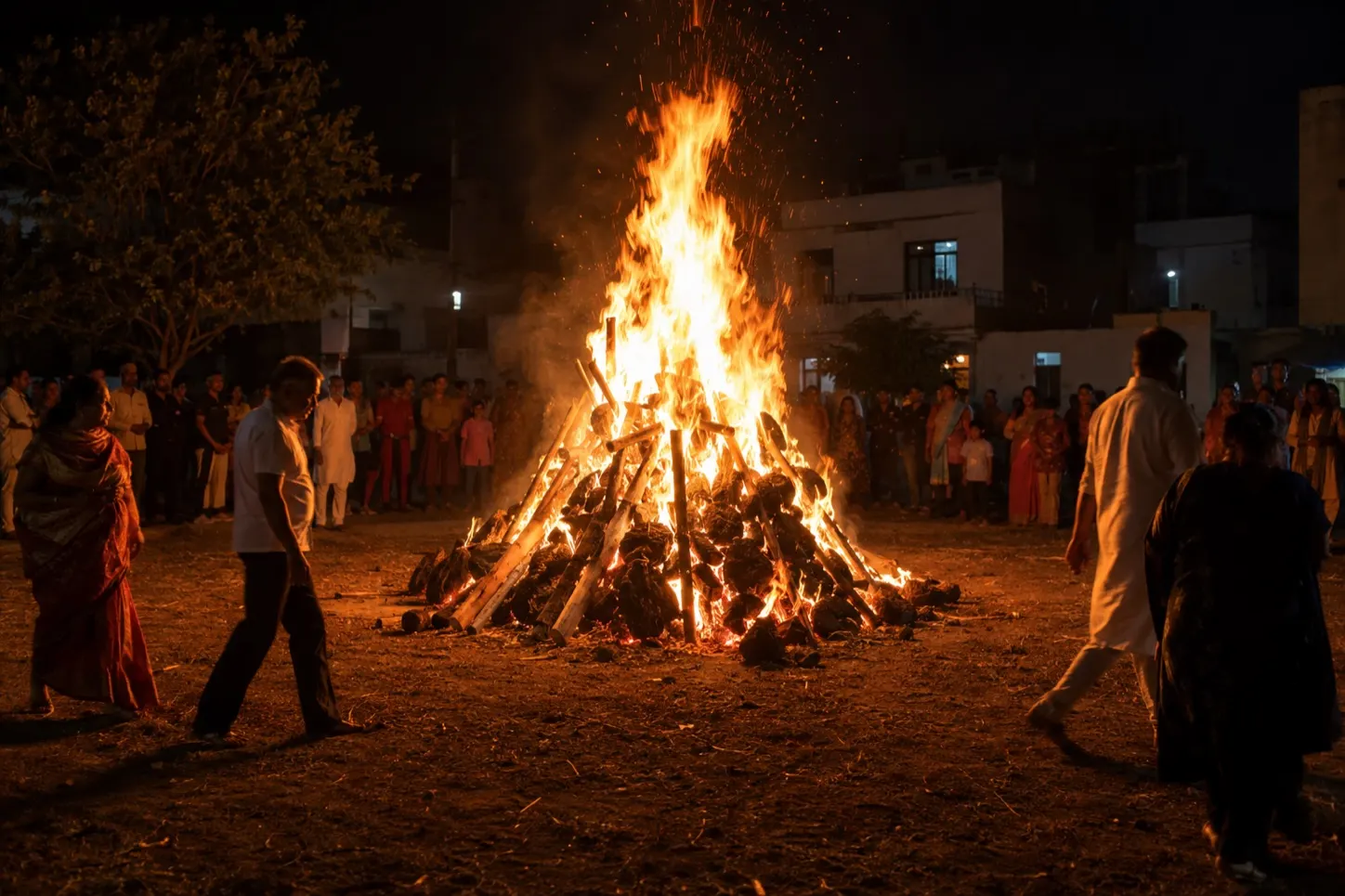
The night before. A pile of wood and dung cakes is built at a crossroads or in a courtyard days ahead and burned at the hour the panchang gives. People circle it, offer grain and coconut, and take a little ash. In many places new barley or wheat is roasted and eaten.
The morning after. Dry powder first, then water, then whatever is at hand. Households make gujiya, and in the north thandai — sometimes prepared with bhang, which is where a substantial fraction of Holi mishaps come from.
By afternoon it is over. People bathe, change, and visit relatives in clean clothes; the second half of Holi is entirely sedate, which visitors rarely expect.
How this changes across India
Holi in Braj — Mathura, Vrindavan, Barsana, Nandgaon
More than a week of it. Lathmar Holi at Barsana, flowers rather than powder at the Banke Bihari temple, and widows' Holi at Vrindavan, which is recent and deliberately corrective.
Holi in Bengal
Dol Jatra, on the Phalguna full moon itself — a day before the northern colour play. Images of Krishna and Radha are carried in a swing and colour is applied with far more restraint. Shantiniketan's Basanta Utsav was the famous public version, but Visva-Bharati has not opened it to visitors since 2019; what runs now is an internal programme, and travelling for it means being turned away.
Holi in Maharashtra and Goa
Shimga or Shigmo — processions, folk performance and temple palanquins over several days, with the colour a smaller part of it.
Punjab — and Hola Mohalla, which is not Holi
Holi is played in Punjab. Hola Mohalla is a different festival: Guru Gobind Singh established it at Anandpur Sahib in 1701 as a deliberate Sikh alternative, held over three days beginning the day after Holi — martial display, riding and mock combat rather than colour. Filing it as the Punjabi version of Holi is a common error and a resented one.
Holi in Manipur
Yaosang, five days from the Phalguna full moon. It is the Meitei festival, onto which Vaishnav Holi was layered after Vaishnavism spread in Manipur in the eighteenth century — not the other way round. Thabal chongba dancing at night.
Holi in Tamil Nadu and Kerala
Barely observed as Holi. The spring festivals of the far south — Panguni Uthiram, Vishu — sit at different points and have nothing to do with it.
Playing it abroad
Diaspora Holi is almost always an organised daytime event on the nearest weekend, at a temple, a community hall or a park, with powders sold in packets. That format solves several problems at once — supervision, cleanup, and a place for the people who do not want an unpredictable street version.
If you are taking children: oil their hair, use old clothes, keep the powder away from eyes and mouths, and check what the powder is made of. Several suppliers now sell food-grade or herbal colours, and the difference is noticeable by the evening.
Questions people ask
What is being burned in the bonfire?
An effigy of Holika, the demoness who sat in fire holding Prahlada and burned while he survived. In practice a household or a street builds a pile of wood and cow-dung cakes and burns it after the correct moment, which the panchang gives; new grain is roasted in it in agricultural areas, which is probably the older layer of the festival.
Is it safe to play Holi as a visitor?
Mostly, with care. The colours are often synthetic and can irritate eyes and skin — oil your skin and hair beforehand, wear clothes you will throw away, and use sunglasses. Bhang, a cannabis preparation, is legally sold in some states during Holi and is frequently far stronger than expected. Women visitors are advised in most guidance to play at organised or private events rather than in open street crowds.
Why is Holi such a big deal in Mathura and Vrindavan?
Because in the Braj region it is Krishna's festival, and the celebrations run for more than a week with forms found nowhere else — Lathmar Holi at Barsana, where women drive men off with sticks, and Phoolon wali Holi at Vrindavan, played with flowers.
Is there a serious side to it?
Yes, and it is worth naming. The suspension of ordinary rules is the point of the festival, and it is also what makes it a cover for harassment in some public settings. Many Indian women avoid street Holi for this reason. A page that describes only the joy of it is not describing the festival accurately.
Sources (3)
- Bhāgavata Purāṇa 7.2–7.10, for Prahlada and Hiranyakashipu — the attempts on Prahlada's life are at 7.5.43–44 — For Prahlada, Hiranyakashipu and the Holika episode
- McKim Marriott, 'The Feast of Love' — For the classic anthropological account of Holi's inversion of social order
- Printed panchang for the year and location — For the Holika Dahan muhurta, which is time-specific and not merely a date
Fact-checked by Ajay Gupta on 7 September 2026.
Something wrong here? Tell us — corrections are made in the open, and our editorial standards set out what checking a page involves.