Sacred India
Mathura and Vrindavan — Krishna's country
Two towns twelve kilometres apart, one where Krishna was born and one where he grew up, and a devotional world with its own music, calendar and language.
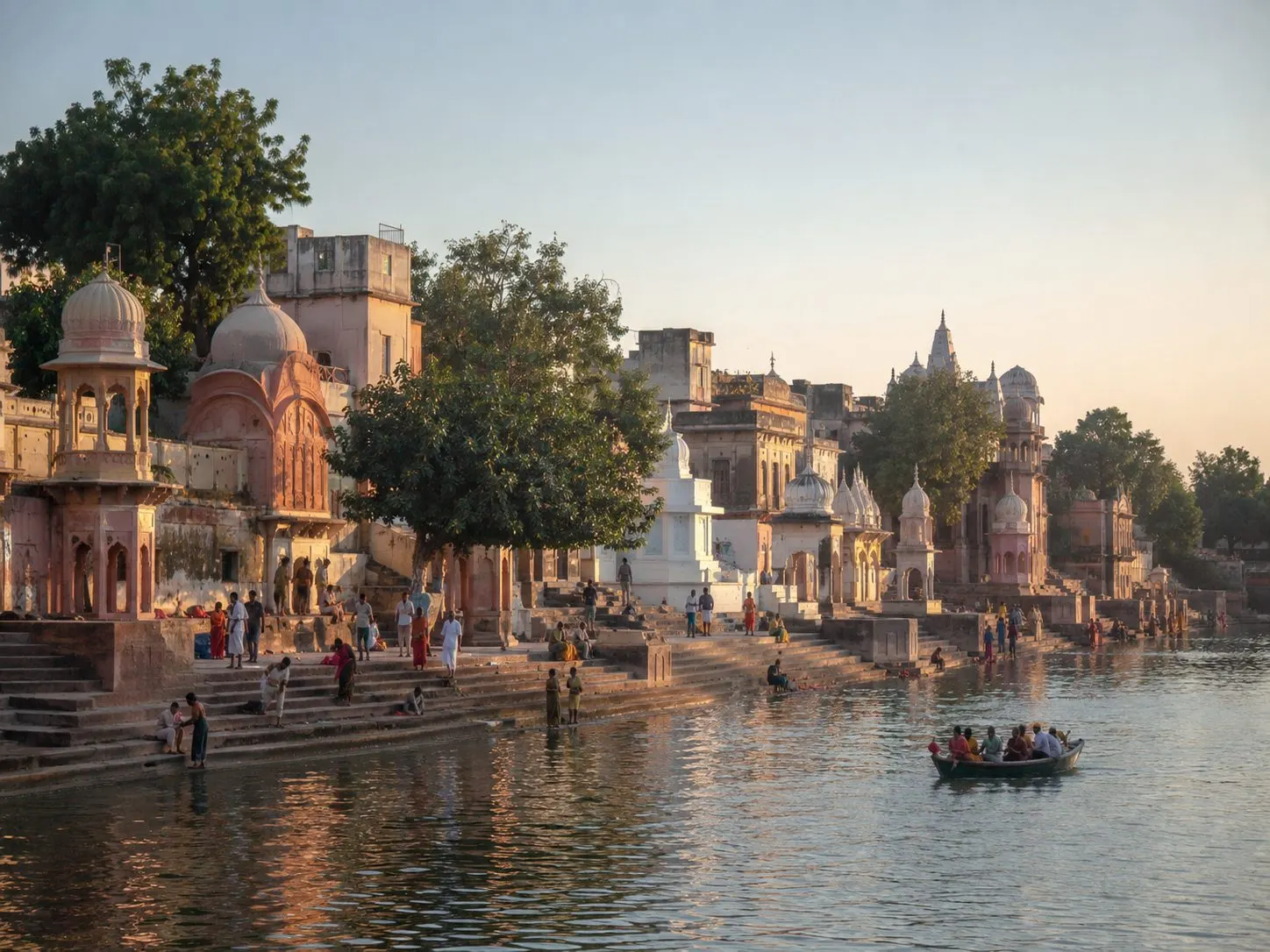
The short answer
Mathura is Krishna's birthplace; Vrindavan, twelve kilometres away, is where the childhood and youth stories are set. Together with the surrounding villages they form Braj, a devotional landscape with its own festivals, music and pilgrimage circuit.
Key facts
- Where
- Uttar Pradesh, about 150 km south of Delhi; Mathura and Vrindavan are 12 km apart
- Mathura
- Krishna Janmabhoomi, held to be the prison where Krishna was born; the Vishram Ghat on the Yamuna
- Vrindavan
- Banke Bihari, ISKCON Krishna-Balaram, Prem Mandir, Radha Raman, Nidhivan; the childhood and rāsa-līlā landscape
- The wider region
- Braj — Govardhan, Barsana, Nandgaon, Gokul; the Braj Chaurasi Kos parikrama circuit runs about 252 km
Before you go
- best time
- October to March. Holi and Janmashtami are extraordinary and extremely crowded
- security
- Krishna Janmabhoomi in Mathura has airport-level security; phones and bags are generally not permitted inside
- monkeys
- Langurs and rhesus macaques take glasses, phones and bags in Vrindavan, systematically. Hold everything
- crowds
- Banke Bihari can be dangerously crowded on festival days; there have been fatal crushes
Timings and rules at living temples change, and are set by the temple, not by us. Check with the temple before travelling.
The landscape as text
Braj is unusual among Indian sacred places in that the whole landscape is read as narrative. This is the pond where the serpent was subdued; this is the hill lifted on a finger; this grove is where the rāsa-līlā took place, and is closed after dark because it is held that the līlā continues there.
That is why the pilgrimage here is a circuit rather than a single shrine. The Braj Chaurasi Kos parikrama runs some 252 kilometres around the region, and pilgrims walk sections of it or the whole thing.
Mathura
A working city on the Yamuna with a much longer history than the Krishna association alone. In antiquity it was a major centre of Buddhist and Jain art — the Mathura school of sculpture is one of the two great early Indian schools — and the Government Museum holds a serious collection of it.
The Janmabhoomi complex marks the traditional birthplace. Security is heavy, the site adjoins a mosque, and the dispute over it is live and litigated. Vishram Ghat on the river is where the evening aarti happens and is a quieter introduction to the city.
Vrindavan
Dense, loud, devotional, and full of temples of very different ages and characters.
Banke Bihari is the emotional centre — a small, crowded temple where the curtain before the deity is drawn and closed repeatedly rather than left open, which devotees explain in terms of the deity's gaze being too much to sustain. Crowds here are severe on festival days and have been fatal; go early and on an ordinary day if you want to see it properly.
Radha Raman, Radha Damodar and the other Gauḍīya temples carry the Bengali Vaishnava tradition brought by Chaitanya's followers in the sixteenth century. ISKCON's Krishna-Balaram temple is the international one, and is the easiest entry point for a visitor who does not speak Hindi or Braj Bhasha. Prem Mandir is modern, enormous, marble and floodlit, and popular.
The part usually left out
Vrindavan is home to several thousand widowed women, many originally from Bengal, who came or were sent here after being widowed and live in ashrams, shelters and rented rooms, singing in bhajan ashrams in exchange for food and a small payment.
This has been documented for well over a century. Conditions have improved — government pensions, NGO shelters, some rehabilitation programmes — and remain poor for many. A visitor will see it, and a page about the town that describes only the temples is not describing the town.
How this changes across Braj
| Place | What happens there |
|---|---|
| Mathura | Birthplace; the Janmabhoomi complex, Vishram Ghat, and the antiquities museum. |
| Vrindavan | The childhood and youth landscape; the greatest concentration of temples and ashrams. |
| Govardhan | The hill lifted by Krishna; the 21 km parikrama around it, walked barefoot by many, and the Annakut offering after Diwali. |
| Barsana | Radha's village; Lathmar Holi, in which women drive men off with sticks, is held here and at Nandgaon. |
| Gokul and Mahavan | Where the infant Krishna was hidden and raised; quieter, and the setting for the butter-stealing stories. |
Questions people ask
What is the difference between Mathura and Vrindavan?
Mathura is the city of Krishna's birth and of his return as a king — a working city with a long history, including as a major Buddhist and Jain centre in antiquity. Vrindavan is the village landscape of the childhood and youth stories, and is now a dense town of temples, ashrams and pilgrims. The moods are entirely different.
When is the best time to see the festivals?
Holi in Braj runs for more than a week and includes forms found nowhere else — Lathmar Holi at Barsana, flower Holi at Banke Bihari. Janmashtami fills both towns. Both are worth planning for and both mean crowds on a scale that requires care.
What is the situation with the widows of Vrindavan?
Several thousand widowed women, many from Bengal, live in Vrindavan, historically abandoned by families and dependent on ashram shelters and alms. Conditions have improved through government and NGO programmes, and the situation is not resolved. It is a real part of what this town is, and worth knowing before visiting.
Is the Krishna Janmabhoomi site disputed?
Yes. The temple complex adjoins the Shahi Idgah mosque and the site is the subject of ongoing litigation and political contention. This site does not take a position on it; visitors should expect heavy security and should be aware that the subject is sensitive locally.
Sources (3)
- Bhāgavata Purāṇa, book 10 — For the Krishna narrative that the landscape is read through
- John Stratton Hawley, At Play with Krishna: Pilgrimage Dramas from Brindavan — For the performance traditions of Braj
- Reports of the National Commission for Women on widows in Vrindavan — For the situation of widowed women in the town
Fact-checked by Ajay Gupta on 7 September 2026.
Something wrong here? Tell us — corrections are made in the open, and our editorial standards set out what checking a page involves.