Sacred India
Madurai — the Meenakshi temple and the city around it
A temple where the goddess outranks the god, at the centre of a city laid out in concentric squares around her.
The short answer
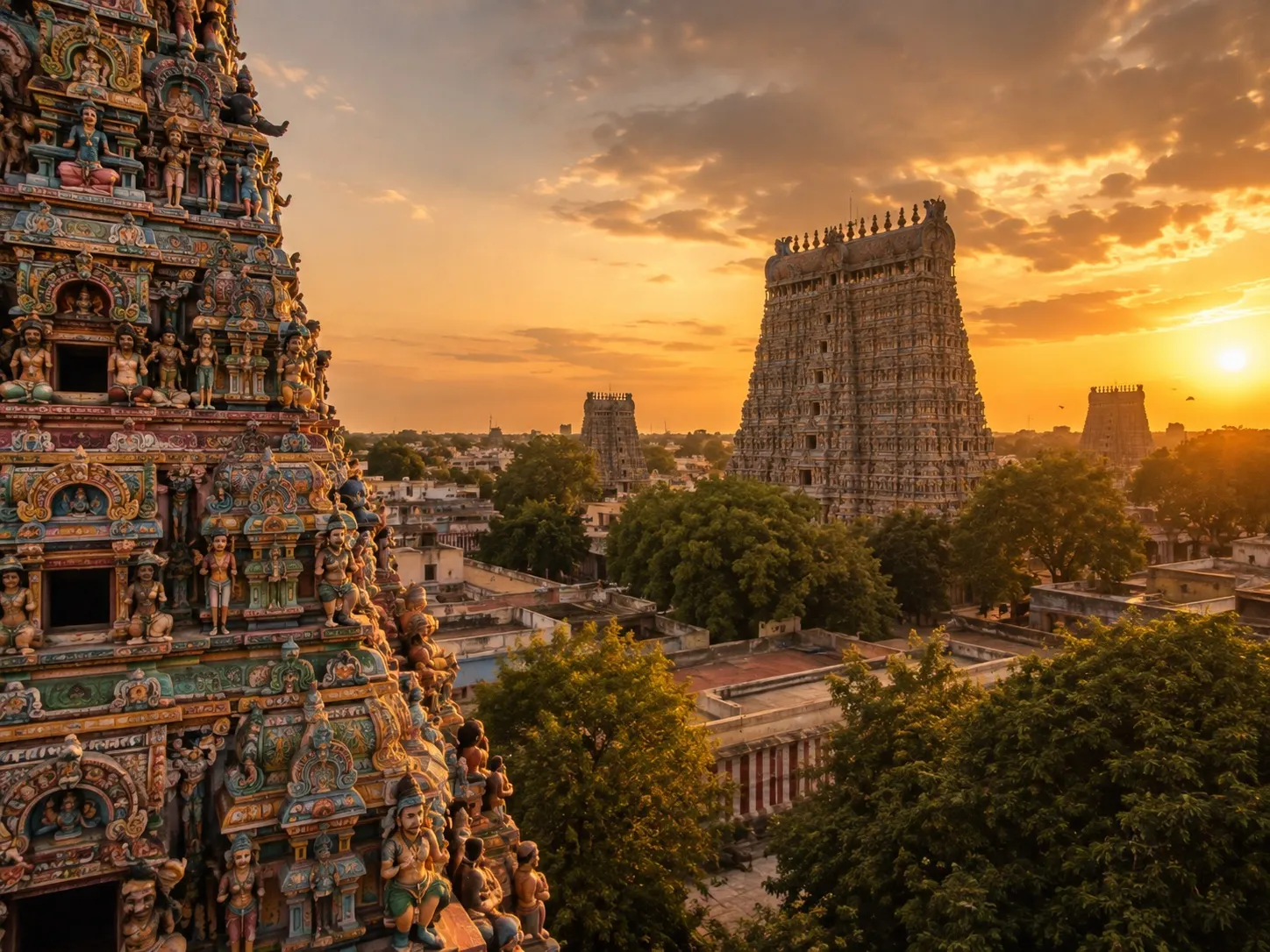
Meenakshi Amman temple in Madurai is dedicated to the goddess Meenakshi and to Shiva as Sundareswarar — and unusually, the goddess is the principal deity. The temple's fourteen gopurams are covered in thousands of painted figures, and the old city is laid out in concentric streets around it.
Key facts
- The deities
- Meenakshi, a form of Parvati, and Sundareswarar, Shiva; the goddess takes precedence, which is unusual
- Where
- Madurai, Tamil Nadu, on the Vaigai river. It appears in Sangam-era Tamil literature and, as Modoura, in Ptolemy's second-century geography
- The structure
- 14 gopurams, the tallest around 52 m; the Hall of a Thousand Pillars; the Potramarai Kulam tank
- The present buildings
- Largely 16th–17th century, rebuilt under Nayak rule after earlier destruction; the site is far older
Before you go
- dress
- Covered shoulders and knees; men are asked to remove shirts in parts of the inner precinct
- cameras
- Cameras and mobile phones are not allowed inside and must be deposited at the counters. Leather belts, wallets and bags are also barred, and footwear is left outside
- the night ceremony
- The palliyarai puja, in which Sundareswarar is carried to Meenakshi's chamber for the night, is held each evening
- hours
- Roughly 05:00–12:30 and 16:00–22:00. It closes in the middle of the day, which catches out visitors who arrive after lunch — check locally before setting out
- when
- November to February for weather; the Chithirai festival in April–May is the largest and hottest. A Maha Kumbabhishekam — the consecration held once in many years — is scheduled for 17 September 2026
Timings and rules at living temples change, and are set by the temple, not by us. Check with the temple before travelling.
The plan of the city
Madurai's old city is laid out in concentric rectangles around the temple — streets named for the months and for the processional routes, with the temple at the centre and the city arranged as a set of frames around it.
That plan is the clearest surviving example in India of a temple city built as a mandala. Walking one of the outer streets and then working inward is a better introduction to the place than arriving at the gate by car.
The temple
Fourteen gopurams — towered gateways — rise over the walls, the tallest around fifty-two metres, and every surface of them is covered in painted stucco figures: deities, demons, animals, guardians, stacked in tiers. They are repainted periodically, which is why they look bright rather than weathered, and which occasionally upsets visitors who expect ancient stone.
Inside: the Potramarai Kulam, the golden lotus tank, with a colonnade around it; the Hall of a Thousand Pillars, now partly a museum, where the carving on individual columns is worth the time; the two main sanctums, Meenakshi's and Sundareswarar's; and the musical pillars, which ring when struck, in the outer precinct.
The building you see is largely sixteenth and seventeenth century, from the Nayak period, on a much older site that was damaged in the fourteenth century.
The goddess who outranks her husband
Most Shaiva temples are Shiva's, with the goddess in a subordinate shrine. Madurai reverses it, and the reversal is not incidental — it runs through the liturgy, the festival calendar and the city's identity.
The story is told in the Tiruviḷaiyāṭal Purāṇam: Meenakshi, born to the Pandyan king with three breasts and a prophecy attached, becomes a conqueror, meets Shiva at Kailasa, loses the third breast as foretold, and returns to Madurai as its ruler with Shiva as her consort. The annual Chithirai festival celebrates the coronation and the marriage, in that order — and then, in its second half, brings Alagar down from his hills to the river, a Vaishnava procession folded into a Shaiva festival by a seventeenth-century king.
The evening ceremony
Each night, Sundareswarar is carried in procession to Meenakshi's chamber and returned in the morning. It is a domestic ritual performed at scale — the god going to bed with his wife — and it is one of the more affecting things to witness in a South Indian temple because of how ordinary its logic is.
How this changes across the great Tamil temples
| Temple | What differs |
|---|---|
| Madurai Meenakshi | Goddess-primary, urban, and the most complete example of a temple city plan. |
| Thanjavur Brihadisvara | Chola, eleventh century, and architecturally the opposite: severe, monumental, with a vimāna over the sanctum rather than gopurams dominating. |
| Chidambaram Nataraja | Shiva as the dancer, with the cit sabhā and the ritual of the empty space — the Chidambaram Rahasya. |
| Srirangam | Vaishnava, the largest functioning complex in India by area, with seven concentric enclosures. |
| Rameswaram | Long corridors and sacred tanks, and the pilgrimage link between Varanasi and the southern tip. |
Questions people ask
Why is the goddess the main deity?
Because the temple's own narrative makes her so. Meenakshi is a Pandyan princess born with three breasts, prophesied to lose the third when she meets the man she will marry; she conquers the world, meets Shiva, and the third breast disappears. She then rules Madurai. The temple treats her as the sovereign and Shiva as the consort who came to her city — the reverse of the usual arrangement.
What is the Chithirai festival?
The celebration of Meenakshi's coronation and her marriage to Sundareswarar, held in April–May. The wedding itself runs about a fortnight, and the wider festival close to a month. The part visitors are often unprepared for is the second half: Alagar, the Vishnu of Alagar Koyil, travels to Madurai as Meenakshi's brother and enters the Vaigai on a golden horse — then turns back without entering the city. Accounts differ as to why, one holding that he came to give his sister away and another that he arrived too late for the wedding; the tradition carries both. A Shaiva and a Vaishnava festival were merged under Tirumalai Nayak in the seventeenth century, which is why the two run together. The crowds are very large and the heat is severe.
Can non-Hindus enter?
Non-Hindus may enter the outer precincts and see the gopurams, the tank and the pillared halls. Access to the inner sanctums is restricted to Hindus, and the restriction is enforced.
How long does a visit take?
Two to three hours does the main precincts unhurried. A proper look at the sculpture on the gopurams and the Thousand Pillar Hall takes longer, and going twice — once early morning, once for the evening ceremony — is better than one long visit.
Sources (3)
- Tiruviḷaiyāṭal Purāṇam — For the Madurai sthala purāṇa and the Meenakshi narrative
- George Michell, The Hindu Temple: An Introduction to Its Meaning and Forms — For gopuram architecture and the Dravidian temple plan
- Archaeological Survey of India documentation on the Madurai complex — For the dating of the surviving structures
Fact-checked by Ajay Gupta on 7 September 2026.
Something wrong here? Tell us — corrections are made in the open, and our editorial standards set out what checking a page involves.