Festivals
Navratri — nine nights, and four different festivals
Nine nights of the Goddess, kept so differently across India that the same festival is barely recognisable between two states.
The short answer
Navratri is nine nights of worship of the Goddess, the autumn one ending in Vijayadashami. Even the shape of it varies: Bengal keeps five days of Durga Puja, Kerala the last three. What happens during them varies more — garba in Gujarat, Durga Puja in Bengal, golu displays in Tamil Nadu, and a fast that runs from strict to nominal.
Key facts
- Also called
- Navarātri (nine nights); Durga Puja in Bengal and the east; Bommai Golu in Tamil Nadu, Gombe Habba in Karnataka, Bommala Koluvu in Andhra; Bathukamma in Telangana
- When
- The bright fortnight of Ashvina, ending on the tenth day, Vijayadashami. There are four Navratris in the year: this one, Chaitra Navratri in spring — which ends in Rama Navami, not Vijayadashami — and two Gupta Navratris in Magha and Ashadha, kept privately rather than publicly
- The nine forms
- Navadurgā — Shailaputri, Brahmacharini, Chandraghanta, Kushmanda, Skandamata, Katyayani, Kalaratri, Mahagauri, Siddhidatri
- The tenth day
- Vijayadashami or Dussehra — Rama's victory over Ravana in the north, Durga's over Mahishasura in the east
- Fasting
- Common but not uniform: many keep a grain-free diet, some fast on the first and eighth days only, and many households do not fast at all
The story
Two, depending on where you are.
In the east and much of the north, Mahishasura — a buffalo demon with a boon protecting him from men and gods — is defeated by Durga, created from the combined power of the gods and armed by each of them. The battle runs nine nights; the tenth day is her victory.
In much of the north, the same tenth day is Rama's victory over Ravana, and the Ramlila performances of the preceding nights lead to the burning of Ravana's effigy at Dussehra.
Both are held, and in most places they sit together without friction. The Bengali tradition supplies the join: Rama is said to have woken the Goddess out of season to ask her help against Ravana — the akāl bodhan, the untimely awakening, which is why her great worship falls in autumn. That episode is in Krittibas's fifteenth-century Bengali Rāmāyaṇ, not in Valmiki.
What it means
The nine nights are a sustained approach to the Goddess: nine forms, worshipped in sequence, from the mountain's daughter through the fierce Kalaratri to Siddhidatri, the granter of attainment. Households that keep the sequence change the colour they wear each day, which is a modern refinement widely adopted.
Underneath the theology is a seasonal marker. The autumn Navratri sits at the end of the monsoon and the start of the harvest, and the spring one at the other turn of the agricultural year. The barley sown in a pot on the first day and cut on the tenth — khetri — is the clearest surviving trace of that.
How it is kept
- GhatasthapanaOn the first day a pot is installed, barley sown in soil around it, and a lamp lit that will burn for the nine nights.
- The nine nightsWorship each evening, one form of the Goddess a night; a fast in many households; garba or dandiya where that is the tradition.
- Ashtami and NavamiThe eighth and ninth days carry the heaviest observance — Sandhi Puja in the Bengali tradition, and Kanya Pujan, where young girls are fed and honoured, in the north.
- VijayadashamiThe tenth day. Effigies burned in the north, images immersed in the east, tools and books worshipped in the south and west, and children begun on their first letters.
How this changes across India
Navratri in Gujarat
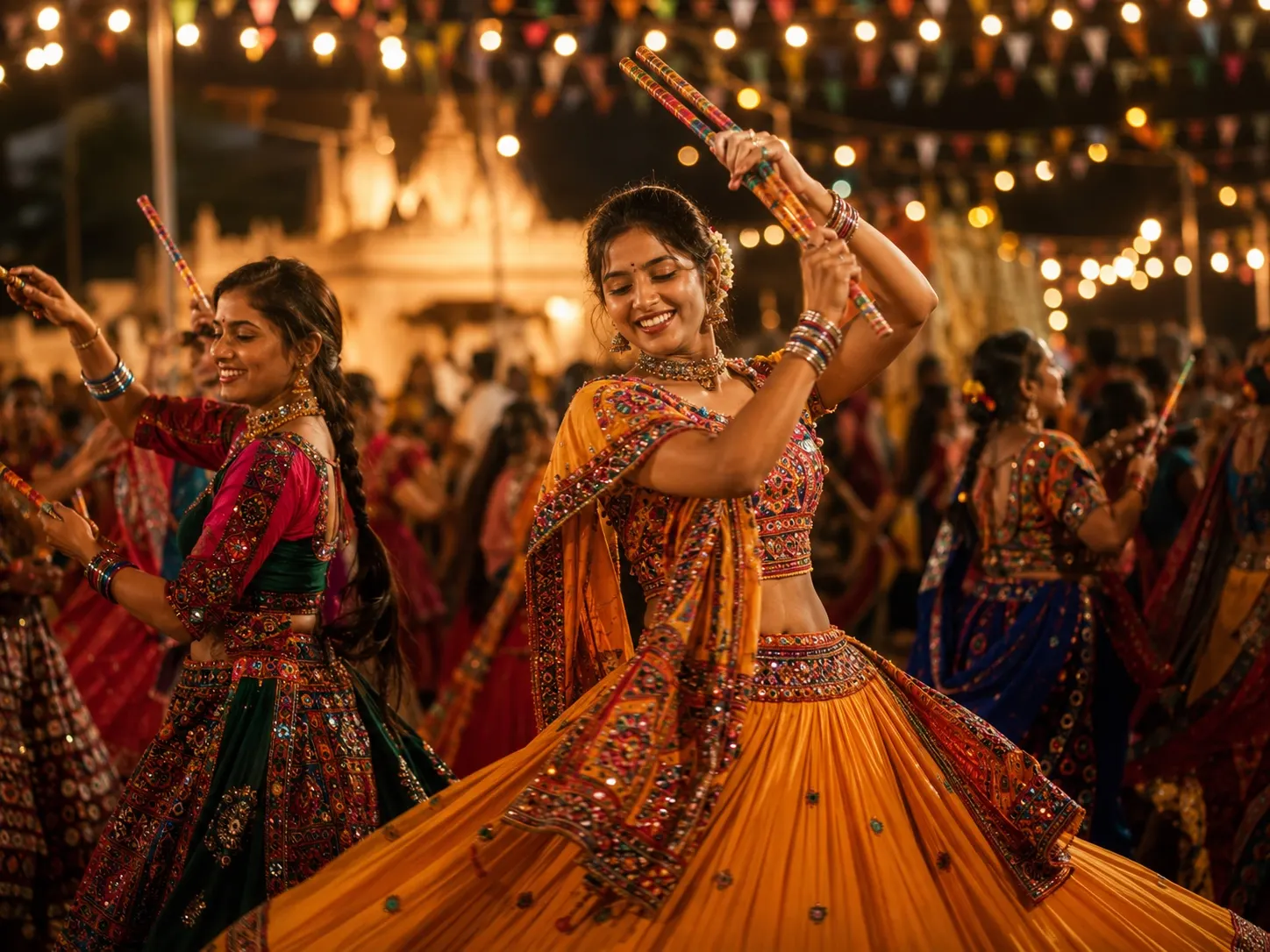
Nine nights of garba and dandiya raas circling a perforated lamp-pot, beginning after the evening aarti. The dance is the observance.
Navratri in Bengal, Assam, Odisha
Durga Puja: four days of public worship at community pandals with commissioned clay images, ending in immersion. The scale is civic rather than domestic.
Navratri in Tamil Nadu, Karnataka, Andhra
The stepped display of dolls at home, with visiting between households and Saraswati Puja on the ninth day — Bommai Golu in Tamil Nadu, Gombe Habba in Karnataka, Bommala Koluvu in Andhra. Ayudha Puja, when tools, instruments and vehicles are worshipped, falls on Mahanavami. Mysuru's Dasara procession, the Jamboo Savari, is the public counterpart and is Karnataka's state festival.
Navratri in Telangana
Bathukamma: nine days of women stacking seasonal flowers into conical arrangements, floated on water at the end. It runs from Mahalaya Amavasya to Saddula Bathukamma and is a Telangana state festival — a distinct observance rather than a variant of the golu kept next door.
Navratri in North India
Ramlila performances through the nine nights, fasting, Kanya Pujan on Ashtami or Navami, and Ravana's effigy burned on Dussehra.
Navratri in Maharashtra
Ghatasthapana and bhondla or hadga songs; Vijayadashami is a day for beginning things and for exchanging apta leaves as symbolic gold.
Navratri in Kerala
The last three days only, as Vidyarambham: a child's first letters are written in rice on Vijayadashami, and books and tools are worshipped.
Keeping it abroad
Garba and dandiya travel better than almost any other Indian festival practice, because they need a hall, music and people rather than a priest or a consecrated space. Most large diaspora cities now run ticketed garba nights across the nine nights, and they are the single most reliable place to find a crowd of second-generation attendees who arrived for the dancing.
Durga Puja abroad is harder and more impressive: a committee, a shipped or locally made image, a priest, and a river or a tank willing to accept an immersion. Where it happens, it is usually the largest annual gathering of the local Bengali community, and the immersion is often replaced by a symbolic one in a tank for environmental reasons.
Questions people ask
How can Durga Puja and Navratri be the same festival?
They fall on the same nine nights and worship the same Goddess, but the ritual centres differ entirely. Bengal's is a public, image-centred festival concentrated in the last four days, with clay images immersed at the end. Gujarat's is nine nights of dance around a lamp. Tamil Nadu's is a household display of dolls. They are regional forms of one festival, not versions of each other.
What is a golu?
A tiered display of dolls and figurines set up in the house for the nine nights — deities, but also scenes of village life, weddings, and often something contemporary. Women and children visit each other's displays, sing, and are sent home with turmeric, kumkum and a small gift.
Is garba religious or social?
Both, and the balance has shifted. The dance circles a lamp or an image of the Goddess and begins after the evening aarti; commercial garba events with ticketing and sponsorship are now a large part of it in Gujarat and in the diaspora.
What can be eaten during the fast?
Where a fast is kept it usually excludes grains, pulses, onion and garlic. Buckwheat, water chestnut flour, samak rice, potatoes, dairy and rock salt are the standard substitutes. Practice varies by community, and there is no single list.
Sources (3)
- Devī Māhātmya (Durgā Saptaśatī), chapters 81–93 of the Mārkaṇḍeya Purāṇa — For the Mahishasura narrative and the forms of the Goddess
- Tulsīdās, Rāmcaritmānas — the recension Ramlila follows; and Krittibas's Bengali Rāmāyaṇ for the akāl bodhan, which is not in Valmiki — For the northern Dussehra association
- Printed panchang for the year and location — For the dates, which shift and occasionally compress to eight days
Fact-checked by Ajay Gupta on 7 September 2026.
Something wrong here? Tell us — corrections are made in the open, and our editorial standards set out what checking a page involves.