History & Civilization
India's extraordinary stepwells
Inverted architecture — buildings that go down rather than up, built to reach water in places where water was the whole problem.
The short answer
A stepwell is a well reached by descending stairs, built across western India from roughly the 6th century onwards. They gave year-round access to groundwater as the water table rose and fell, and the largest are architecturally elaborate public buildings.
Key facts
- Names
- Vāv or vāvadi in Gujarat, bāoli or bāvdi in Rajasthan and the north, kalyāṇi or puṣkariṇī in the south
- When
- From roughly the 6th century CE; the greatest examples are 11th to 16th century
- Where
- Concentrated in Gujarat and Rajasthan, with examples across western and central India and in Delhi
- Rani ki Vav
- Patan, Gujarat, 11th century; a UNESCO World Heritage Site, and depicted on the Indian 100-rupee note
- Chand Baori
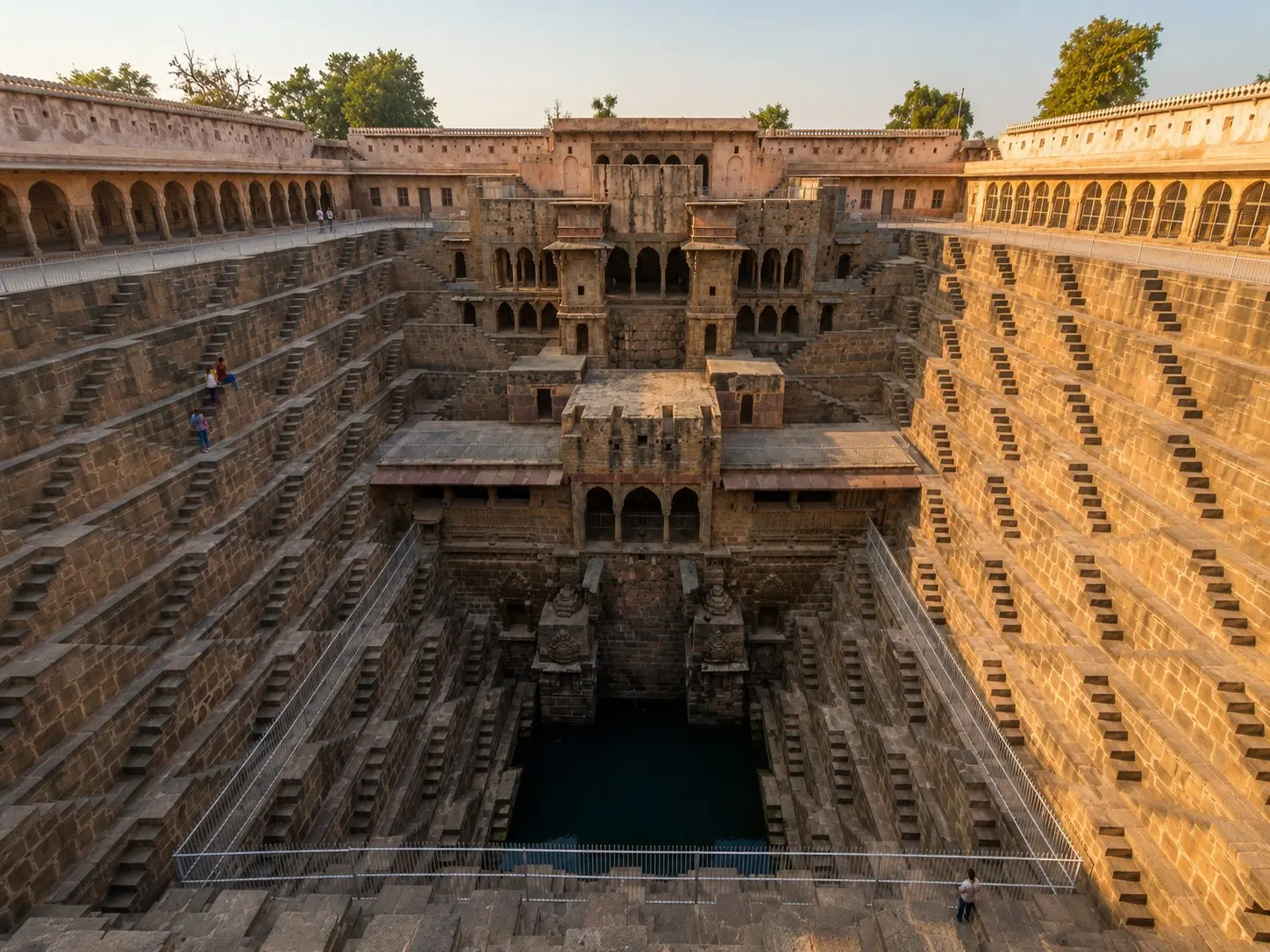
- Abhaneri, Rajasthan; around 3,500 steps in thirteen storeys, one of the deepest
The problem they solve
In western India the monsoon delivers most of the year's rain in a few weeks, and then nothing for months. The water table falls steadily through the dry season.
A conventional well gives you a rope and a bucket at one level. A stepwell gives you a staircase that follows the water down — usable in September when the water is high and again in May when it has fallen far below the surface.
That is the entire engineering idea, and everything else follows from it.
What they became
Once you have built a large excavated structure with a staircase, you have also built the coolest public space for miles. Temperatures at the bottom of a deep stepwell run several degrees below the surface, and the shade is constant.
So they acquired functions: pavilions to rest in, shrines in the wall niches, sculpture across every surface, and a social role — particularly for women, who did the water-carrying and for whom the stepwell was one of the few sanctioned places to gather outside the house.
Who counted as the public was regulated by caste. Dalit communities were kept from wells and tanks that caste Hindus drew from — the restriction Ambedkar's satyagraha at the Chavdar tank in Mahad in March 1927 was mounted against, and that Article 17 of the Constitution abolished in 1950.
Several of the finest were commissioned by women. Rani ki Vav at Patan was built by Queen Udayamati in memory of her husband. Adalaj was begun by Rana Veer Singh of the Vaghela dynasty and completed under Mahmud Begada, who had killed him — and the story attached to its completion, in which Veer Singh's queen Rudabai agrees to marry Begada on condition that he finish the well and then takes her own life once it is done, is part of how the building is remembered.
The great ones
Rani ki Vav, Patan, Gujarat. Eleventh century, seven storeys, and more than five hundred principal sculptures — mostly Vishnu in his avatars, and a remarkable series of women's figures. Silted up for centuries, which preserved it, and excavated in the twentieth century.
Adalaj ni Vav, near Ahmedabad. Fifteenth century, five storeys, octagonal opening, and a mixture of Hindu and Islamic ornament that makes it one of the best examples of the shared architectural vocabulary of the period.
Chand Baori, Abhaneri, Rajasthan. Around three and a half thousand steps descending three sides in a geometric lattice, thirteen storeys deep, with a pavilion on the fourth. The most photographed, and the most disorientating in person.
Agrasen ki Baoli, Delhi. Off Hailey Road, a few minutes from Connaught Place, unexpectedly, at the end of a lane.
What happened to them
Piped supply and, later, borewells removed the need. Colonial administrations discouraged them as insanitary — standing water and a communal descent, in the germ theory era, looked like a problem. Many were closed, filled or abandoned; a great many silted up.
The recent turn is interesting. Groundwater depletion across western India has made recharge structures valuable again, and several stepwells have been desilted and returned to use — not as a heritage gesture but because they still work.
How this changes across regions
| Where | What differs |
|---|---|
| Gujarat | Vāv — long, linear, often east-west, with elaborately sculpted storeys; the greatest concentration of the finest examples. |
| Rajasthan | Bāoli — often square and geometric, with staircases on multiple sides; Chand Baori is the extreme case. |
| Delhi and the north | Sultanate-period baolis, plainer, built into urban fabric; several survive in the middle of the modern city. |
| Deccan | Stepped tanks attached to temples — puṣkariṇī — where the ritual function leads and the water supply follows. |
| Karnataka | The stepped tank at Hampi, precise and terraced, built to a different aesthetic again. |
Questions people ask
Why build downwards instead of just digging a well?
Because the water table moves. A vertical well with a rope works at one depth; a stepwell lets people walk down to whatever level the water has fallen to, in summer as well as after the monsoon. The steps are the mechanism, not decoration.
Were they only for water?
No. The larger ones were social and religious buildings — cool in summer, shaded, with pavilions and sculpture, used as resting places on trade routes and as spaces where women who came for water gathered — though who was permitted to draw from a given well was regulated by caste. Several are attached to temples, and several were built by women.
What happened to them?
Piped water and borewells removed the need, colonial administrations discouraged them on hygiene grounds, and many silted up, were filled in, or became rubbish dumps. A number have been restored in the last two decades, and some are being brought back into use as groundwater recharge structures.
Which are worth visiting?
Rani ki Vav at Patan for the sculpture; Adalaj near Ahmedabad for its intact structure and its story; Chand Baori at Abhaneri for the sheer geometry; Agrasen ki Baoli in central Delhi for being suddenly there in the middle of the city.
Sources (5)
- Jutta Jain-Neubauer, The Stepwells of Gujarat — For the architectural typology and the Gujarat examples
- Morna Livingston, Steps to Water: The Ancient Stepwells of India — For a survey with photography and regional coverage
- UNESCO World Heritage documentation for Rani ki Vav — For the dating and conservation history of the Patan stepwell
- Constitution of India, Article 17 — For the abolition of untouchability; the Protection of Civil Rights Act 1955 carries the penalties
- B. R. Ambedkar, and the record of the Mahad satyagraha of March 1927 — For the contest over access to public water, which is the standard case in this history
Fact-checked by Ajay Gupta on 7 September 2026.
Something wrong here? Tell us — corrections are made in the open, and our editorial standards set out what checking a page involves.