Food & Cuisine
The six tastes of Ayurveda
A classification of taste that still governs how a South Indian meal is sequenced, whatever you make of the medicine around it.
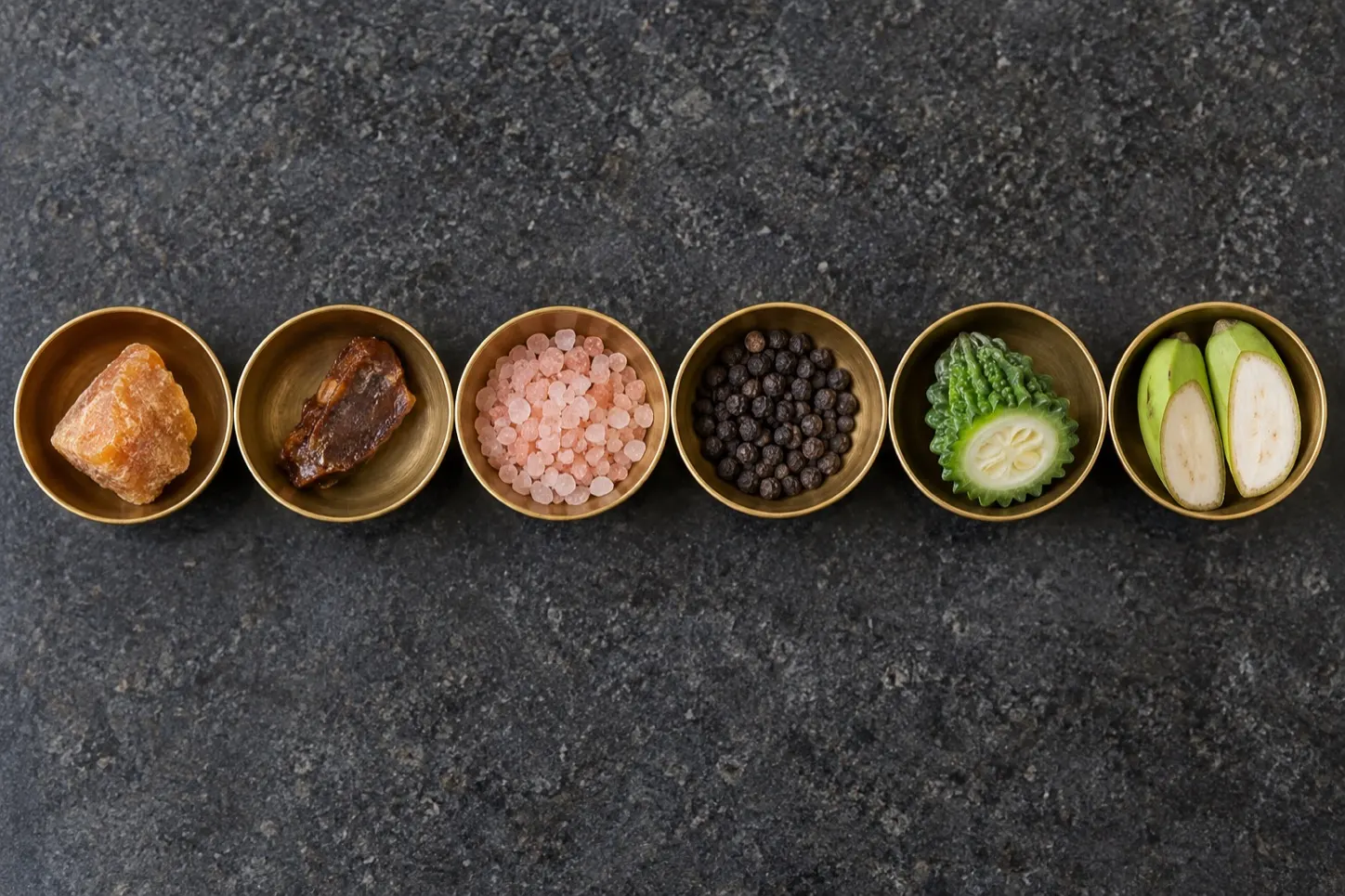
The short answer
Ayurveda classifies taste into six — sweet, sour, salty, pungent, bitter and astringent — and holds that a balanced meal contains all six. The scheme also governs which tastes are held to increase or reduce each of the three doshas.
Key facts
- The six
- Madhura (sweet), amla (sour), lavaṇa (salty), kaṭu (pungent), tikta (bitter), kaṣāya (astringent)
- The principle
- All six in a meal, in proportions adjusted to constitution, season and condition
- The elements
- Each taste is analysed as a combination of two of the five elements — the scheme is systematic rather than impressionistic
- Astringent
- The one with no English culinary equivalent — the drying, puckering quality of unripe banana, turmeric, many pulses and strong tea
- Where it shows
- The Bengali course sequence, the Kerala sadya, the components of a thali, and the Ugadi pachadi that contains all six deliberately
The six
| Taste | Sanskrit | Where you meet it |
|---|---|---|
| Sweet | madhura | Grains, milk, ghee, ripe fruit, jaggery — and, importantly, rice and wheat rather than only sugar |
| Sour | amla | Tamarind, lime, curd, kokum, raw mango, fermented batters |
| Salty | lavaṇa | Salt, and salted preparations such as pickle and papad |
| Pungent | kaṭu | Chilli, black pepper, ginger, mustard, asafoetida |
| Bitter | tikta | Bitter gourd, fenugreek, neem, many greens, turmeric |
| Astringent | kaṣāya | Unripe banana, pomegranate, pulses, tea, turmeric again |
Note that "sweet" in this scheme is a much larger category than in English — it covers the staple grains, which is why a plain rice meal is not considered devoid of the sweet taste.
How the scheme is used
The classical rule is that all six should appear in a meal, and that their proportions should be adjusted for the person, the season and the condition. A heavy, cold, damp constitution is prescribed more of the pungent, bitter and astringent; a dry, light one more of the sweet, sour and salty.
The practical consequence is a bias towards composite meals: several small dishes rather than one large one, which is exactly what a thali or a sadya is.
Where you can see it operating
The Bengali course sequence. Bitter first — shukto — then greens, then dal, then the substantial dishes, then sour chutney and sweet at the end. That is the six-taste scheme laid out in time rather than across a plate.
The Kerala sadya. Two dozen items on a leaf, in fixed positions, covering every taste. Payasam is the sweet course rather than the close — the meal ends with rice and moru, spiced buttermilk.
Ugadi pachadi. The Telugu and Kannada new year preparation that contains neem flowers, jaggery, tamarind, salt, chilli and raw mango — bitter, sweet, sour, salty, pungent and astringent, eaten together deliberately as a statement that the year will contain all of them.
That last one is the clearest evidence that the framework is not merely a medical theory but a cultural one.
How this changes across India
| Where | How the scheme shows up |
|---|---|
| Kerala | Ayurvedic practice is strongest here, and the sadya is the clearest six-taste meal in the country. |
| Bengal | The course sequence follows the taste order explicitly, bitter to sweet. |
| Tamil Nadu | Sambar, rasam and curd in sequence with rice; each stage shifts the dominant taste. |
| Andhra and Karnataka | Ugadi pachadi as a formal six-taste preparation at the new year. |
| North India | The framework is present in principle — pickle, chutney, yoghurt, a bitter vegetable — but less explicitly sequenced. |
Questions people ask
What is astringency, exactly?
A tactile quality rather than a taste in the narrow sense — the drying sensation from tannins. Unripe banana, pomegranate, many lentils, turmeric and over-brewed tea all have it. English cooking vocabulary lacks a word for it, which is why the six-taste scheme reads as five plus one to English speakers.
Do the six tastes have a nutritional basis?
Loosely and partially. A meal containing all six will in practice contain a range of food groups, and bitter and astringent items are often vegetables and pulses. But the framework is a classical system reasoning from its own principles, not a set of findings, and the dosha claims specifically have not been established in clinical terms.
Which tastes suit which dosha?
In the classical scheme, sweet, sour and salty increase kapha and reduce vata; pungent, bitter and astringent reduce kapha and increase vata; sour, salty and pungent increase pitta while sweet, bitter and astringent reduce it. Practitioners use this to adjust a diet rather than to prescribe a fixed menu.
Is this why Indian meals have so many components?
It is one reason and probably not the first. The completeness principle is genuinely reflected in the thali, the sadya and the Bengali sequence. Availability, agriculture and the practicalities of feeding a household did at least as much work.
Sources (3)
- Caraka Saṃhitā, Sūtrasthāna — For the six tastes and their relation to the doshas
- Suśruta Saṃhitā — For the parallel treatment of taste and digestion
- NIH National Center for Complementary and Integrative Health, Ayurveda summary — For the current state of evidence on Ayurvedic dietary claims
Fact-checked by Ajay Gupta on 7 September 2026.
Something wrong here? Tell us — corrections are made in the open, and our editorial standards set out what checking a page involves.