Food & Cuisine
What makes a traditional Indian thali
Not a sampler platter. A complete meal with a fixed logic, arranged in an order that is doing something.
The short answer
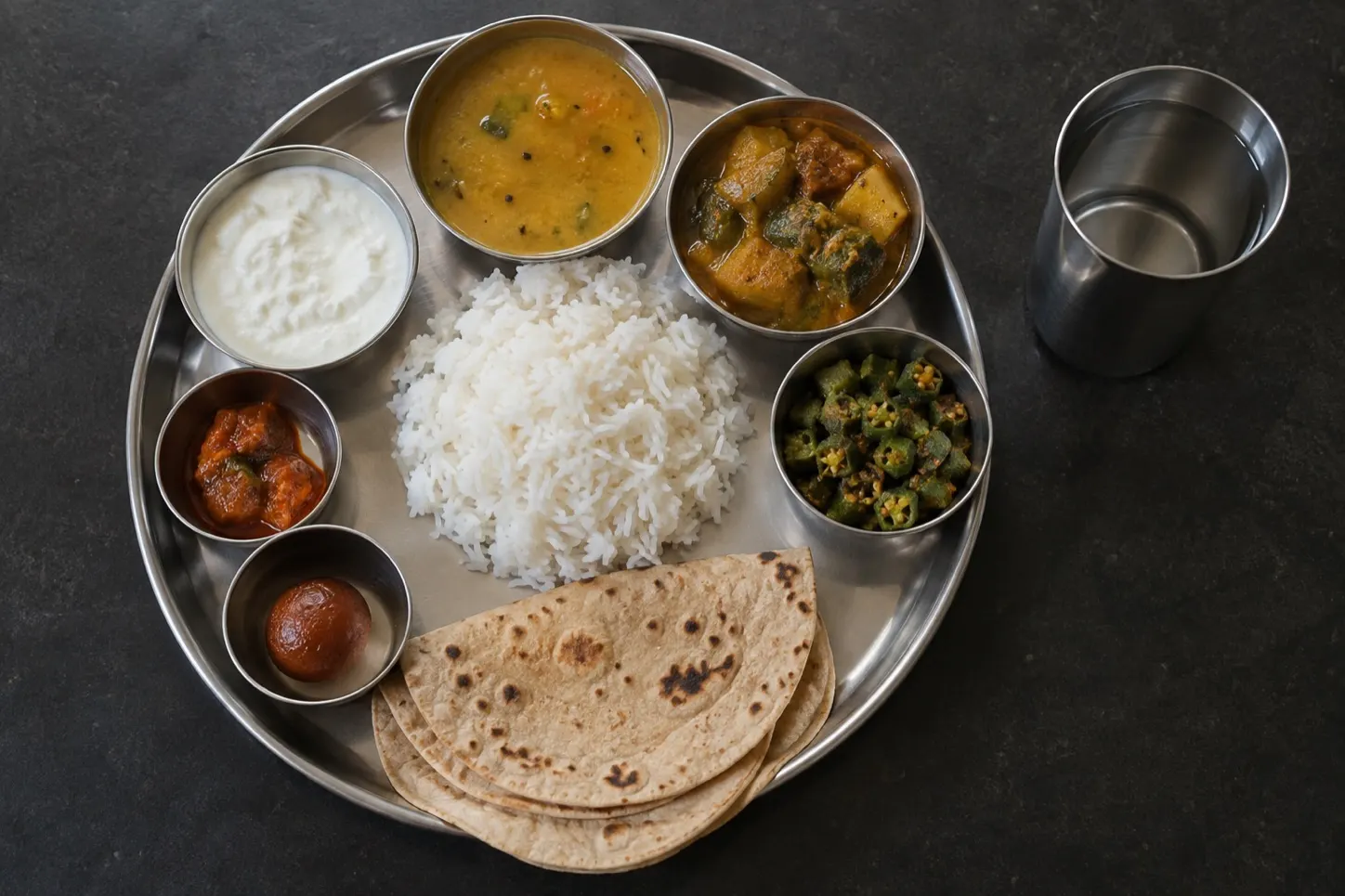
A thali is a full meal served together on one plate: a grain, a lentil dish, two or three vegetables, yoghurt, pickle, a sweet and a bread, arranged in a fixed order. The point is completeness — every taste and every food group in one service.
Key facts
- The word
- Thālī simply means a plate — the round metal one; the meal took the name of the vessel
- What is on it
- Rice and/or flatbread, dal, two or three vegetable dishes, yoghurt, pickle, papad, chutney, a sweet
- The arrangement
- Wet items in katoris around the rim, dry items and grain in the centre; sweet and pickle at fixed positions
- The principle
- All six tastes — sweet, sour, salty, bitter, pungent, astringent — present in one meal
- Refills
- In a traditional thali service, everything except the sweet is refilled until you stop it
The idea
A thali is not a tasting menu, though it is often presented abroad as one. It is a complete meal delivered in one service, built so that nothing is missing.
The classical framework behind it is the six tastes — sweet, sour, salty, bitter, pungent and astringent — which Ayurvedic texts hold should all appear in a balanced meal. A thali is that idea made practical: something sweet, something sour, a pickle for salt and pungency, a bitter or astringent vegetable, and the neutral bulk of grain to carry them.
The arrangement
The layout is not decorative. Wet dishes go in small bowls — katoris — around the rim; rice and bread occupy the centre; pickle, chutney, salt and the sweet sit at fixed positions, which vary by region but not within one.
That fixity has a practical purpose. A diner eating with their hands, not looking at the plate, reaches for the right thing.
How to eat one
- Take a little of everything before you decide what you like. The meal is composed; eating one bowl to the bottom first is eating it wrong.
- Mix on the plate, not in the bowl. Rice is combined with dal or sambar in the centre of the thali, a portion at a time.
- Expect refills of everything except the sweet, and say when to stop.
- The sequence, where there is one: in the south, sambar first, then rasam, then curd, each with rice. In Gujarat, the sweet early. In Bengal, bitter first.
How this changes across India
| Where | What is on it |
|---|---|
| Gujarat | Rotli, rice, dal or kadhi, two vegetables, farsan, sweet, pickle, chutney, papad, buttermilk. Continuous refills. |
| Rajasthan | Dal baati churma, gatte, ker sangri, bajra roti, ghee in quantity. |
| Tamil Nadu (leaf meal) | Rice with sambar, rasam and curd in sequence; poriyal, kootu, appalam, pickle, payasam. |
| Kerala (sadya) | Up to two dozen items on a banana leaf in a set order, ending in payasam; entirely vegetarian, served at Onam and at weddings. |
| Bengal | Served in courses rather than all at once — bitter, greens, dal, vegetables, fish, chutney, sweet. |
| Maharashtra | Bhakri or chapati, varan, amti, a bhaji, koshimbir, and often a non-vegetarian dish on the coast. |
Questions people ask
Is a thali the same as a sadya or a bhojanam?
They belong to the same idea. Kerala's sadya is served on a banana leaf with a set sequence of items at Onam and at weddings; a Tamil bhojanam on a leaf follows its own order. A north Indian thali is more compressed and less sequenced. Same principle, different execution.
How do I stop the refills?
Say so clearly, or cover the bowl with your hand. Servers move fast and will keep filling anything that empties. Leaving a little in each bowl is the passive version and works less reliably.
Why is there a sweet with a savoury meal?
Because completeness is the organising idea rather than a progression from savoury to sweet. Sweet is one of the six tastes, and in several regional traditions it is eaten early or alongside rather than at the end.
Is a thali always vegetarian?
Usually, in restaurants, and not necessarily. Non-vegetarian thalis are standard in coastal Maharashtra, in Bengal, in Kerala and in Punjab, where a fish or mutton preparation replaces or joins the vegetable dishes.
Sources (2)
- Caraka Saṃhitā, on the six tastes and the composition of a meal — For the classical rationale behind the arrangement
- K. T. Achaya, Indian Food: A Historical Companion — For the historical development of the composite meal
Fact-checked by Ajay Gupta on 7 September 2026.
Something wrong here? Tell us — corrections are made in the open, and our editorial standards set out what checking a page involves.