Food & Cuisine
Why do Indians eat with their hands?
There is a technique, there are rules, and the usual health explanation is not the main one.
The short answer
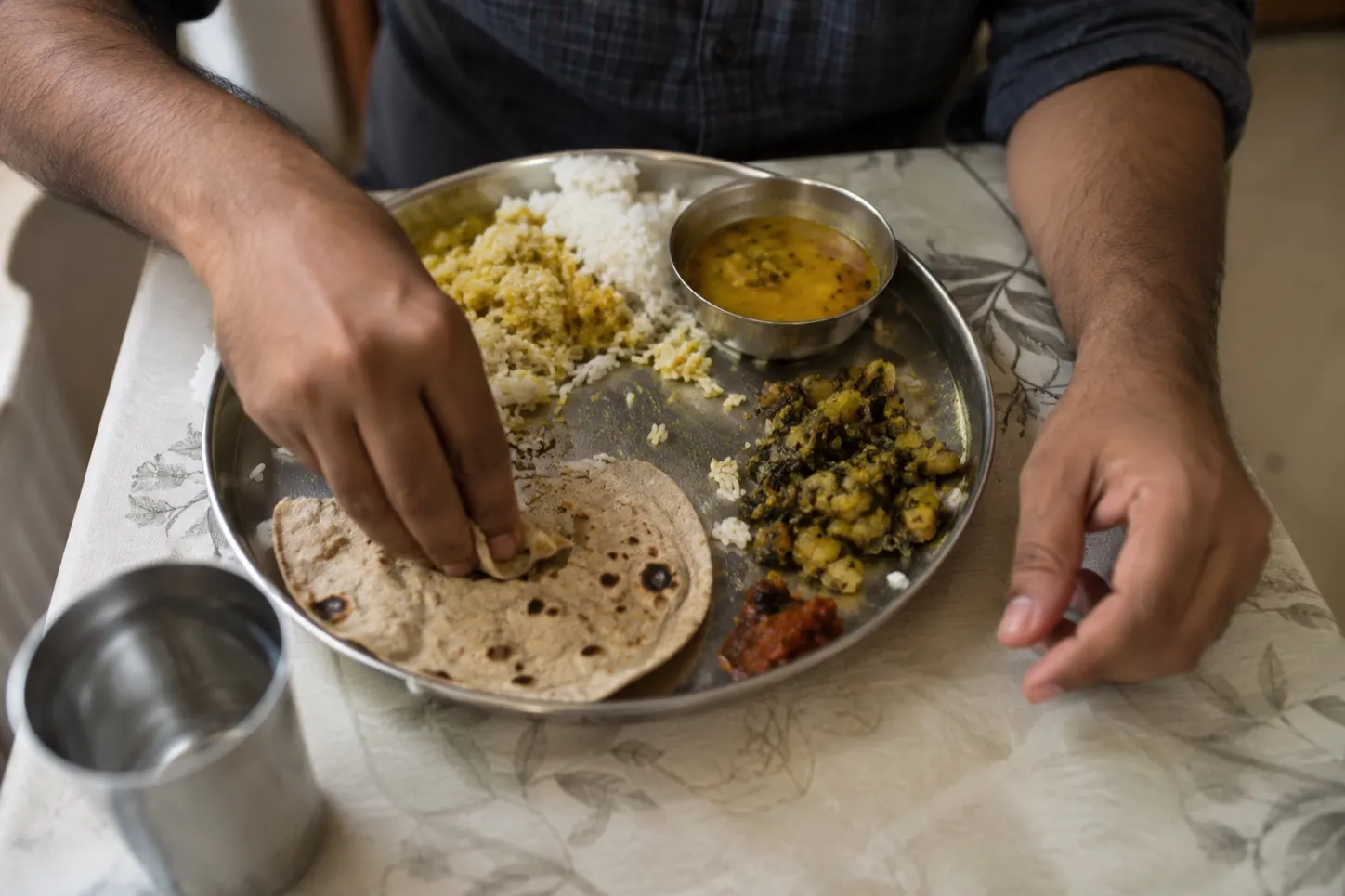
Indian food is largely designed to be eaten by hand — flatbread tears and scoops, rice is mixed with gravy and gathered. The right hand only is used, because the left is reserved for washing, and the technique differs between north and south.
Key facts
- Which hand
- The right, always. The left is used for personal washing and is not brought to shared food or to the mouth
- How far up the hand
- In the north, the fingertips only, and using the palm is considered poor form; in the south, the whole hand is used and this is normal
- Serving
- Serving spoons are used for shared dishes; the eating hand does not go into a communal bowl
- Before and after
- Hands are washed immediately before and after eating, which is why a basin sits near the dining area in most Indian homes
The food is built for it
The most straightforward answer: Indian food is designed for hands.
A roti tears with one hand against the plate, folds into a scoop, and picks up a dry vegetable dish cleanly. Rice is mixed with dal or sambar until it holds together, gathered into a small ball with the fingers, and delivered with the thumb. Neither operation works well with a fork, and both are faster and less messy than the fork version.
Cutlery suits food cut into pieces on a plate. Most Indian meals are not constructed that way.
The right hand, and why
The left hand is used for personal washing, and in a culture organised around distinctions of purity, that makes it unsuitable for food — anyone's food, including your own.
This is not treated as a soft preference. Handing someone food with the left hand, or eating with it at a shared meal, is a visible breach, and it is the one rule a visitor should actually keep.
The technique
North. Fingertips only. The food is picked up with the ends of the fingers, and the palm stays clean. Someone whose palm is smeared has, in the northern convention, eaten badly.
South. The whole hand is used. Rice and sambar are mixed thoroughly with the fingers and gathered; the hand gets messy and that is entirely correct. A northern visitor at a Tamil meal frequently gets this wrong in one direction and a southern visitor in the other.
Both. Food goes into the mouth pushed by the thumb rather than by the lips touching the fingers, in the tidier versions of the technique.
The rules that actually matter
- Right hand only, for eating and for passing food.
- Serving spoons for shared dishes. Your eating hand does not enter a communal bowl.
- Do not touch someone else's plate, or offer food from it. Food that has been touched by another person's plate or mouth is jhūṭhā — polluted — and the concept is taken seriously in many households, including secular ones.
- Wash before and after, at the basin, not with a napkin.
How this changes across India
| Where | What differs |
|---|---|
| Tamil Nadu and Kerala | Whole hand; rice mixed thoroughly with sambar or rasam; a banana leaf rather than a plate at formal meals. |
| North India | Fingertips; the flatbread does most of the work; a spoon for anything liquid. |
| Bengal | Hand for the whole course sequence, including fish, where separating bones by hand is a practised skill. |
| Gujarat and Rajasthan | Fingertips with rotli; spoons common for kadhi and liquid dals. |
| Urban India generally | Cutlery is routine at restaurants and in many homes, and using it is not a lapse. |
Questions people ask
Is it unhygienic?
No more so than a fork that has been washed in the same kitchen. Hands are washed immediately before eating, and only one hand touches food. Where hygiene genuinely matters is in the serving convention — a serving spoon is used for shared dishes precisely so that eating hands do not enter them.
Which hand if I am left-handed?
The right, in company. Left-handed people in India learn to eat right-handed, and doing otherwise at a shared meal will be noticed, particularly by older relatives. In your own home it is nobody's business.
Do people eat everything by hand?
No. Liquids — rasam, kadhi, soupy dals — take a spoon, and many households use spoons for rice dishes too. Cutlery is entirely normal in urban India; the hand is the default for flatbread meals and for a traditional rice meal on a leaf.
Should a visitor try?
Yes, and nobody will mind an imperfect attempt. Two rules cover most of it: right hand only, and do not put your eating hand into a shared dish.
Sources (2)
- K. T. Achaya, Indian Food: A Historical Companion — For meal customs and the historical form of Indian eating
- Manusmṛti and Gṛhya Sūtra material on purity in eating — For the classical rules on right and left and on shared food
Fact-checked by Ajay Gupta on 7 September 2026.
Something wrong here? Tell us — corrections are made in the open, and our editorial standards set out what checking a page involves.