Ayurveda & Wellness
Prāṇāyāma — breath practice, described accurately
The fourth limb of yoga, and the one most often taught as a wellness technique with its cautions removed.
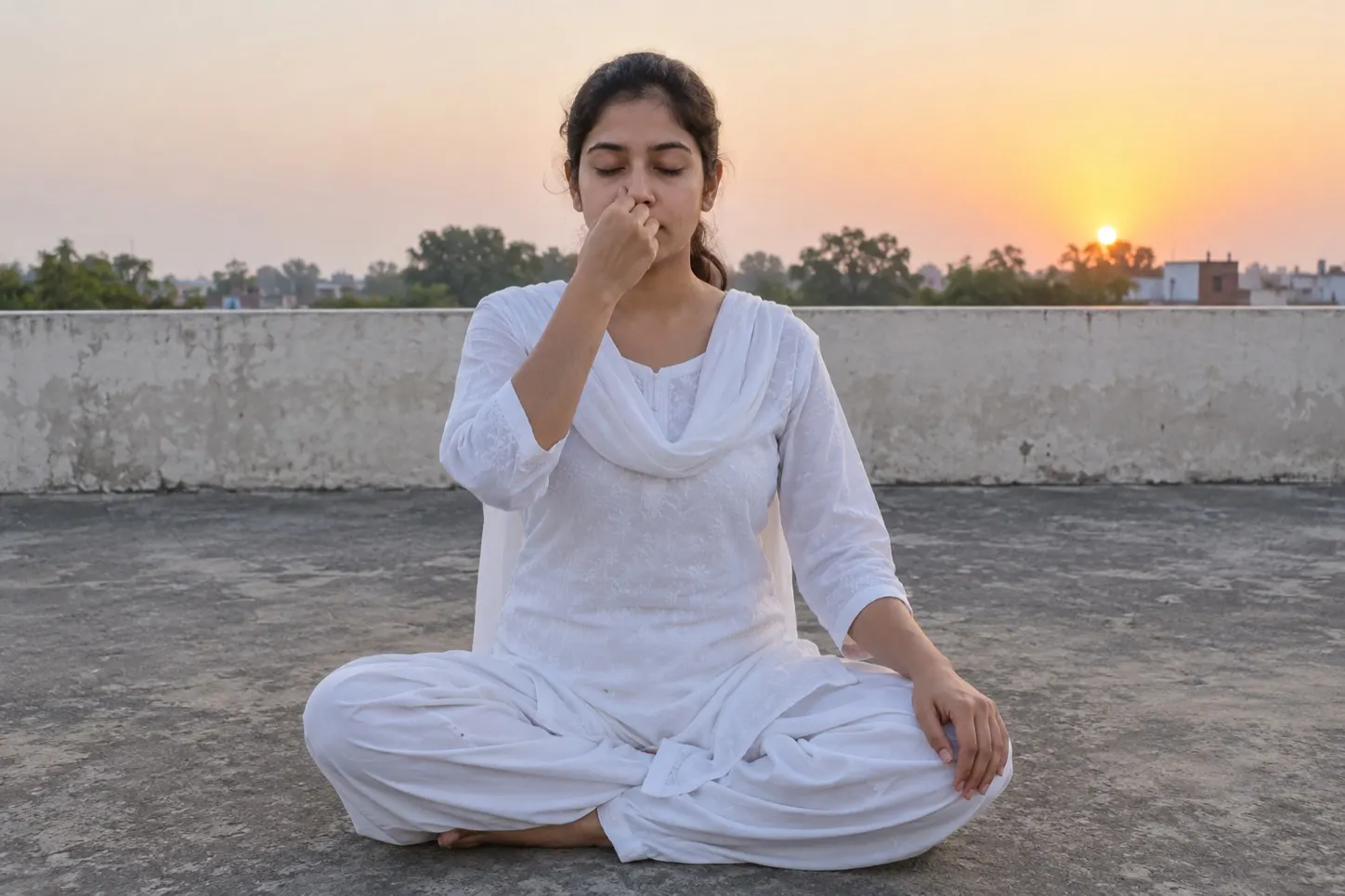
The short answer
Prāṇāyāma is the regulation of the breath — the fourth of Patañjali's eight limbs, and a large technical literature in the haṭha yoga texts. Its classical purpose is to prepare the mind for concentration, not to relax the body, though relaxation is a common effect.
Key facts
- The word
- Prāṇa, vital breath or energy, plus āyāma, extension or restraint — the practice is a lengthening and controlling of the breath
- The components
- Pūraka (inhalation), rechaka (exhalation), kumbhaka (retention) — the haṭha vocabulary; Patañjali (2.50) uses different terms. Retention is the technically demanding element
- Main techniques
- Nāḍī śodhana (alternate nostril), ujjāyī, bhrāmarī, kapālabhāti, bhastrikā, śītalī
- In the eight limbs
- Fourth, after āsana and before pratyāhāra — the hinge between the physical and the mental limbs
- Classical caution
- Haṭha Yoga Pradīpikā 2.1 requires a teacher; 2.15 says wrong practice kills the practitioner; 2.17 names the injuries
What it is for
In Patañjali's scheme, prāṇāyāma sits fourth, after posture and before the withdrawal of the senses. Its stated function is to remove what obscures clarity and make the mind fit for concentration.
That is worth holding onto, because most contemporary teaching presents it as a relaxation technique. Calm is a common effect. It is not what the text says the practice is for, and several of the classical techniques are stimulating rather than calming.
The main techniques
Nāḍī śodhana — alternate nostril. Inhale through one nostril, exhale through the other, alternating. The standard beginning practice, low-risk without retention, and the one most widely taught.
Ujjāyī — a slight constriction at the throat producing an audible breath, used to lengthen and smooth the cycle. Familiar to anyone who has done a vinyasa class.
Bhrāmarī — the humming breath, exhaling with a bee-like sound and the ears lightly closed. Reliably settling. It is often taught with the fingers pressing the eyeballs, which is the one thing anyone with glaucoma or retinal disease should not do; the humming does not require it.
Kapālabhāti — sharp forceful exhalations with passive inhalation. Vigorous; classified in the older texts as a cleansing practice rather than as prāṇāyāma proper.
Bhastrikā — bellows breath, forceful in both directions. The most demanding of the common practices and the one most often taught carelessly.
Śītalī and śītkārī — cooling breaths drawn over the tongue.
Kumbhaka — retention, after inhalation or exhalation. This is where the classical literature places the real work of prāṇāyāma, and also where it places its warnings.
What the research supports
Slow-breathing practices — roughly six breaths a minute — have been studied reasonably well, and the three main findings do not stand at the same strength.
Heart-rate variability is the clearest: a 2022 review pooling 223 studies found vagally-mediated HRV rose during practice and afterwards. Stress and anxiety improve by a small-to-medium margin, though most of those trials carry a moderate risk of bias.
Blood pressure is contested, and this page does not claim it. Pooled trials show falls of roughly five to seven mmHg systolic. But when the analysis is restricted to trials that were blinded and compared against an active control rather than against nothing, the effect disappears — a 2014 individual-patient meta-analysis in JAMA Internal Medicine found 2.2 mmHg in favour of the control group. Both results are in the sources below. Reporting only the first would not be summarising, it would be choosing.
Beyond that, the picture thins quickly. Trials of specific techniques for specific conditions are mostly small, short and of variable quality, and the literature has the same positive-result bias found across yoga research.
What is not supported by that literature — and is often asserted — is that particular techniques detoxify, oxygenate the blood beyond normal levels, or alter the course of serious disease.
The safety section that classes skip
The haṭha texts are blunter about this than most modern classes are. The Haṭha Yoga Pradīpikā requires a teacher (2.1), states that badly practised breath kills the practitioner (2.15), and names what goes wrong — hiccup, breathlessness, cough, and pain in the head, ears and eyes (2.17). That warning is part of the tradition, not a modern caveat bolted onto it.
Never practise any of this in water. Hyperventilating before going under removes the urge to breathe without adding useful oxygen, so a practitioner loses consciousness with no warning. This is the one item on this page with deaths behind it.
In modern terms, the specific cautions are:
- Forceful practices and retention in uncontrolled high blood pressure, glaucoma or retinal disease, epilepsy, and pregnancy.
- Forceful practices if you have had a collapsed lung, or have bullous or emphysematous lung disease. Kapālabhāti has a published case report of causing a pneumothorax in an otherwise healthy 29-year-old.
- Hyperventilation techniques can cause dizziness, tetany and fainting — practise seated, never standing.
- Recent surgery to the abdomen or chest, and active respiratory infection.
- Intensive practice can surface anxiety and dissociation in susceptible people. A 2020 review of 83 studies put the overall adverse-event rate at about 8%, in people with and without any prior mental health history.
Sudden chest pain or breathlessness during or after forceful breathing is a reason to go to an emergency department, not a reason to persevere.
None of that is a reason not to practise. It is a reason to start with the mild techniques, to build slowly, and to treat "more is better" as the error it is.
This page describes a tradition and what research has found. It is not medical advice, and nothing here is a reason to stop a treatment a doctor has prescribed.
How this changes across traditions
| Tradition | Emphasis |
|---|---|
| Pātañjala yoga | Prāṇāyāma as preparation for concentration; brief textual treatment, heavy in implication. |
| Haṭha yoga texts | Extensive technical detail, cleansing practices, retention ratios, and explicit warnings. |
| Iyengar teaching | Posture first, prāṇāyāma introduced only after years, and taught with props and supported positions. |
| Bihar School of Yoga | A systematic graded syllabus with the practices sequenced and the theory taught alongside. |
| Modern studio teaching | Ujjāyī and a little nāḍī śodhana, usually without the cautions and without the framework. |
Questions people ask
Is alternate nostril breathing actually doing anything?
There is a real alternating-nostril phenomenon: the nasal cycle, in which airflow shifts between nostrils over hours, is well documented. Whether it is what the practice acts on has not been shown — the two coexist, which is not the same as one explaining the other. Trials of nāḍī śodhana report short-term changes in heart-rate variability and blood pressure, but in small samples and with almost no blinding. The larger classical claims about balancing energy channels are not claims this kind of research addresses.
Which technique should a beginner start with?
Simple lengthening of the exhalation, and nāḍī śodhana without retention. Both are low-risk and the second is the standard entry point. Kapālabhāti and bhastrikā are forceful practices, and prolonged retention should not be attempted from a book.
Are there people who should not do this?
Yes, and it is routinely left out of classes. Forceful practices and breath retention are inadvisable in uncontrolled hypertension, in glaucoma and retinal conditions, in epilepsy, in pregnancy, after recent abdominal or chest surgery, and for anyone who has had a collapsed lung or has bullous lung disease. Hyperventilation techniques can cause fainting. If in doubt, ask a doctor rather than a teacher.
What is the difference between prāṇāyāma and breathwork?
Modern breathwork borrows techniques and drops the framework — the ethical limbs before it, the concentration practice after it, and the theory of prāṇa it belongs to. Some modern methods also use sustained hyperventilation in ways the classical tradition does not, and those carry their own risks.
Sources (8)
- Patañjali, Yoga Sūtras 2.29 and 2.49–2.53 — For prāṇāyāma's place in the eight limbs and its stated purpose
- Haṭha Yoga Pradīpikā 2.1, 2.15–2.18, 2.22, 2.35 — For the technical descriptions, and for the tradition's own warnings
- Laborde S et al., Effects of voluntary slow breathing on heart rate and heart rate variability. Neurosci Biobehav Rev 2022;138:104711 — 223 studies; the heart-rate variability finding, which is the best-supported claim on this page
- Fincham GW et al., Effect of breathwork on stress and mental health. Sci Rep 2023;13:432 — Stress and anxiety improve by a small-to-medium margin; most trials at moderate risk of bias
- Chaddha A et al., Device and non-device-guided slow breathing to reduce blood pressure. Complement Ther Med 2019;45:179 — 17 trials pooled, showing a fall in blood pressure — heterogeneity high throughout
- Landman GW et al., Efficacy of device-guided breathing for hypertension in blinded, randomized, active-controlled trials. JAMA Intern Med 2014;174:1815 — The counter-evidence, and why this page does not claim a blood-pressure effect
- Farias M et al., Adverse events in meditation practices and meditation-based therapies. Acta Psychiatr Scand 2020;142:374 — For the adverse-event rate behind the note on intensive practice
- Johnson DB et al., Kapalabhati pranayama: breath of fire or cause of pneumothorax? Chest 2004;125:1951 — The documented serious harm from a forceful practice
Fact-checked by Ajay Gupta on 7 September 2026.
Something wrong here? Tell us — corrections are made in the open, and our editorial standards set out what checking a page involves.