Sacred India
Rishikesh — ashrams, the river, and the yoga industry
Two towns occupying the same place — a Himalayan pilgrimage gateway, and the world's largest yoga teacher-training market.
The short answer
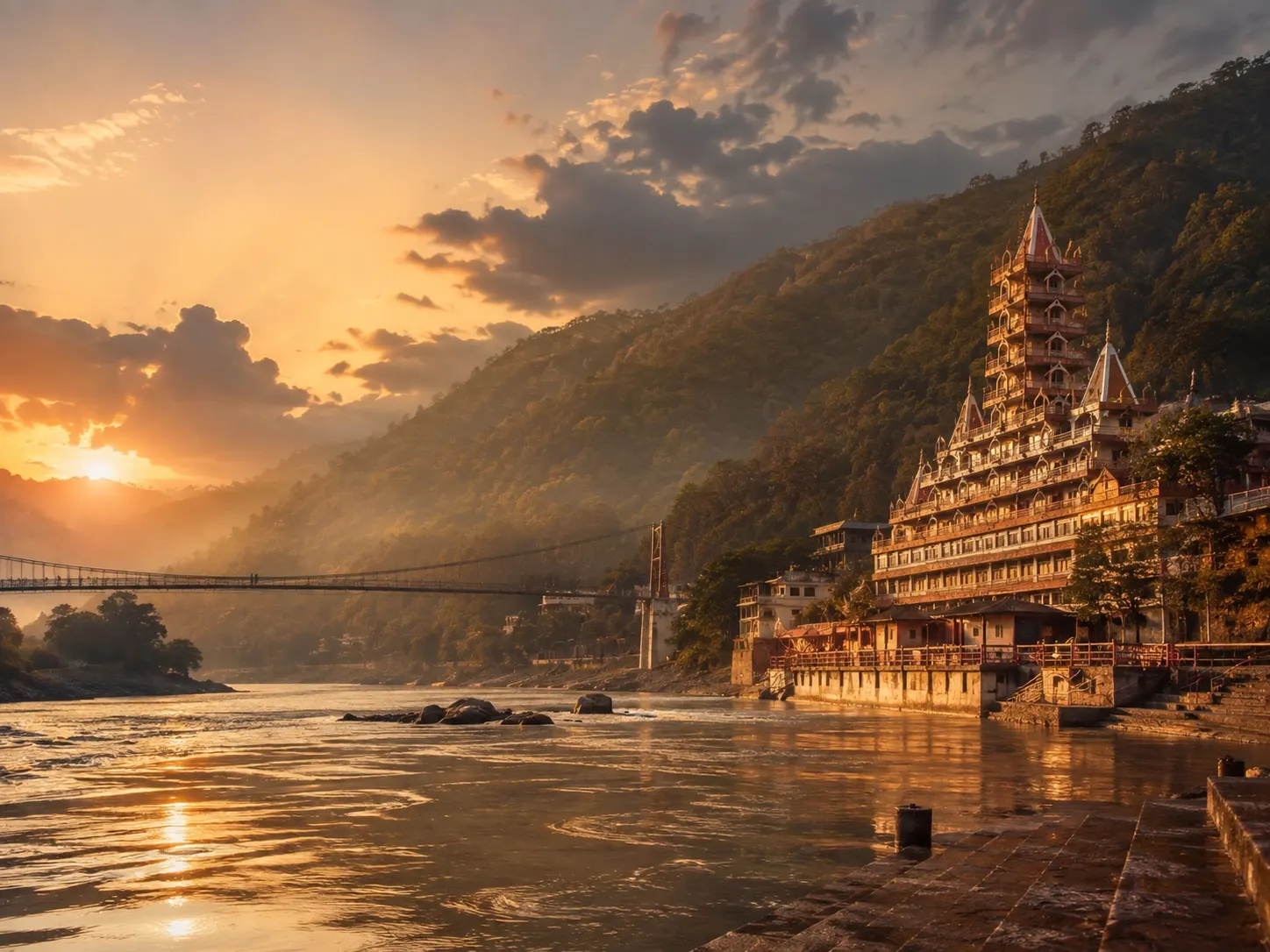
Rishikesh sits where the Ganga leaves the Himalaya, and it has been a place of ascetic retreat for centuries. It is also the gateway to the Char Dham pilgrimage, and since the 1960s the centre of a global yoga-teaching economy that now dominates the town's visible life.
Key facts
- Where
- Uttarakhand, where the Ganga emerges from the Himalaya, about 25 km upstream of Haridwar
- Known for
- Ashrams and ascetic retreat; the Char Dham gateway; yoga teacher training; white-water rafting
- The bridges
- Lakshman Jhula and Ram Jhula, the pedestrian suspension bridges that define the two banks; Lakshman Jhula has been closed to traffic and replaced
- Alcohol and meat
- Both prohibited within the municipal area — the town is legally vegetarian and dry
Before you go
- best time
- February to April and September to November. The monsoon brings landslides on the mountain roads
- the river
- Fast, cold and dangerous. Bathe only at the ghats with chains and steps, and never after rain upstream
- dress
- Covered shoulders and knees at ashrams and temples; the yoga-district norms are laxer and the pilgrimage areas are not
Timings and rules at living temples change, and are set by the temple, not by us. Check with the temple before travelling.
What the place is
The Ganga is a mountain river here — fast, green and cold — and it emerges from the Himalaya just above the town. That geography is the reason for everything else.
For centuries this stretch has been a place of ascetic retreat, and it remains the standard first stop on the Char Dham pilgrimage: Yamunotri, Gangotri, Kedarnath and Badrinath, all of which sit up the roads that begin here.
Then, from the 1960s, the town acquired a second life as the destination for foreign seekers, and since roughly 2000 that has consolidated into an industrial-scale yoga teacher-training market. Both towns are here, sharing the same two bridges.
The pilgrimage town
The ghats at Triveni, the evening aarti at Parmarth Niketan, the temples along both banks, and a steady traffic of Indian pilgrims moving through on their way higher.
This is the older and larger of the two towns, and it is easy for a visitor to miss it entirely by staying in the guesthouse district and eating in cafés with English menus.
The yoga town
Several hundred schools, most offering 200- and 300-hour certifications on a month-long cycle, and an ecosystem of cafés, shops and hostels built around them.
The quality range is enormous. There are teachers here with decades of practice and real lineages, and there are certificate mills with a rented hall. The signals worth checking:
- A named teacher with a traceable lineage, not a school brand alone.
- A schedule that includes philosophy, not just āsana — the classical practice has eight limbs and a course that touches one of them is teaching exercise.
- Recognition that means something where you live. Yoga Alliance registration is a self-regulatory arrangement, not an accreditation in the ordinary sense.
- Realistic promises. A month cannot make an experienced teacher, and a school that says otherwise is selling.
Practical
The river. People drown here. The current is faster than it looks, the water is snow-fed and cold enough to shock, and rain upstream changes the flow with little warning. Bathe at the ghats with steps and chains, and not elsewhere.
Rafting operates in season with licensed operators; the town is one of India's main white-water centres and the safety record is decent with a proper operator and poor with a cheap one.
Dry and vegetarian. Alcohol and meat are prohibited within the municipal limits. Enforcement varies; the norm is real.
Monkeys on both bridges take food, bags and phones, and are not sentimental about it.
How this changes across the region
| Place | What differs |
|---|---|
| Haridwar | Downstream, and considerably more orthodox — one of the four Kumbh Mela cities, with Har Ki Pauri as its ritual centre and far fewer foreign visitors. |
| Rishikesh | Ashram and yoga economy alongside pilgrimage; the meeting point of Indian and international religious tourism. |
| Devprayag | The confluence where the Bhagirathi and Alaknanda become the Ganga; small, quiet, and ritually important out of proportion to its size. |
| Uttarkashi and Gangotri | Higher, colder, seasonal; the Ganga's source pilgrimage, closed for winter. |
Questions people ask
How do I tell a serious ashram from a tourist operation?
Look for a fixed daily schedule that starts before dawn, a resident teacher with a named lineage, rules a guest is expected to keep, and a fee structure that reads as a donation and contribution to the kitchen rather than a package price. A 200-hour certification sold with airport pickup and a course completion photograph is a different product, and not a dishonest one, but it is not an ashram stay.
Is the yoga teacher training worth it?
Depends what for. Rishikesh has genuinely experienced teachers and also a high volume of quick certifications from schools whose accreditation is largely self-referential. If the certificate is for teaching abroad, check what your own country's studios recognise before booking anything.
What is the Beatles connection?
They stayed at Maharishi Mahesh Yogi's ashram in 1968 and wrote a large part of the White Album there. The site — the "Beatles Ashram", now within Rajaji Tiger Reserve — is open to visitors as a ruin, and it is the single largest reason Western visitors first heard of the town.
Can I do the Char Dham from here?
Rishikesh is the standard starting point. The four shrines open from around late April or early May to late October or November, and Kedarnath and Yamunotri require walking. Registration is now required, and altitude, weather and road conditions are the real constraints.
Sources (2)
- Uttarakhand tourism and Char Dham Yatra registration information — For opening dates and pilgrimage registration, which change annually
- Elizabeth De Michelis, A History of Modern Yoga — For Vivekananda, Neo-Vedānta and the making of the category "modern yoga". Her book does not cover Sivananda's Rishikesh or the ashram movement — Sarah Strauss, Positioning Yoga (2005), is the study of that
Fact-checked by Ajay Gupta on 7 September 2026.
Something wrong here? Tell us — corrections are made in the open, and our editorial standards set out what checking a page involves.